France’s $13 Billion Nuclear Aircraft Carrier Gamble, Europe Pushed Toward a Precarious Era of Forced Strategic Autonomy

Oliver Griffin is a policy and tech reporter at The Economy, focusing on the intersection of artificial intelligence, government regulation, and macroeconomic strategy. Based in Dublin, Oliver has reported extensively on European Union policy shifts and their ripple effects across global markets. Prior to joining The Economy, he covered technology policy for an international think tank, producing research cited by major institutions, including the OECD and IMF. Oliver studied political economy at Trinity College Dublin and later completed a master’s in data journalism at Columbia University. His reporting blends field interviews with rigorous statistical analysis, offering readers a nuanced understanding of how policy decisions shape industries and everyday lives. Beyond his newsroom work, Oliver contributes op-eds on ethics in AI and has been a guest commentator on BBC World and CNBC Europe.
Authored On
Modified
France confirms construction of a next-generation nuclear-powered aircraft carrier valued at roughly $13 billion, a strategic decision by President Emmanuel Macron aimed at securing independent defense capabilities
U.S. demands for greater security self-reliance intensify, while Europe confronts deepening constraints spanning fiscal stress, manpower shortages, and a fragmented defense industrial base
As Russian security threats and “gray-zone” provocations materialize, NATO agrees on defense investment targets equivalent to 5% of GDP, accelerating readiness postures
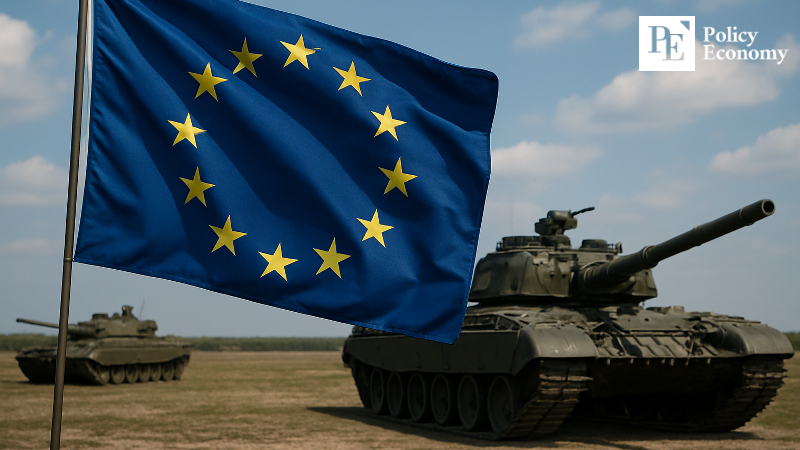
France has formally approved the construction of a next-generation nuclear-powered aircraft carrier valued at approximately $13 billion. The decision reflects a strategic judgment by President Emmanuel Macron to reinforce autonomous defense capabilities amid a rapidly deteriorating security environment. As U.S. “America First” priorities converge with escalating Russian threats, Europe is drawing a definitive line under decades of reliance on the so-called peace dividend and pivoting toward a reinforced defense posture. Fiscal deterioration, chronic personnel shortages, and enduring structural weaknesses within Europe’s defense industry, however, cast doubt over the smooth execution of this rearmament drive. This report examines the complex calculus behind Europe’s pursuit of security autonomy, shaped by the determination to avoid repeating the continent’s painful historical lessons.
Self-Help Under Security Strain, France Breaks Fiscal Barriers to Approve an 80,000-Ton Nuclear Carrier
According to AFP and other international media on the 21st (local time), France has finalized plans to build a next-generation nuclear-powered aircraft carrier, known as PANG (Porte-avions de nouvelle génération), to replace its current flagship, the Charles de Gaulle. President Macron announced the decision during a visit to French forces stationed in the United Arab Emirates, declaring that “in an age of predators, strength is the only way to inspire fear in adversaries.” The move signals France’s determination to consolidate strategic initiative through independent defense capacity as the security landscape continues to shift dramatically in the wake of the war in Ukraine.
The scale of ambition is evident in the vessel itself, whose preliminary construction work began in September at the Cherbourg shipyard. With a displacement approaching 80,000 tons—nearly double that of the Charles de Gaulle—the carrier will span 310 meters, making it the largest warship ever built in Europe. Powered by two next-generation K22 nuclear reactors, the platform is designed for sustained long-range operations. Crucially, the ship will deploy electromagnetic aircraft launch systems (EMALS) and advanced arresting gear (AAG), subject to U.S. Foreign Military Sales approval, underscoring its role as a cornerstone of France’s future power projection capabilities.
Significant challenges remain. Foremost among them is the fiscal burden. With total program costs estimated at roughly $13 billion, France faces mounting budgetary strain at a time when it is already subject to the European Union’s Excessive Deficit Procedure due to elevated fiscal shortfalls. Critics within the military and political establishment have argued for postponement, urging a reallocation of resources toward homeland defense. Despite these pressures, the Macron administration has pressed ahead, viewing the aircraft carrier not merely as a weapons platform but as a tangible embodiment of strategic autonomy.
Europe Confronts a Triple Constraint of Capital, Manpower, and Industry
According to AFP and other international media on the 21st (local time), France has finalized plans to build a next-generation nuclear-powered aircraft carrier, known as PANG (Porte-avions de nouvelle génération), to replace its current flagship, the Charles de Gaulle. President Macron announced the decision during a visit to French forces stationed in the United Arab Emirates, declaring that “in an age of predators, strength is the only way to inspire fear in adversaries.” The move signals France’s determination to consolidate strategic initiative through independent defense capacity as the security landscape continues to shift dramatically in the wake of the war in Ukraine.
The scale of ambition is evident in the vessel itself, whose preliminary construction work began in September at the Cherbourg shipyard. With a displacement approaching 80,000 tons—nearly double that of the Charles de Gaulle—the carrier will span 310 meters, making it the largest warship ever built in Europe. Powered by two next-generFrance’s decision illustrates the broader structural reality confronting Europe as U.S. security commitments appear increasingly conditional. The latest National Security Strategy issued by the administration of U.S. President Donald Trump has been interpreted as setting 2027 as an effective deadline for Europe to assume greater responsibility for its own defense. At present, the United States accounts for nearly two-thirds of NATO’s total defense spending. In response, NATO leaders agreed at the 2025 Hague Summit to pursue security investments equivalent to 5% of GDP by 2035, allocating resources toward both core military capabilities and enabling infrastructure.
Yet the scale of the challenge is daunting. According to estimates by Bruegel and the Kiel Institute for the World Economy, replacing U.S. capabilities and mounting an independent deterrence posture against Russia would require an immediate expansion of roughly 300,000 additional troops and annual defense spending increases approaching $270 billion.
Fiscal fragility remains a binding constraint. Under the EU’s Stability and Growth Pact, member states are required to cap annual budget deficits at 3% of GDP and public debt at 60%. In practice, these thresholds have been widely breached. As of 2024, twelve member states, including Poland and France, exceeded the deficit ceiling, while another twelve, among them Greece and Italy, surpassed the debt limit. In an environment of constrained fiscal space, defense expansion inevitably forces difficult trade-offs involving higher taxation or reductions in social spending—choices that risk political backlash in aging European societies. Lee Sung-won, a senior researcher at the Sejong Institute, cautioned that “even with flexibility, military buildup will ultimately erode fiscal sustainability.”ation K22 nuclear reactors, the platform is designed for sustained long-range operations. Crucially, the ship will deploy electromagnetic aircraft launch systems (EMALS) and advanced arresting gear (AAG), subject to U.S. Foreign Military Sales approval, underscoring its role as a cornerstone of France’s future power projection capabilities.
Significant challenges remain. Foremost among them is the fiscal burden. With total program costs estimated at roughly $13 billion, France faces mounting budgetary strain at a time when it is already subject to the European Union’s Excessive Deficit Procedure due to elevated fiscal shortfalls. Critics within the military and political establishment have argued for postponement, urging a reallocation of resources toward homeland defense. Despite these pressures, the Macron administration has pressed ahead, viewing the aircraft carrier not merely as a weapons platform but as a tangible embodiment of strategic autonomy.
Manpower shortages compound the problem. Europe’s combined military strength has shrunk from 3.4 million personnel at the end of the Cold War to fewer than 2 million today. Defense committees, including those in the United Kingdom, have raised concerns about sustaining combat readiness in high-intensity conflict scenarios. Germany has reopened debate over conscription and set targets to expand active-duty forces by 2035, but recruitment efforts across Europe continue to struggle despite enhanced pay and benefits.
The anticipated domestic economic multiplier from defense spending also appears limited. NATO data show a rising share of European arms procurement flowing to U.S. suppliers, reflecting severe fragmentation within Europe’s own defense industrial base. European militaries operate more than ten main battle tank models and over thirty helicopter variants, undermining interoperability. Flagship joint programs, such as the Franco-German Main Ground Combat System, remain delayed amid industrial rivalries. Restrictions by the European Investment Bank on direct financing of lethal weapons have further constrained industrial scaling.
“A Ceasefire Is Not Peace,” Europe Raises Its Guard
Despite these structural headwinds, Europe’s acceleration toward a quasi-wartime footing is driven by a stark assessment of Russian intent. European leaders increasingly frame the threat not merely in terms of Russia’s military strength but its persistent expansionist resolve. German Chancellor Friedrich Merz has likened President Vladimir Putin’s actions to Adolf Hitler’s 1938 seizure of the Sudetenland, warning that the collapse of Ukraine would not mark an endpoint. NATO Secretary General Mark Rutte has similarly cautioned that Russia could mount direct military challenges to NATO members within years.
An additional source of anxiety lies in Washington’s push for an early settlement to the war in Ukraine. European security officials warn that a premature ceasefire along current front lines would offer Moscow time to rebuild depleted arsenals before redirecting pressure toward the Baltic states or Poland. Signals of U.S. retrenchment and doubts surrounding the durability of the nuclear umbrella have sharpened Europe’s survival instincts.
Conflict is no longer viewed as a distant contingency. Gray-zone operations are already underway, encompassing cyberattacks, disinformation campaigns, and physical sabotage of critical infrastructure. British intelligence chief Blaise Metreweli has warned that “the front line is everywhere,” citing incidents ranging from attempted intrusions into air traffic control systems to undersea cable disruptions, railway arson, and GPS interference affecting civilian aviation. European intelligence agencies interpret these acts as preparatory measures designed to disrupt NATO mobilization in a crisis.
Europe now acknowledges that the era of peace dividends enjoyed over the past three decades has decisively ended. From France’s nuclear aircraft carrier program to Germany’s troop expansion plans and NATO’s collective defense spending commitments, the continent is mobilizing every available instrument in pursuit of strategic self-reliance. The fiscal burden and societal consensus required will be formidable, but in an international system where power underwrites survival, Europe appears to have concluded that abstention is no longer an option.
Oliver Griffin is a policy and tech reporter at The Economy, focusing on the intersection of artificial intelligence, government regulation, and macroeconomic strategy. Based in Dublin, Oliver has reported extensively on European Union policy shifts and their ripple effects across global markets. Prior to joining The Economy, he covered technology policy for an international think tank, producing research cited by major institutions, including the OECD and IMF. Oliver studied political economy at Trinity College Dublin and later completed a master’s in data journalism at Columbia University. His reporting blends field interviews with rigorous statistical analysis, offering readers a nuanced understanding of how policy decisions shape industries and everyday lives. Beyond his newsroom work, Oliver contributes op-eds on ethics in AI and has been a guest commentator on BBC World and CNBC Europe.
Similar Post