Japan Launches Proof-of-Concept for Deep-Sea Rare Earth Mining, Accelerating U.S.-Led Reshaping of the Global Mineral Security Order

Siobhán Delaney is a Dublin-based writer for The Economy, focusing on culture, education, and international affairs. With a background in media and communication from University College Dublin, she contributes to cross-regional coverage and translation-based commentary. Her work emphasizes clarity and balance, especially in contexts shaped by cultural difference and policy translation.
Authored On
Modified
Japan to extract rare earth–bearing seabed sediments from deep waters
Seawater to be removed at processing facilities to separate rare earths
U.S.–Japan–Australia supply chain alliance accelerates post-China resource realignment
The Japanese government has embarked on an unprecedented initiative to directly develop deep-sea resources within its exclusive economic zone (EEZ), signaling a strategic push to reconfigure rare earth supply chains long dominated by China toward a mineral alliance centered on the United States, Australia, and Japan. With Washington intensifying efforts to secure critical mineral supply chains, momentum is building to establish an independent rare earth ecosystem insulated from Chinese leverage.
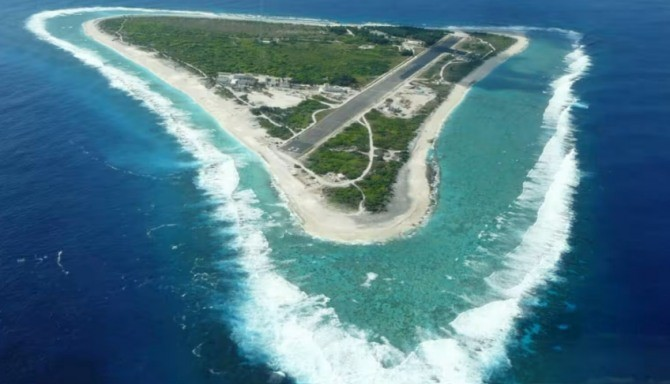
Minamitorishima, 1,950 km from Tokyo, Emerges as a Strategic Rare Earth Hub
According to the Nihon Keizai Shimbun on the 24th, the Japanese government plans to install a sediment processing facility containing rare earth elements on Minamitorishima in the Ogasawara archipelago by 2027. The initiative forms part of the Cabinet Office–led Strategic Innovation Program (SIP), under which Japan aims to launch proof-of-concept tests for deep-sea rare earth mining at depths of 6,000 meters starting in 2027. To support large-scale testing, Japan intends to establish in advance a system capable of processing substantial volumes of seabed sediment, with the new facility playing a central role.
Minamitorishima is widely regarded as a rare earth treasure trove. The surrounding seabed is estimated to contain approximately 16 million tons of rare earth resources, ranking third globally by reserves. The area is particularly rich in dysprosium, used in electric vehicle motor magnets, and gadolinium, applied in nuclear reactor control rods. In addition, the seabed mud near Minamitorishima contains minimal radioactive or hazardous materials, offering a significant advantage in processing efficiency.
Under the SIP framework, marine rare earth resource development has been designated a core priority. In December next year, the Japan Agency for Marine-Earth Science and Technology (JAMSTEC) plans to deploy its deep-sea drilling vessel Chikyu to conduct a pilot extraction of small quantities of sediment from the seabed within Japan’s EEZ near Minamitorishima. The operation will lower pipes from the vessel to retrieve sediment mixed with rare earths and seawater. During the full-scale demonstration scheduled for February 2027, Japan will verify a daily extraction capacity of 350 tons of rare earth–bearing sediment. Given the volume involved, onboard processing will be impractical. Extracted material will therefore be transferred by transport vessels to Minamitorishima, where a facility equipped with centrifuge-like spin dryers will remove roughly 80% of the moisture. The resulting concentrated sediment, significantly reduced in volume, will then be shipped to the Japanese mainland for final refinement.
For the project, the Japanese government has allocated approximately $113 million from a supplementary budget for fiscal year 2025. The funds will be used not only for constructing processing facilities but also for dedicated transport vessels, personnel helicopters, and related infrastructure. Tokyo intends to move beyond a short-term pilot, laying the groundwork for commercialization from fiscal year 2028 so that private companies can begin full-scale utilization of rare earth resources. Authorities are also reviewing plans to build a simplified refining facility near Minamitorishima to reduce the cost and time required to transport sediment to the mainland.
U.S. and Japan Agree to Joint Deep-Sea Rare Earth Mining in Japanese Waters
The Minamitorishima project is a joint U.S.–Japan research initiative. On October 28, U.S. President Donald Trump and Japanese Prime Minister Sanae Takaichi signed the “Framework for Securing Critical Minerals and Rare Earths” at a bilateral summit. The agreement outlines coordinated use of financial support, trade measures, and stockpiling systems to stabilize critical mineral supply chains, alongside expanded subsidies, loans, and equity investments in mining and refining.
Both governments view rare earth security as a core economic security issue, given China’s overwhelming dominance of global supply. China controls 49% of global rare earth mineral reserves, 61% of production, and 92% of refined output. Between 2020 and 2023, 70% of the rare earth compounds and metals imported by the United States originated from China. In the processing of heavy rare earths, China accounts for 99% of global capacity, effectively maintaining a monopoly.
Beijing has recently tightened centralized control over rare earth mining, refining, and exports through its Export Control Law and Rare Earth Management Regulations. In April, China restricted exports of seven heavy rare earth elements to the United States, and in August mandated government approval and volume reporting for companies handling rare earths, with violations subject to legal penalties and quota reductions. Overseas mineral investment under the Belt and Road Initiative has also surged, with China’s mineral and rare earth investments reaching $24.9 billion in the first half of this year alone, already surpassing the previous year’s total.
China’s weaponization of rare earths has intensified. During recent trade tensions with the Trump administration, Beijing responded to U.S. tariff threats not only with counter-tariffs but also by deploying export controls on rare earths. Similar tactics have reportedly been used against Japan, including delays in export licensing for Japanese firms, even in the absence of formal restrictions.
The United States has responded through initiatives such as the establishment of the National Energy Dominance Council, expansion of domestic exploration and processing, and strengthened alliances. Despite billions of dollars invested in partnerships such as MP Materials, U.S. output this year is projected at 10 million tons, less than 1% of China’s 2018 production level of 138,000 tons. Japan, despite 15 years of diversification efforts since the 2010 Senkaku Islands dispute, still sources about 60% of its rare earth imports from China.
U.S.–Japan–Australia Triangle May Fracture China’s Resource Hegemony
Washington is also deepening cooperation with Australia in response to China’s tightening export controls. Australia, the world’s fourth-largest rare earth producer, signed a “Framework for Securing Stable Supply Chains of Critical Minerals and Rare Earths” with the United States in October during talks between President Trump and Prime Minister Anthony Albanese. The two countries plan to jointly invest more than $3 billion over the next six months in related projects, supporting defense and advanced manufacturing supply chains. The recoverable resource value from these investments is estimated at $53 billion.
According to the White House, the U.S. Department of Defense will fund construction of a gallium refinery in Australia with an annual capacity of 100 metric tons of CO₂-equivalent. The project, led by U.S. aluminum producer Alcoa, also involves Japan’s state-owned Japan Organization for Metals and Energy Security and trading house Sojitz. Under the arrangement, Australia will secure raw materials, Japan will provide refining and processing technology, and the United States will supply capital and demand. The Center for Strategic and International Studies noted that gallium can only be produced as a byproduct of bauxite mining and that Australia, with the world’s second-largest bauxite reserves, offers the most suitable geological and commercial environment.
Beyond Japan and Australia, the United States is expanding cooperation with other rare earth–rich countries, including Vietnam. South Korea, despite being a member of the Mineral Security Partnership launched by Washington to stabilize and diversify supplies of lithium, graphite, and nickel, has yet to establish significant cooperation. While Japan has built an end-to-end supply chain from resource acquisition to refining, South Korea lacks production infrastructure and depends on imports for more than 80% of its critical minerals. According to the Korea Institute of Geoscience and Mineral Resources, 83% of South Korea’s rare earth imports in 2023 came from China.
Experts assess that if the U.S.–Japan–Australia triangular alliance becomes fully operational around 2027, the effectiveness of China’s rare earth leverage is likely to erode in stages. China has long combined production dominance with refining capacity and price control to shape the global rare earth order. As the share of Chinese rare earths in global markets declines, its pricing power and political leverage are expected to weaken in tandem. The longstanding mechanism by which monopolized supply translated directly into diplomatic bargaining power may lose traction as multiple production centers emerge simultaneously.
Siobhán Delaney is a Dublin-based writer for The Economy, focusing on culture, education, and international affairs. With a background in media and communication from University College Dublin, she contributes to cross-regional coverage and translation-based commentary. Her work emphasizes clarity and balance, especially in contexts shaped by cultural difference and policy translation.
Similar Post