Samsung Electronics Moves to Expand Memory Supply as Pyeongtaek P4 Timeline Shortens and P5 Restart Comes into View

Authored On
Modified
Shortened construction timelines lead to additional investment and renewed expansion
Moves to address both advanced logic processes and memory simultaneously
Additional profits to hinge on the pace of capacity expansion
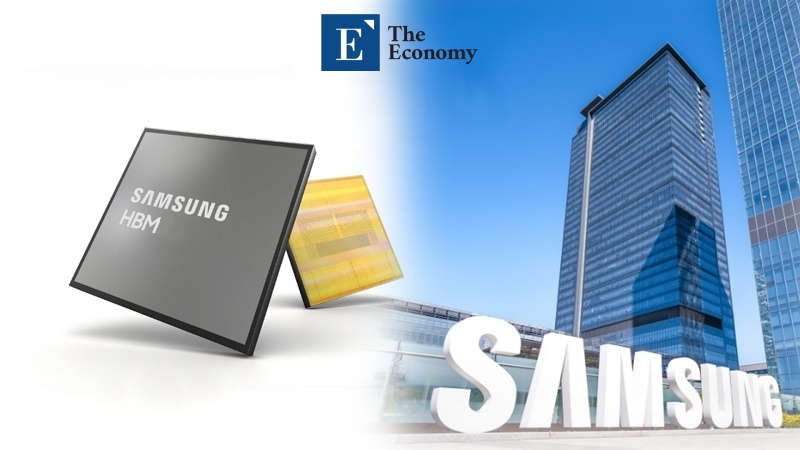
Samsung Electronics has begun accelerating once again at its Pyeongtaek semiconductor campus. With construction timelines shortened on parts of its fourth plant and discussions underway to resume investment in the fifth, the company’s expansion strategy—centered on existing production space—is becoming increasingly clear. As demand for high-bandwidth memory (HBM) continues to rise alongside the spread of artificial intelligence (AI) servers, the market is increasingly focused on which suppliers can ramp up output fastest, a factor now seen as decisive for future profitability and competitive positioning.
Blueprint for Expanding 1c DRAM-Based HBM Production
According to the semiconductor industry, Samsung Electronics has recently moved to shorten the construction schedule for Phase 4 (Ph4) of Pyeongtaek Plant 4 (P4). While the facility was originally slated to begin operations toward the end of next year, the company is now reportedly targeting equipment move-in and test operations in the third quarter of next year—bringing the schedule forward by roughly two to three months. At the same time, finishing work on Phase 2 (Ph2) of P4, which was suspended in 2023, is also expected to resume. Because Ph2 had already progressed further than Ph4 at the time construction was halted, the remaining work is expected to require less time than Ph4.
These shortened timelines and the resumption of stalled construction are widely interpreted as part of an effort to rapidly build out HBM production capacity within the Pyeongtaek campus. Both Ph4 and Ph2 are slated to be used for sixth-generation (1c) DRAM-based HBM production, reinforcing the view that Samsung is expanding a 1c-centered HBM manufacturing framework across P4 as a whole. The 1c DRAM process serves as the core base technology for next-generation HBM4 and is expected to become one of the most fiercely contested segments in the AI server memory market starting next year.
This direction is also evident in equipment procurement trends. Due to the high reliance on extreme ultraviolet (EUV) lithography, 1c DRAM production requires not only exposure tools but also the early deployment of supporting infrastructure across gas, chemical, vacuum, and materials-handling processes. Samsung has recently continued placing orders for gas and chemical equipment, signaling a push to build out the infrastructure required ahead of full-scale mass production. Earlier this month, the company also committed approximately 690 million dollars to acquire ASML’s high–numerical aperture (High-NA) EUV lithography tools, often referred to as the “dream equipment” of advanced semiconductor manufacturing.
Market dynamics are further accelerating Samsung’s moves. Beyond Nvidia, major cloud service providers such as Google, Amazon, and Microsoft have begun directly requesting HBM supplies to support next-generation AI server deployments, making stable volume delivery from global memory suppliers increasingly critical. One industry source noted that as HBM demand rises sharply, production capacity on the supply side is becoming ever more important, adding that Samsung’s actions appear aimed at pushing its response capabilities to the limit amid intense demand pressure.
Six-Plant Long-Term Blueprint Moves Into Execution Phase
This mounting HBM demand pressure is now extending beyond P4 to revive investment in Pyeongtaek Plant 5 (P5), where spending had previously been paced more cautiously. Last month, Samsung Electronics’ interim management committee approved the continuation of structural construction work for P5 within the second complex of the Pyeongtaek site, premised on expectations of sustained long-term semiconductor demand growth. The company stated that it plans to secure production lines proactively to respond swiftly to market changes, while simultaneously investing in supporting infrastructure to ensure stable operations. It also noted that once operational, P5 would further strengthen the Pyeongtaek site’s position within Samsung’s global supply chain.
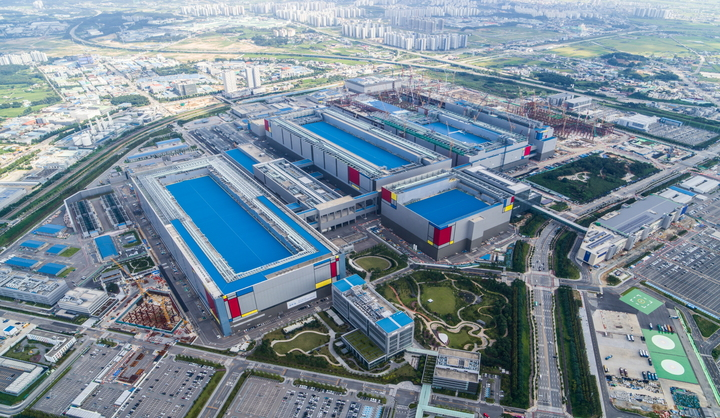
Samsung’s Pyeongtaek campus is divided into two complexes separated by a roadway. The first complex houses Plants P1 through P4, EUV lithography lines, and office facilities, while the second will accommodate P5 and P6 alongside parking structures. P5 is planned as a three-story building measuring 650 meters in width and 195 meters in length, with a total of six cleanrooms—roughly 1.5 times the number found in P4. Industry observers expect groundwork to begin in the near term, with operations targeted for 2028.
The scale of investment is also expected to rise sharply compared with previous projects. Plants P1 through P4 each required up to approximately 20.7 billion dollars per line. By contrast, P5 is widely expected to require more than 34.5 billion dollars, reflecting both further process miniaturization and expanded mass-production capacity. Given that Samsung’s annual capital expenditures already approach the 34 to 35 billion dollar range, P5 stands out as a major investment even on a standalone basis. The fact that discussions around P5 are proceeding while P4 investment has yet to be fully completed underscores Samsung’s emphasis on speed in responding to supply-side constraints.
Changes are already visible on the ground. Some managerial staff have reportedly returned to the P5 construction site, with full-scale construction expected between January and March next year. At peak activity, the workforce—including construction, piping, electrical, and semiconductor engineering personnel—could swell to as many as 20,000 workers. Samsung has previously outlined a long-term plan to build six plants from P1 through P6, targeting production-inducing effects totaling approximately 379 billion dollars and the creation of 1.3 million jobs. The restart of P5 investment is increasingly seen as a representative case of that long-term blueprint moving into execution, aligned with the rapid expansion of AI servers and surging HBM demand.
Market Braces for Deepening Supply Shortages and Price Spikes
Against this backdrop, market attention is shifting toward how quickly suppliers can expand output amid a sharp upswing in DRAM prices. Memory prices have been climbing at a notably accelerated pace. According to market research firm TrendForce, contract prices for NAND wafers rose by at least 20 percent month-on-month in November compared with October, with certain TLC and QLC products surging by as much as 60 percent. DRAM prices have risen even more steeply. Fixed contract prices for DDR5 climbed from 3.75 dollars earlier this year to 19.50 dollars last month, representing an increase of roughly 420 percent.
Similar trends are evident in the spot market. TrendForce’s weekly spot price report shows that as of the 24th, major DRAM spot prices rose by as much as 12.87 percent from the previous week. The DDR4 8Gb 1Gx8 3200 model recorded the largest increase at 12.87 percent, followed by the DDR4 16Gb 2Gx8 3200 at 10.84 percent. In NAND, the 128Mx8 1Gb SLC rose 3.15 percent, while the 256Mx8 2Gb SLC increased 2.65 percent. TrendForce attributed the broad-based spot price strength to substantial price hikes by major memory module suppliers such as Kingston.
The surge in prices is largely attributed to a shift in production portfolios among memory manufacturers. Major players including Samsung Electronics and SK hynix have concentrated capacity on high-value products such as HBM and server-grade DDR5, sharply reducing supply of commodity DRAM and NAND used in PCs and mobile devices. At the same time, rapid expansion of AI data centers has driven up demand for hard disk drives, intensifying bottlenecks across the storage ecosystem. Bain & Company recently observed that accelerating data center growth combined with rising SSD substitution demand has pushed HDD inventories to near depletion.
In this pricing environment, gains are increasingly concentrated among memory suppliers. Samsung Electronics and SK hynix together control more than half of the NAND market and maintain cost competitiveness through production structures centered on HBM and high-layer V-NAND. Another industry source noted that the simultaneous rebound across HBM, DDR5, and NAND represents an unusually favorable configuration, with all three product segments contributing to earnings at once. Given that spot price increases tend to feed into contract prices with a lag, the recent price surge is widely expected to influence earnings toward the end of this year or early next year.
By contrast, the burden on finished-product manufacturers and consumers is mounting rapidly. DRAM and storage components account for up to 25 percent of the bill of materials for PCs and smartphones, making memory price increases especially impactful in markets such as graphics processing units. In some premium segments, such as Nvidia’s RTX 5090, prices are now projected to approach 5,000 dollars. Reports that Nvidia and AMD may raise factory gate prices as early as January next year further underscore the ripple effects of the current memory price cycle.
Similar Post