SoftBank bets on M&A to build an AI infrastructure portfolio; Big Tech and private markets also ramp up investment

Aoife Brennan is a contributing writer for The Economy, with a focus on education, youth, and societal change. Based in Limerick, she holds a degree in political communication from Queen’s University Belfast. Aoife’s work draws connections between cultural narratives and public discourse in Europe and Asia.
Authored On
Modified
SoftBank buys DigitalBridge for $4B, accelerating expansion of its AI infrastructure portfolio
Google also moves into infrastructure M&A to secure priority access to power and land
Private markets turn more optimistic, with the AI infrastructure investment boom set to accelerate

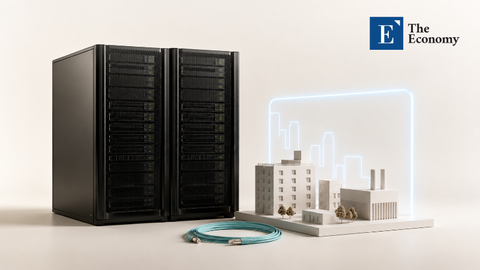
Japan’s SoftBank Group is set to acquire DigitalBridge Group, a U.S. private equity (PE) manager with a robust digital infrastructure portfolio. As AI adoption drives a surge in data center demand, SoftBank aims to strengthen its competitiveness by tapping DigitalBridge’s investment network and portfolio. The AI infrastructure investment boom is also accelerating, spurring not only direct M&A by Big Tech but also more aggressive capital inflows into private markets.
DigitalBridge to be acquired by SoftBank
On December 29 (local time), SoftBank and DigitalBridge announced in a joint statement that they have agreed to a takeover deal. SoftBank will acquire DigitalBridge shares for $16 per share in an all-cash transaction, representing a 15% premium to the December 26 close and about a 50% premium to December 4, before media reports about a potential deal. The transaction implies an enterprise value of about $4.0 billion, including debt.
DigitalBridge is one of the world’s largest specialized investors in digital infrastructure such as communications towers and data centers, with about $108 billion in assets under management (AUM) as of the end of September. Its portfolio includes a range of digital infrastructure operators, including AIMS, AtlasEdge, DataBank, Switch, Vantage Data Centers, and Yondr Group. After the acquisition, DigitalBridge will be run as a separate platform led by CEO Marc Ganzi.
Market watchers say the deal reflects SoftBank Group Chairman Masayoshi Son’s ambition to dominate the AI infrastructure market. SoftBank has already been pursuing Stargate, an AI data center project worth up to $500 billion, alongside OpenAI and Oracle, and the acquisition is seen as another step to broaden its related portfolio. Commenting on the transaction, Son said that as AI transforms industries worldwide, the world will need more computing, connectivity, power, and infrastructure—and that the acquisition will strengthen the foundation for next-generation AI data centers.
Google’s dual-purpose M&A strategy
Global enthusiasm for AI infrastructure investment is only intensifying, and Big Tech has begun acquiring AI infrastructure companies outright. On December 22, Alphabet, Google’s parent, said it will buy Intersect, a colocation developer that builds data centers alongside on-site solar and natural-gas power plants, in an all-cash deal worth $4.75 billion. Google, which already held a minority stake, will secure Intersect’s energy pipeline valued at roughly $15 billion, including a multi-gigawatt project under construction in Haskell County, Texas.
Experts say Alphabet effectively “bought a place in line” for data center expansion through the Intersect deal. In the U.S., building a data center requires securing priority access to grid interconnection from state-level authorities. But obtaining that right—along with permits and other approvals—can take five to 10 years, a major hurdle for companies racing to add capacity to meet AI-driven demand. By acquiring Intersect, Google gains access to the priority positions Intersect had already locked in across Texas.
The deal is also seen as a way to reduce reliance on external grids by supplying part of the electricity needed for AI operations in-house. As AI services become more widespread and demand for data center and computing power surges, many expect companies will struggle to meet energy needs through existing power grids alone. Organizations including the U.S. Department of Energy’s Lawrence Berkeley National Laboratory, as well as Goldman Sachs and Bain & Company, have warned of a potential “power bottleneck” in which AI servers cannot be run due to a lack of available electricity.

Capital inflows into private markets also accelerate
The AI infrastructure investment boom is spreading rapidly into private markets as well. Limited partners (LPs) and general partners (GPs) are increasingly upbeat about the growing pipeline of AI infrastructure opportunities. According to Goldman Sachs’ “2025 Private Markets Diagnostic Survey,” conducted in October among 250 LPs and GPs worldwide, 83% of respondents said they plan to allocate the same or more capital to private markets than last year. Optimism toward real assets has also risen sharply. Investors expect conditions to remain stable or improve by year-end across infrastructure (93%), private equity (82%), real estate (81%), and private credit (70%). In addition, 45% of LPs said private market allocations to infrastructure are currently underweight—five times the share who said they are overweight (9%).
Market outlooks are similarly positive. Preqin, a global alternative investment data provider, said in its “Private Markets Outlook to 2030,” published last month, that private markets are entering a new “infrastructure-centric” era. Rachel Deborah, a research insights analyst at Preqin, said infrastructure AUM is expected to grow at a faster compound annual rate from late 2024 through 2040 than it did between 2021 and 2024, reaching about $2.88 trillion by the end of 2030. She cited energy security, the energy transition, government-led infrastructure modernization, and accelerating digitalization as key drivers. In particular, she noted that rising investor demand for AI and data centers will be a core engine of infrastructure fundraising over the next five years.
Large-scale investments are already materializing. One example is Princeton Digital Group (PDG), a data center developer and operator backed by U.S. private equity firm Warburg Pincus, which recently announced plans to enter the Korean market alongside a major investment. PDG plans to invest about $700 million to build its first data center campus in Incheon, with initial capacity of 48 megawatts and a long-term expansion target of 500 megawatts. The company said it has already secured the required power supply and aims to begin commercial operations in early 2028. It also said it plans to invest a total of $25 billion over the next five years to expand its infrastructure capacity across Asia from 1.3 gigawatts to more than 4 gigawatts.
Aoife Brennan is a contributing writer for The Economy, with a focus on education, youth, and societal change. Based in Limerick, she holds a degree in political communication from Queen’s University Belfast. Aoife’s work draws connections between cultural narratives and public discourse in Europe and Asia.
Similar Post