“Beyond Vietnam to Indonesia”: K-food gains a foothold despite halal certification hurdles

Aoife Brennan is a contributing writer for The Economy, with a focus on education, youth, and societal change. Based in Limerick, she holds a degree in political communication from Queen’s University Belfast. Aoife’s work draws connections between cultural narratives and public discourse in Europe and Asia.
Authored On
Modified
K-food accelerates expansion into Indonesia, widening its reach beyond Vietnam as a core hub
Export flows smooth further after last year’s easing of regulations on key items such as instant noodles
Halal certification, a key factor for local consumers, is unlikely to become a major variable
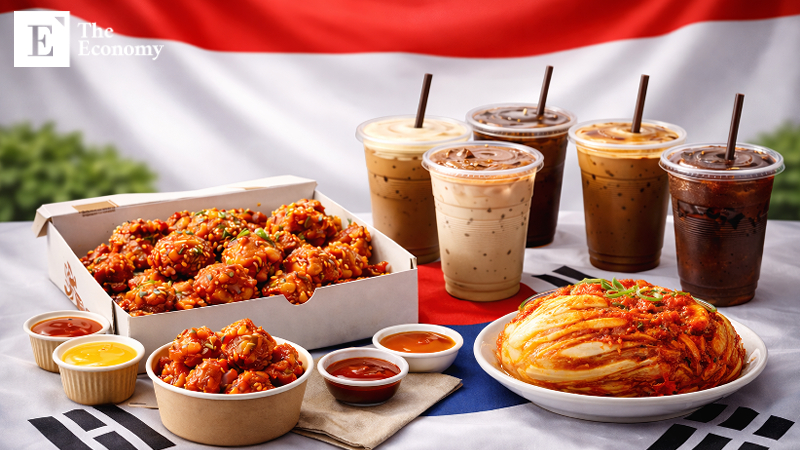
Korean food and franchise companies are rushing into the Indonesian market. With an eye on the country’s growth potential and a broader trend toward regulatory easing, firms are expanding their Southeast Asia playbook beyond Vietnam—long viewed as a regional hub—to Indonesia. Halal certification, which is critical to distribution and sales competitiveness given local market dynamics, remains a consideration, but many in the industry see it as manageable, arguing that Korean brands are already well established in the market and unlikely to face major disruption.
Korean food and beverage brands land in Indonesia
According to the food industry on December 30, Korean food and franchise companies are accelerating store launches and expansion in Indonesia. BBQ, a Korean fried chicken chain, signed a master franchise agreement in September last year with Jakarta Heritage Rasa Harum, an affiliate of Indonesia’s major food company Gunung Sewu Group. It has opened four outlets this year in Jakarta and elsewhere and plans to add four more next year, positioning Indonesia as a strategic foothold for broader Southeast Asia expansion. Rival bhc also opened its first store this month at Neo Soho Mall in central Jakarta and is leaning into sales via local delivery platforms.
Ottogi, the No. 2 player in Korea’s instant noodle market, obtained halal certification for its flagship Jin Ramen from Indonesia’s Ulama Council in December last year, completed import licensing procedures in August, and began full-scale sales of Jin Ramen last month through major hypermarkets and supermarkets. Nongshim built a local production facility in 2022 and has been manufacturing and selling products such as Shin Ramyun, Neoguri, and Chapagetti. More recently, it has rolled out a wider range of Shin Ramyun variants tailored to local youth preferences, adding stronger spice profiles and heat. Samyang Foods’ Buldak Bokkeum Myun has also been gaining popularity, benefiting from Indonesia’s strong appetite for spicy flavors.
Bakery franchises are steadily increasing their presence, focusing on high-traffic mixed-use malls in major cities. As of late this month, Paris Baguette operates 21 stores in Indonesia, while Tous les Jours runs more than 70 and is preparing for further expansion. Coffee chain Ediya has also signed master franchise agreements earlier this year to enter Laos, Cambodia, and Myanmar, and has begun market research with an eye toward a future move into Indonesia.
Indonesia’s untapped potential comes into focus
For Korean food and franchise companies, Vietnam has long served as the main hub in Southeast Asia. Over the past several years, the popularity of K-content there has fueled a rapid rise in preference for Korean products. According to the “2025 Overseas Hallyu Survey” released by the Korea Foundation for International Cultural Exchange, Vietnamese consumers spent an average of $17.8 per month on K-food content, up 40.2% from a year earlier, and 84.3% went on to purchase Korean food products after consuming such content.
Growth in the food and beverage market was also robust. Structural factors such as urbanization, the expansion of the middle class, and a growing young population helped energize the sector. Data from iPOS.vn, a Vietnamese provider of food-service management software, and Nestlé Vietnam show that Vietnam’s food and beverage market reached about $27.5 billion in 2024, up 16.6% year on year. More recently, however, momentum has slowed amid an economic downturn and rising raw-material costs. Market research firm Q&Me estimates that Vietnamese consumers spend an average of about $240 on food and beverages, accounting for roughly 30% of household income—a notably high share compared with advanced economies in the U.S. and Europe.
Against this backdrop, Korean companies are looking to Indonesia for the next phase of growth. Alongside Vietnam, Indonesia is widely viewed as one of Southeast Asia’s most economically and politically stable markets. The world’s fourth-most-populous country has around 280 million people, with roughly 10% classified as middle class, forming a solid base of potential consumers. According to Verified Market Research, Indonesia’s food market—including restaurant franchises—expanded from about $53 billion in 2020 to roughly $66 billion this year and is projected to reach around $122 billion by 2030. With government-led infrastructure investment and reforms aimed at attracting foreign capital, industry growth is expected to continue, supporting longer-term improvements in employment conditions and private consumption.
Easing rules strengthens export competitiveness
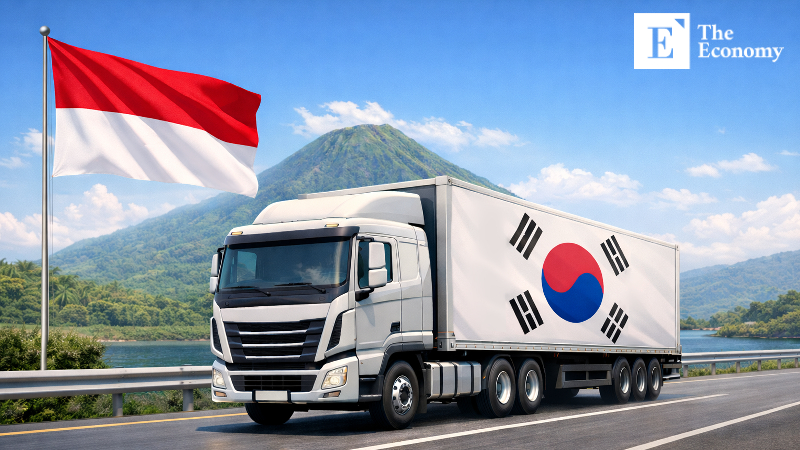
Last year, Indonesia removed its requirement for Korean instant noodles to submit ethylene oxide (EO) test reports, making it easier for Korean companies to enter the market. Indonesia’s food and drug authority had tightened EO checks on Korean noodles starting in October 2022, requiring exporters to submit, for every shipment, test certificates proving compliance with maximum residue limits for EO and 2-CE. The requirement delayed exports and increased costs. EO is used as a fumigant and sterilant for agricultural products in countries such as the United States and Canada, with residue standards set and managed by each jurisdiction.
In response, Korea’s Ministry of Food and Drug Safety stepped up diplomatic engagement, including a bilateral meeting in September last year where it shared Korea’s food-safety oversight practices for instant noodles and asked Indonesia to lift the enhanced EO measures. In December of the same year, Indonesia’s regulator recognized Korea’s food-safety management system for Korean instant noodles and decided it would no longer require additional EO testing. The decision effectively fully opened access to Indonesia’s instant noodle market, the world’s second largest after China. Indonesia consumes about 14.5 billion servings of instant noodles a year, roughly 12% of global consumption.
Some point to halal certification as a constraint for fully penetrating the market. Indonesia is the world’s largest Muslim-majority country, where consumers show a strong preference for products certified as halal under Islamic law. From October next year, rules on halal certification for imported foods are set to tighten further. Currently, non-halal products that do not contain pork or alcohol can be displayed on the same shelves as halal products, but under the new regime, shelves will be fully separated, sharply reducing consumer access to uncertified products. Even so, industry observers expect the impact on K-food exports to be limited, arguing that Korean companies have already built substantial on-the-ground experience in the Indonesian market.
Aoife Brennan is a contributing writer for The Economy, with a focus on education, youth, and societal change. Based in Limerick, she holds a degree in political communication from Queen’s University Belfast. Aoife’s work draws connections between cultural narratives and public discourse in Europe and Asia.
Similar Post