“HBM draws wafer supply” wafer bottleneck emerges across memory industry, capacity expansion to take time

Authored On
Modified
Memory makers’ HBM push tightens wafer supply for DRAM and NAND
Wafer capacity stagnates as the post–COVID-19 supercycle memory slump drags on
Capex is rising, but a near-term end to the supply crunch looks unlikely
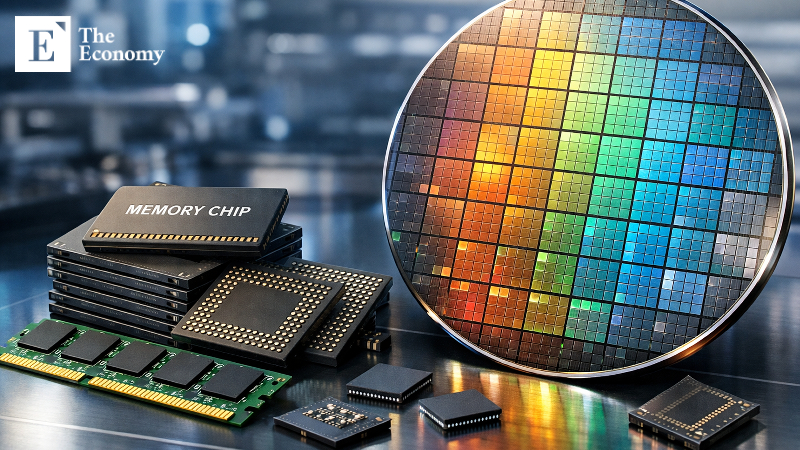
A view is emerging that memory chip prices could surge again this year. After the pandemic-era “supercycle” faded, wafer supply expansion has largely stalled. At the same time, memory makers are allocating a growing share of limited wafer output to high-bandwidth memory (HBM), fueling a tightening supply situation for DRAM and NAND flash. While wafer capacity investment is picking up in various areas, expanding actual production capacity is expected to take years.
Global semiconductor market splits in two
On the 5th (local time), U.S. electronics industry outlet EE Times and IT site Wccftech reported that the global semiconductor market is splitting into an AI-driven, high value-added segment and the consumer market, in what they described as “The Great Memory Pivot.” As major manufacturers such as Samsung Electronics and SK hynix focus on producing highly profitable AI-oriented HBM, supply of conventional DRAM has shrunk, fueling expectations that DRAM prices could jump sharply early this year.
Industry sources say HBM3E, the fifth-generation HBM, takes up about three times as much wafer area as standard DDR5. That is because the chips themselves are larger and the vertical stacking process is more complex, reducing yields. In this context, market research firm IDC said the industry is facing a zero-sum dynamic in which every wafer allocated to producing HBM for Nvidia GPUs effectively removes a wafer that could have been used to make LPDDR5X for smartphones or SSDs for PCs. With wafer supply tight, average DRAM prices early this year are projected to surge 50–55%, and consumer electronics prices could rise by as much as 20% as manufacturers pass higher memory costs on through product pricing.
Contract prices for NAND flash in the first quarter are also expected to rise about 33–38%. That is because NAND flash wafer supply has fallen sharply over the past few months. As major suppliers concentrate capacity on HBM and other enterprise and premium products, an accelerated drawdown of legacy processes has further tightened supply of mainstream-capacity wafers. As a result, NAND flash wafer contract prices reportedly jumped by as much as 60% for some items in November.
Why wafer shortages stand out
The failure of wafer supply to keep pace with demand reflects the downturn that followed the semiconductor supercycle triggered by the COVID-19 pandemic. As chip demand surged during the pandemic, a global wafer shortage took hold, and that supply crunch proved slow to ease even after economic conditions deteriorated across major economies in the first half of 2022. Wafer manufacturing, as an upstream industry, tends to respond more slowly to shifts in downstream demand. In fact, while operating profits at major chipmakers such as Samsung Electronics and SK hynix fell by roughly 50–60% year on year in the third quarter of 2022, wafer manufacturers saw their profits climb in succession.
The turning point came in 2023, when memory makers across the board moved to cut output. Micron reduced the number of wafers fed into its production lines by 20%, while SK hynix maintained a conservative production stance. Samsung Electronics, which had initially insisted that the risk of oversupply was low and that it would avoid artificial cuts, ultimately followed suit as earnings weakened. This marked a sharp contraction in wafer demand from the memory sector. As a result, most wafer suppliers have spent the past few years holding back on capacity expansion and waiting out market conditions.
Since AI-driven semiconductor demand began to accelerate in earnest, investment in advanced wafer facilities has started to pick up again. According to SEMI’s “300mm Fab Outlook Report” released in July, global wafer production capacity is expected to grow at an average annual rate of 7% from late 2024 through 2028. Monthly wafer capacity is projected to reach a record 11.1 million wafers by 2028. Even so, capacity expansion can only proceed gradually, making it unlikely that the current supply crunch will be resolved in the near term.
SK Siltron also unlikely to boost supply in the near term
SK Siltron’s wafer capacity is also expected to take time to expand, even as market expectations have risen with talks over a potential M&A deal with Doosan. SK previously put SK Siltron up for sale as part of a group-wide rebalancing effort. With SK Siltron’s enterprise value estimated at around $3.6 billion, the deal size is expected to come in at roughly $2.2 billion to $2.9 billion. Doosan has been selected as the preferred bidder and is expected to proceed with steps including on-site due diligence and negotiations over terms before signing a share purchase agreement.
As speculation grows that Doosan could step up its semiconductor push in line with its new growth strategy, the industry is watching closely whether SK Siltron will expand capital spending. SK Siltron has said it will invest a total of about $1.7 billion through this year to expand 300mm (12-inch) silicon wafer manufacturing facilities at its Gumi Plant 3. It also plans to invest $640 million in its Bay City plant in the United States to increase output of silicon carbide (SiC) wafers and maintain a stable revenue structure. If wafer demand continues to rise, SK Siltron’s investment plans could become more aggressive.
Even so, wafer capacity expansion is a long-term investment whose results materialize only gradually over several years. Because wafer manufacturing can show quality variance even with tiny deviations, new equipment must undergo repeated testing and process tuning until it achieves yields and reliability comparable to existing lines. In other words, even after spending is completed, it can still take significant time before meaningful gains in output are realized. An industry official said wafer facility investment “effectively begins after equipment is moved in,” adding that after trial runs, process stabilization, and customer qualification, it can take several months—and in some cases more than one to two years after completion—before shipments increase in a meaningful way.
Similar Post