Intel Accelerates 14A Development, Bets Its Future on 1-Nanometer Amid Foundry Slump

Authored On
Modified
Losses deepen as core businesses stagnate
All-in push to secure competitiveness at next-generation battleground ‘14A’
Sub-1.4-nanometer race ignites, reshaping the global foundry order

Intel has declared a full-scale acceleration of its 1.4-nanometer (14A) process development, pulling forward the timetable of the next phase in the race for advanced-node supremacy. Just months ago, Intel had maintained a cautious stance on 14A investment, citing the absence of external customers. It has now sharply pivoted, expressing confidence in yield progress and portfolio readiness. The shift is widely interpreted as a strategic move to secure technological advantage in the foundry market, as Samsung Electronics and TSMC make visible headway in their respective 2-nanometer processes.
Intel Goes All In on ‘Full Acceleration’ of 14A
According to U.S. technology outlet Tom’s Hardware on the 11th (local time), Intel announced at CES 2026—the world’s largest consumer electronics and IT exhibition, which opened on the 10th in Las Vegas—that it is moving at full speed on 14A development. Intel CEO Lip-Bu Tan stated, “We are fully engaged in 14A,” adding, “There will be significant progress in yield and intellectual property (IP) portfolios, and we will serve our customers well.”
Intel aims to complete preparations for mass production of 14A by 2027. An initial version of the process design kit (PDK) is scheduled to be released to external customers early this year. Tan’s use of the plural “customers” suggests that Intel has already secured multiple clients for 14A products. This is interpreted to mean that Intel Foundry has lined up at least one external buyer in addition to its own internal demand for 14A chips.
The 14A node builds on the 18A process while incorporating more advanced technologies. It introduces second-generation RibbonFET gate-all-around (GAA) transistors and applies the second-generation backside power delivery network (BSPDN), branded PowerDirect. PowerDirect connects power directly to the transistor source and drain, reducing transient voltage drop and clock stretching. Intel also employs Turbo Cells using high-drive, double-height cells to optimize critical timing paths within dense standard-cell libraries. According to Intel, 14A is expected to deliver a 15–20% improvement in performance-per-watt compared with 18A.
TSMC Opens the ‘2-Nanometer Era,’ Samsung Close on Its Heels
Intel’s renewed commitment to 14A marks a stark reversal from its position last July, when it openly suggested the possibility of halting 14A development if large external customers failed to materialize. At the time, prolonged weak performance had prompted Tan to initiate a comprehensive review of the foundry business. Intel had struggled to capitalize on surging demand for AI semiconductors, ceding ground to rivals such as Nvidia and AMD. As a result, the company chose to focus on bringing the 1.8-nanometer (18A) process into mass production, while deferring 14A investment until firm customer orders were secured. It even signaled that the foundry business targeting external clients could be discontinued if 18A were used solely for internal products yet still generated acceptable returns.
Intel’s abrupt course correction just five months later is widely attributed to competitive pressure from rivals, particularly Samsung Electronics. According to market research firm TrendForce, Samsung has achieved a 40% performance improvement over its current model in the next-generation application processor (AP) Exynos 2700 (codename Ulysses), slated for launch in 2027. The chip is built on Samsung Foundry’s second-generation 2-nanometer process, SF2P. Compared with the earlier SF2 node, SF2P delivers a 12% performance gain and reduces power consumption by 25%. Its GAA-based three-dimensional transistor structure fully surrounds the channel, improving electrostatic control.
A key change in Exynos 2700 lies in packaging technology. Samsung has adopted fan-out wafer-level packaging side-by-side (FOWLP-SbS), integrating a heat-path block (HPB) across both the DRAM and the AP. A copper-based heat sink covers the entire AP, enhancing thermal dissipation. While the previous Exynos 2600 had heat-sink contact limited to part of the AP, the new design places the heat path across the full surface, improving stability under heavy workloads. The chip supports next-generation low-power DDR (LPDDR)6 memory with speeds of up to 14.4 gigabits per second (Gbps) and adopts UFS 5.0 storage. The critical variable remains yield. Samsung has faced persistent criticism for yield instability during the early adoption of its 3-nanometer process, widening the gap with TSMC, and is now concentrating efforts on stabilizing yields at the 2-nanometer node.
‘We Will Reach 1 Nanometer First’
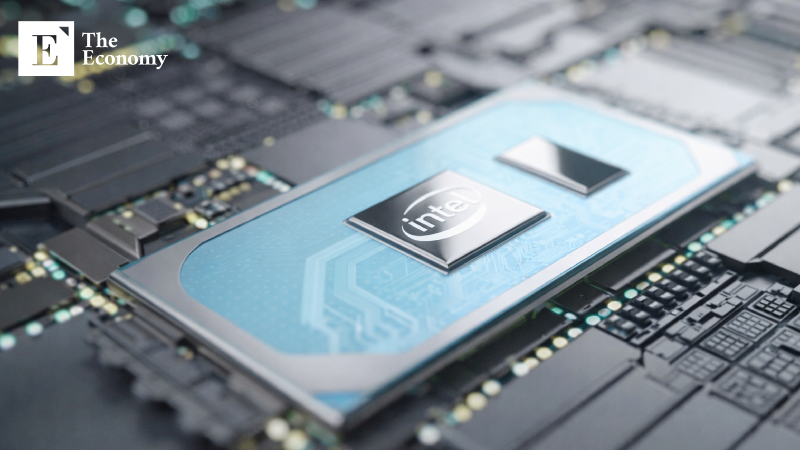
Against this backdrop, Intel’s ultimate objective is to be the first to reach the 1-nanometer era. The 14A process represents a more advanced node than the 2-nanometer technologies currently spearheaded by Samsung and TSMC, effectively positioning Intel one generation ahead of the mainstream. Intel first unveiled its 14A roadmap in 2024 at the Intel Foundry Direct Connect forum in San Jose, California. Based solely on publicly disclosed plans, Intel’s 1-nanometer-class timeline appears to be roughly a year ahead of Samsung and TSMC, both widely regarded as technology leaders. Early introduction of cutting-edge nodes is a common latecomer strategy aimed at signaling technological prowess and attracting customers.
One factor reinforcing Intel’s strategy is equity participation by the Donald Trump administration. In exchange for government investment subsidies, the Trump administration acquired a stake in Intel, while major technology firms such as SoftBank and Nvidia also made equity investments, providing active support. The U.S. government has articulated a clear view that long-term reliance on foreign firms like TSMC for advanced semiconductor manufacturing is untenable. Support for Intel is therefore widely seen as a measure to ensure uninterrupted investment in 14A foundry facilities.
Industry observers increasingly expect Samsung Electronics, TSMC, and Intel to enter full-scale competition for customer orders at the 14A node in the coming years. Samsung is targeting production of 14A-class chips from 2029 and is intensifying related R&D efforts. TSMC is also preparing mass production of its A14 process at its Kaohsiung plant in Taiwan, where construction timelines have reportedly been brought forward, according to Taiwanese outlet Commercial Times. Japan’s Rapidus has likewise announced plans to commence full-scale R&D on 14A products this year. Taken together, these moves suggest that the semiconductor process battlefield is rapidly shifting beyond 2 nanometers into the sub-1.4-nanometer domain.
Similar Post