Trump seeks 10% cap on credit card rates; U.S. banks warn it could hurt low-income households

Aoife Brennan is a contributing writer for The Economy, with a focus on education, youth, and societal change. Based in Limerick, she holds a degree in political communication from Queen’s University Belfast. Aoife’s work draws connections between cultural narratives and public discourse in Europe and Asia.
Authored On
Modified
“Ease the cost-of-living burden,” Trump demands steep cuts to credit card interest rates
U.S. financial industry warns of side effects, including reduced credit access for low-income borrowers and fewer card benefits
J.P. Morgan, the largest U.S. bank, signals the possibility of legal action
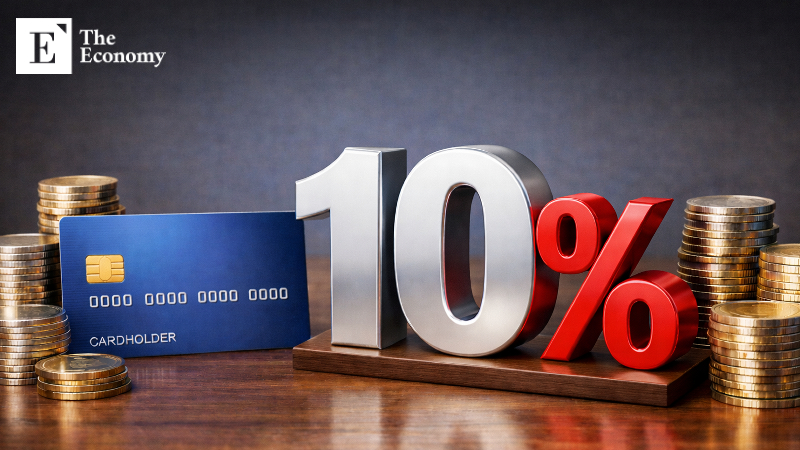
U.S. President Donald Trump has urged domestic financial firms to cut credit card interest rates, proposing to lower them to as much as 10% to ease Americans’ cost-of-living burden. However, the U.S. financial industry has pushed back strongly, warning that if rates fall abruptly and card issuers’ profitability deteriorates, access to credit could tighten and low-credit borrowers could be pushed into high-cost alternative financing.
Trump: Card issuers are “ripping off” the public
Media reports on the 14th say President Trump announced on the 9th (local time) that he would cap credit card interest rates at up to 10%. He said he would no longer allow Americans to be “ripped off” by card companies charging 20% to 30% interest, and warned that any financial firm that does not comply by January 20 would be “breaking the law.”
The move is seen as an effort to ease households’ cost-of-living burden. Credit cards are a key source of credit for U.S. households and the fourth-largest category of household debt after mortgages, student loans, and auto loans. The Federal Reserve said credit card debt topped $1.23 trillion as of September last year. Average credit card rates are above 21%, and for higher-risk borrowers they can rise to as high as 38%. As a result, more households are struggling to keep up with payments. The New York Fed said the share of credit card balances that were 90 days or more past due rose to 12.2% in the second quarter of last year, the highest level since the first quarter of 2011.
However, a clear legal basis for adjusting a credit card interest-rate cap has not yet been established. The U.S. Congress has seen legislative attempts related to a cap, but none have been enacted. Earlier, independent Senator Bernie Sanders and Republican Senator Josh Hawley introduced a bipartisan bill to limit credit card rates to 10% for five years. In the House, Democrat Alexandria Ocasio-Cortez and Republican Anna Paulina Luna co-sponsored a bill with the same aim.
Why U.S. credit card rates are so high
The problem is that Trump’s proposal risks disrupting market dynamics. U.S. credit card rates are high largely because issuers use a business model that prices delinquency and default risk directly into interest rates. Revolving balances are common in the United States, and credit cards function much like unsecured loans, so rates vary widely depending on a borrower’s credit profile. While issuers rely on interest income as a core revenue stream, they have also extended credit relatively broadly, including to higher-risk borrowers.
If rates are forced down across the board, credit availability for low-credit borrowers could tighten. That is, card issuers facing weaker profitability may sharply cut back card issuance and lending to riskier customers. In that case, households that need quick cash could be pushed toward payday lenders or other high-cost lending, potentially ending up with an even heavier interest burden.
There are also concerns that a lower cap could undermine the “high-rate, high-perks” model and reduce the benefits consumers actually receive. U.S. card issuers have funded airline miles, cash back, and travel and shopping rewards with a combination of interest income and merchant fees. If profitability is constrained, competition on rewards could fade, giving way to more limited promotions such as simple discounts or lower annual fees.
Backlash intensifies across the U.S. financial industry
U.S. financial groups are voicing strong opposition, citing these risks. Five major industry associations, including the American Bankers Association, the Bank Policy Institute, and the Consumer Bankers Association, said in a joint statement on the 9th that while they share the intent of easing consumer burdens, a 10% cap would reduce credit availability and harm millions of households and small businesses. They warned it could instead push consumers toward less regulated and more expensive alternative financing.
J.P. Morgan Chase, the largest U.S. bank, has also pushed back forcefully, saying a 10% cap would require a fundamental overhaul of its business model. Speaking on a conference call after the bank’s fourth-quarter earnings release on the 13th, CFO Jeremy Barnum said that if directives are imposed without sufficient justification that radically alter the business, “all options would have to be on the table,” stressing that this would be a matter of responsibility to shareholders. The remarks signaled the possibility of legal action against government moves that could undermine core revenue streams. As of the end of December last year, J.P. Morgan’s credit card loan balance stood at $247.8 billion.
Barnum added that such measures could fundamentally change banks’ business structures and harm both lenders and consumers. If that scenario were to materialize, he said, it would lead to very negative outcomes for consumers and the broader economy, forcing card issuers to make sweeping changes to their card businesses.
Aoife Brennan is a contributing writer for The Economy, with a focus on education, youth, and societal change. Based in Limerick, she holds a degree in political communication from Queen’s University Belfast. Aoife’s work draws connections between cultural narratives and public discourse in Europe and Asia.
Similar Post
















