Sharp drop in hiring, rising productivity: how AI is reshaping the U.S. job market

Stefan Schneider brings a dynamic energy to The Economy’s tech desk. With a background in data science, he covers AI, blockchain, and emerging technologies with a skeptical yet open mind. His investigative pieces expose the reality behind tech hype, making him a must-read for business leaders navigating the digital landscape.
Authored On
Modified
Productivity gaps widen depending on AI adoption
Job restructuring and downsizing spread across industries
Shift from “support tool” to strategic deployment

As the U.S. economy continues to grow on the back of the rapid spread of artificial intelligence (AI), employment indicators have failed to keep pace, creating an unusual divergence. Technological adoption has lifted corporate productivity, but the ability to generate more output with the same workforce has limited the need for additional hiring. In this process, the impact has been concentrated on specific roles and worker groups, while corporate hiring strategies have increasingly shifted toward minimizing human involvement.
From 200,000 jobs a month to just 35,000
According to the Job Openings and Labor Turnover Survey (JOLTS) released by the U.S. Department of Labor for November last year, seasonally adjusted job openings totaled 7.146 million. This was well below Bloomberg’s market forecast of 7.6 million and marked the lowest level in a year. The slowdown in new hiring is widely seen as evidence that the U.S. labor market is gradually cooling, with companies opting to scale back recruitment and wait rather than pursue immediate, large-scale layoffs.
This trend stands in contrast to the trajectory of U.S. economic growth. At the National Retail Federation (NRF) 2026 event held in Manhattan, New York, on the 12th, Michael Pearce, chief economist at Oxford Economics, said the U.S. economy is expected to grow by around 2.8% this year, while warning that the perceived economic situation for many consumers could worsen as growth and consumption become increasingly polarized. Citing the fact that U.S. productivity growth has hovered around 2% since the Covid-19 pandemic, Pearce described the current environment as a phase of “growth without labor input.”
Pearce pointed to the expansion of AI as a key factor enabling growth without job creation. While noting that AI’s impact on the labor market has so far been relatively limited, he said a sharp decline in early-career hiring signals major changes ahead. In the 2010s, he explained, around 200,000 new jobs per month were needed to keep up with demand, whereas today roughly 35,000 are sufficient. The weakening link between growth and employment is increasingly visible in the data.
Academic research supports this assessment. A joint research team from the Massachusetts Institute of Technology (MIT) and Oak Ridge National Laboratory developed the “Iceberg Index” to measure AI’s impact on the U.S. labor market. The researchers broke down tasks performed by 151 million U.S. workers into roughly 32,000 skill components and matched them one-to-one with about 13,000 functions provided by AI systems. The study estimated that the value of work AI could potentially perform amounts to 11.7% of total U.S. labor income, or 1.2 trillion dollars.
The influence of AI is not confined to advanced technology sectors, but extends across administrative, financial, and office roles. While the potential value of AI use in the tech and IT sector accounts for about 2.2% of total wages, the potential value of general-purpose AI applicable to most other jobs is far larger. The researchers said the hiring slowdown and job restructuring currently being felt represent only “the tip of the iceberg,” adding that when viewed across all occupations, the volume of work AI could potentially handle is more than five times greater.
Uneven risks across roles and worker groups
At this stage, employment shocks stemming from AI expansion are concentrated in specific roles and worker segments, with restructuring proceeding selectively in areas where automation and cognitive technologies directly intersect. This pattern is evident in layoffs announced by major U.S. companies. Amazon has said it plans to cut about 14,000 headquarters jobs, citing organizational simplification and fewer decision-making layers. UPS reduced 34,000 operational positions between January and September last year, while Nestlé announced plans to cut 16,000 jobs globally over the next two years.
These cases are driven less by economic downturns or demand contraction than by job restructuring tied to AI adoption and efficiency gains. As AI deployment accelerates, organizations are entering a phase of redesigning operations to handle the same tasks with fewer workers. At Salesforce, chief executive Marc Benioff said about 4,000 customer support roles had been replaced by AI-driven service systems, underscoring that office functions requiring repetitive judgment, such as customer response, analysis, and documentation, are among the first to be affected.
Similar findings have been reported by the Society for Human Resource Management (SHRM). In a study conducted last year, SHRM classified about 12.6% of all U.S. jobs, or 19.2 million positions, as being at high risk of replacement through AI automation. By category, 14% of blue-collar jobs, 12.3% of white-collar jobs, and 12.1% of service-sector jobs were rated as highly vulnerable. By contrast, only about 120 occupations, including medical and clinical roles, artistic professions, and skilled trades, were considered difficult for AI to replace.
The impact also varies by age and career stage. Middle-aged office and managerial workers face the risk that accumulated experience could be rapidly supplanted by AI, while younger workers are affected through reduced entry-level hiring and higher barriers to entering the workforce. This suggests the intensity of the shock depends less on industry and more on an individual’s role within the labor market. As a result, the current AI-driven disruption is widely viewed not as uniform job destruction, but as a process of selective adjustment based on role-specific risk.
Expansion of work designs with minimal human involvement
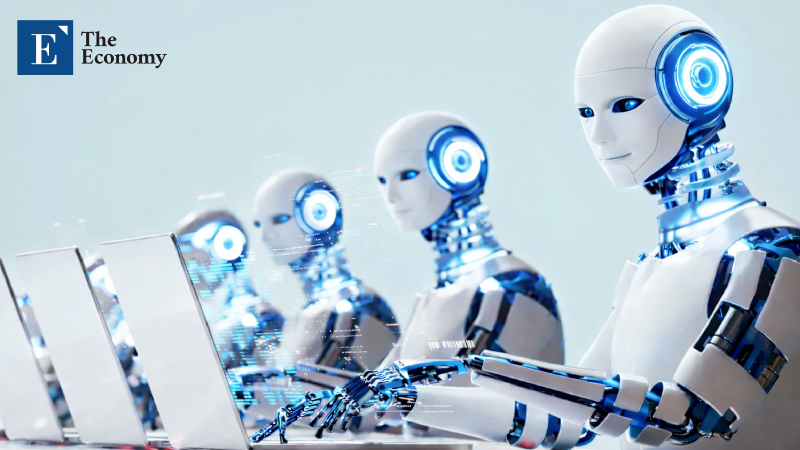
Against this backdrop, corporate hiring strategies are rapidly shifting away from viewing AI as a tool that merely supplements work toward minimizing human intervention altogether. In the early phase of generative AI adoption, usage was largely confined to reducing repetitive tasks or supporting decision-making. More recently, however, companies have begun redesigning entire work units around AI. The spread of AI agents capable of autonomously handling goal-setting, planning, information gathering, execution, and reporting has led to more roles once reliant on human judgment and coordination being absorbed into automated systems.
These changes are reshaping organizational operations. When launching new projects or internal innovation initiatives, companies increasingly default to combining existing staff with high-performance AI systems rather than hiring additional workers. As AI agents process multiple workflows in parallel, the need for team-based structures and multi-layered decision-making has diminished. The rise of “jobless growth” in the United States is therefore seen not as a byproduct of the business cycle, but as the outcome of technology adoption and organizational design.
Shifts in hiring strategy are not confined to the United States. According to a survey conducted by global HR platform Deel in partnership with market research firm IDC across 16 major markets, 66% of companies worldwide said they plan to reduce entry-level hiring over the next three years. Only 5% of respondents cited a university degree as a top hiring requirement, while 66% prioritized AI tools and coding certifications, and 59% emphasized problem-solving and critical thinking skills. Hiring criteria are moving toward capabilities that can be deployed immediately.
The tangible effects of AI-based hiring and organizational management are also reflected in data. In the same survey, Mexico, Chile, Spain, and the United Kingdom cited improved hiring quality as the biggest benefit of AI adoption. The Netherlands, Germany, and Australia highlighted shorter hiring timelines and cost reductions, while Japan, Hong Kong, India, and South Korea were identified as markets where AI use in talent screening is rising rapidly. This indicates that AI is evolving beyond a selective support tool into a framework for reassessing how tasks are allocated and which skills are required.
Stefan Schneider brings a dynamic energy to The Economy’s tech desk. With a background in data science, he covers AI, blockchain, and emerging technologies with a skeptical yet open mind. His investigative pieces expose the reality behind tech hype, making him a must-read for business leaders navigating the digital landscape.
Similar Post