Chinese Solar Firms Sink into Losses En Masse, Trapped by Subsidy Rollbacks and Trade Barriers in a Deepening Squeeze

Authored On
Modified
Low technological barriers fuel chronic oversupply
Rising silver prices intensify cost pressures
Global protectionism tightens, making restructuring inevitable
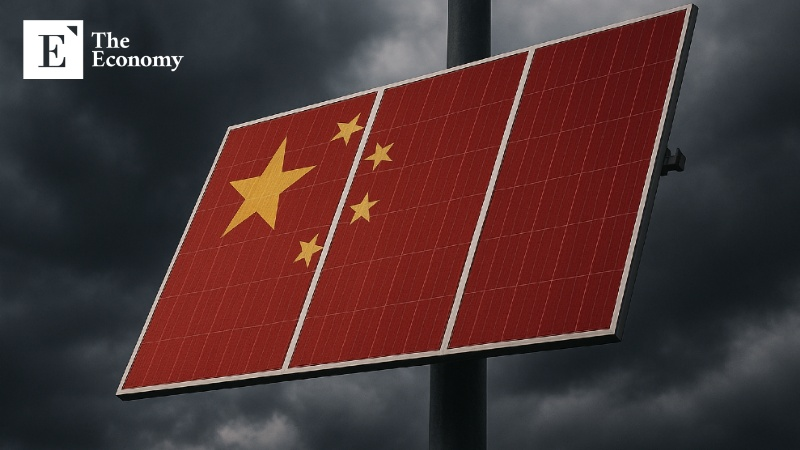
China’s solar panel industry has plunged into its worst financial crisis on record, despite the country’s aggressive push to expand renewable energy. Years of unchecked capacity expansion, driven by heavy reliance on government subsidies in a sector with low technological barriers, have rebounded sharply in the form of collapsing profitability. The situation has been further aggravated by mounting pressure from the United States and Europe, alongside Beijing’s decision to abolish export subsidies, setting the stage for a brutal industry-wide shakeout.
Losses at Major Chinese Solar Companies Exceed USD 45 Billion
According to Securities Times, a Chinese state-run financial daily, many of China’s leading solar companies have recently warned of sharply deteriorating earnings for 2025. Based on earnings guidance released by nine major solar firms—including Tongwei, LONGi Green Energy, and Aiko Solar—their combined losses are estimated to exceed USD 45 billion. Tongwei is the world’s largest producer of polysilicon, LONGi is a global leader in wafers and modules, and Aiko commands top-tier scale and technology in solar cell manufacturing.
Tongwei projected a full-year net loss of between USD 13.5 billion and USD 15 billion for last year, the largest deficit reported among companies that have disclosed results so far. The firm attributed the losses to a pronounced slowdown in new solar installations in the second half of 2025 and a broad decline in industry utilization rates. It also cited the simultaneous surge in key raw material prices, including silver, alongside falling product prices, which severely eroded margins.
LONGi Green Energy forecast a 2025 net loss of USD 9 billion to USD 9.8 billion. The company said that a sharp rise in silver paste and silicon feedstock prices in the fourth quarter significantly drove up production costs, while prolonged weakness in selling prices compounded financial strain. Aiko Solar estimated its 2025 net loss at between USD 1.9 billion and USD 3 billion. Although shipments of its high-efficiency ABC modules more than doubled year on year, the company noted that persistently low prices offset volume growth.
In addition to these three, six other leading players—including JA Solar, TCL Zhonghuan, Trina Solar, JinkoSolar, Junda, and Daqo New Energy—have also warned of losses for 2025. TCL Zhonghuan projected losses of USD 12.3 billion to USD 14.4 billion, the second-largest deficit after Tongwei. JA Solar is expected to post a net loss of roughly USD 6.8 billion to USD 7.3 billion. While companies such as Trina Solar and JinkoSolar did not disclose specific figures, they clearly indicated that their 2025 net results would remain in the red.
Dual Pressure from Oversupply and Rising Costs
China’s solar industry has expanded rapidly since the 2011 Fukushima nuclear disaster in Japan, underpinned by abundant raw materials and low electricity costs at home. Massive government subsidies encouraging the buildout of solar and wind capacity further accelerated growth. According to the International Energy Agency, China invested USD 50 billion in expanding solar generation capacity between 2011 and 2022. Backed by state support, Chinese solar manufacturers gained formidable price competitiveness, sweeping not only the domestic market but also global demand. As of 2024, China accounted for more than 80% of the global solar supply chain.
However, the drawbacks of this state-led expansion began to surface last year, as the industry slid into a profitability trap driven by severe oversupply. Solar cells are relatively easy to manufacture, require modest technological sophistication, and—under generous subsidies—offered easy profits. This combination led to ballooning capacity. While Beijing has attempted to curb destructive price competition, known domestically as “involution,” through policy campaigns, these efforts proved ineffective in the solar sector.
Matters worsened as prices for silver—a critical input for solar cell manufacturing—surged. Silver, which is difficult to substitute, accounts for roughly 10% to 15% of module production costs. With margins already razor-thin due to oversupply, soaring silver prices have effectively pushed the industry into loss-making production. An executive at an integrated module manufacturer said that rising prices for polysilicon and silver have significantly inflated production costs, forcing more companies to sustain operations at a loss and further compressing industry-wide profitability.
U.S. and EU Build Trade Barriers as China Scraps Export Subsidies
Until recently, Chinese manufacturers alleviated domestic oversupply by exporting excess solar products, but that outlet is becoming increasingly constrained. The United States, the European Union, and other economies are erecting institutional barriers to protect their own renewable energy industries. According to reports from South Korea’s National Assembly Research Service and the Export-Import Bank of Korea, the EU has enacted the Net-Zero Industry Act—often dubbed a European version of the Inflation Reduction Act—to curb China’s penetration of its solar market. The legislation aims to raise the share of EU-made products in solar, onshore wind, and nuclear technologies to 40% by 2030 by streamlining permitting procedures.
Individual EU member states have followed suit. In 2024, the EU approved USD 3.1 billion in support for companies manufacturing solar modules, batteries, and wind turbines in France. Portugal announced USD 380 million in subsidies for firms involved in solar modules, wind turbines, and carbon capture and storage projects. In the United States, the second Trump administration has taken an aggressive stance, imposing steep tariffs on Chinese solar components. Since late 2024, Washington has levied a 50% tariff on Chinese solar wafers and polysilicon.
Compounding these pressures, China is also scrapping export tax rebates for solar products. On March 9, the Ministry of Finance and the State Taxation Administration announced that export tax rebates for 249 products, including solar panels, would be fully suspended starting April 1. Export tax rebates refund value-added tax and other levies incurred during production and distribution, effectively functioning as direct subsidies that enhance price competitiveness. Solar products had enjoyed a 13% rebate through the end of 2024, which was first cut to 9% last year before being eliminated entirely.
China’s export subsidies have long drawn criticism from the U.S. and Europe as a driver of unfair competition and massive trade surpluses. Domestically, critics have also warned that subsidies encouraged regressive competition among exporters. Because export performance was treated as a key metric for local governments, companies and municipalities alike prioritized volume over sustainability, fueling price wars and eroding competitiveness. Analysts now argue that 2025 represents a decisive “golden window” for survival in China’s solar industry. With total module manufacturing capacity exceeding 1,800 gigawatts—more than twice global demand—the elimination of export subsidies is expected to force weaker players out of the market, accelerating a long-overdue industry consolidation.
Similar Post