[ESS] Storage Moves Beyond the Grid: China Accelerates While the U.S. Remains at the Starting Line

Authored On
Modified
China holds an edge in pricing power and domestic scale
Latecomer U.S. faces investment uncertainty
Fire safety and legacy technology limits persist
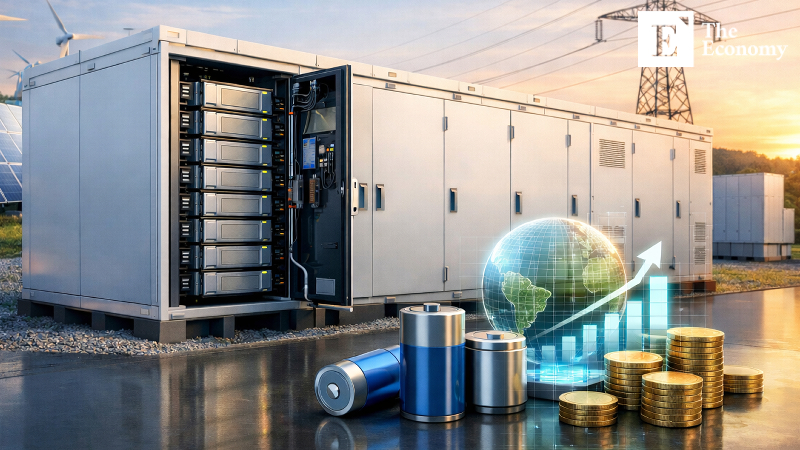
As the global push for renewable energy accelerates and demand from AI data centers rises, electricity storage needs are expanding rapidly, pushing the energy storage system (ESS) market into a full-fledged growth phase. China has moved quickly to lock in market leadership by scaling installations on the back of a massive domestic market and policy support. The United States, by contrast, entered the market later, with industrial structures shaped in no small part by policies aimed at excluding Chinese-made batteries.
Mass production capacity and price competitiveness as core strengths
According to global energy analysis firm Benchmark Intelligence on the 22nd (local time), China’s newly added battery storage capacity surged 40% year on year in 2024 to 174.19 gigawatt-hours (GWh), setting a new record. The spike is attributed to a concentration of project completions toward year-end ahead of the conclusion of China’s 14th Five-Year Plan. In December alone, newly grid-connected battery capacity in China slightly exceeded 65 GWh—about 15 GWh more than the roughly 50 GWh installed across the United States during all of 2025.
Industry observers attribute this concentration to the interaction between policy and industrial structure. China has effectively designated ESS as essential infrastructure to address output volatility from renewable energy expansion and transmission bottlenecks. Added demand from AI data centers and industrial parks has further integrated large-scale storage into national power grid planning. Capacity expansion has thus moved in tandem with central government targets rather than individual corporate investment decisions, culminating in year-end surges in completed capacity.
China’s cumulative scale is also overwhelming. Benchmark Intelligence projects China’s new ESS installations will reach 239 GWh this year, accounting for 52% of global additions. Factoring in plans by the National Development and Reform Commission to invest up to USD 23.8 billion by 2027 to double storage capacity, installation volumes could climb further. The prevailing industry view is that ESS has already become a core pillar of China’s power system.
The dominance of Chinese battery makers is another key factor. SNE Research estimates global ESS market shares at CATL 37%, EVE 13%, BYD 9%, CALB 7%, and Gotion 6%—with Chinese firms occupying most top positions. CATL and BYD, in particular, have transferred mass-production capabilities and pricing advantages honed in electric vehicle batteries directly into ESS. Given that their batteries power more than 70% of EVs worldwide, the same manufacturing and supply chains are clearly operating in stationary storage.
Growth in China’s ESS market also aligns with its broader state-led manufacturing strategy. Since “Made in China 2025,” ESS has been classified as a next-generation strategic industry and is again designated a key growth engine in the 15th Five-Year Plan (2026–2030). With ESS positioned as a connective layer linking renewables, EVs, and data centers, the fact that China accounted for 27.71% of global manufacturing value added in 2024 underscores how quickly this vision has translated into industrial competitiveness.
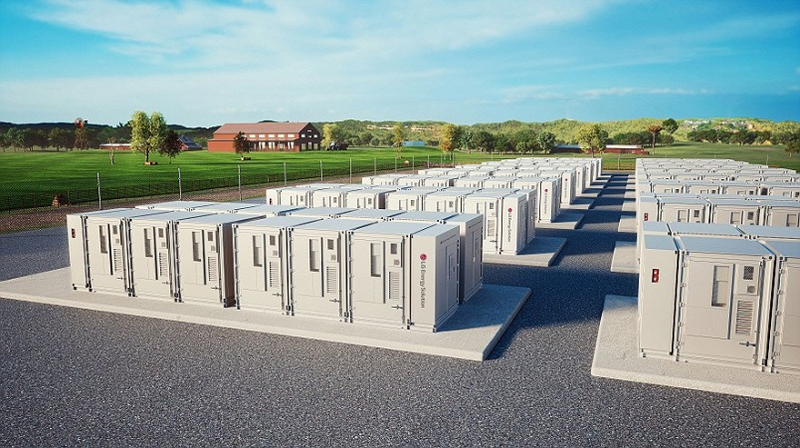
Late-starting U.S. turns to Korean partners
The United States has taken a different path in policy, regulation, and supply chain choices. While China rapidly built large-scale facilities under centralized planning, the U.S. rollout has been slower, shaped by state-level power policies and private investment. Still, changes in the power supply landscape—rising shares of solar and wind and surging demand from AI data centers—have made ESS impossible to ignore. The Solar Energy Industries Association projects U.S. ESS installations will exceed 100 GWh by 2030.
Yet U.S. expansion is not expected to match China’s pace. Wood Mackenzie warned in its October report, U.S. Energy Storage Market Monitor, that installation growth could temporarily slow after 2025. Utility-scale ESS growth may decelerate from 2026, with a potential 10% year-on-year decline in 2027, citing regulatory and policy uncertainty. The Trump administration’s tax package, dubbed the “One Big Beautiful Bill Act,” and Foreign Entity of Concern (FEOC) rules tighten investment tax credit requirements, creating short-term headwinds.
Another defining feature of the U.S. market is its push to decouple from China. With Chinese firms currently controlling about 85% of North American ESS supply, Washington is restructuring supply chains to exclude Chinese batteries and components. Under FEOC rules, projects using Chinese-made cells are ineligible for tax credits, complicating development timelines and procurement strategies. Wood Mackenzie has warned that combined supply chain uncertainty and permitting delays could cut U.S. ESS installations by up to 16.5 GW over the next five years.
This environment both constrains growth and creates demand for alternative suppliers. With limited options for stable supplies of U.S.-made or non-Chinese cells, Korean battery makers are emerging as top substitutes. Having built mass-production experience and quality control systems through EV batteries—and established manufacturing footprints in the U.S.—Korean firms are well positioned to pivot toward ESS.
Companies are already adjusting North American strategies accordingly. SK On secured a 1 GWh ESS battery supply deal with Flatiron Energy Development and first negotiation rights for an additional 6.2 GWh. Samsung SDI has converted production lines at its U.S. affiliate StarPlus Energy for ESS use. LG Energy Solution transformed its Holland, Michigan plant into a dedicated LFP battery base for ESS and plans to begin mass production this year, including converting some lines at its Canada joint venture with Stellantis.
Entering the second phase of technological competition
Consensus is now widespread across industries that ESS is essential for stable power supply. As reliance on centralized grids proves insufficient to absorb supply-demand imbalances, ESS roles have expanded from frequency regulation and short-term output smoothing to renewable stabilization, peak shaving, reserve capacity, and wholesale power market participation. ESS is increasingly viewed as foundational infrastructure for grid flexibility.
Safety concerns, however, are rising alongside market growth. Clean Energy Associates (CEA) reported late last year that, after surveying 30 GWh of ESS installations across the U.S., South Korea, and China, 26% showed deficiencies in fire detection or suppression systems, while 18% had issues in thermal management. CEA warned that defects in fire suppression and heat control systems materially increase fire risk.
At the center of the debate is the industry’s reliance on lithium-ion batteries. While lithium offers high energy density and fast charge-discharge performance, it is also highly reactive and prone to fire. In 2021, a Tesla Megapack ESS fire in Victoria, Australia, required 150 firefighters and four days to extinguish; the system used cylindrical LFP batteries supplied by LG Energy Solution and Panasonic.
Challenges extend beyond safety. As renewable penetration grows, the need for long-duration storage is increasing. Industry and research institutions estimate that future power systems will require storage capable of at least six hours—and up to 12 hours in AI data center-driven scenarios. Lithium-ion costs scale linearly with capacity and duration, making them economical for short-duration use but less competitive for long-duration storage when measured by levelized cost of storage.
As a result, both the U.S. and China are investing in alternatives such as vanadium redox flow batteries (VRFB), compressed air energy storage (CAES), thermal “Carnot” batteries, and gravity-based systems. While these technologies lag lithium-ion in energy density and response speed, they offer advantages in safety, long-duration storage, and repeated cycling. This points to an ESS market likely to evolve toward coexistence: lithium-based short-duration systems alongside non-lithium, long-duration solutions tailored to grid needs.
Similar Post