[HBM] HBM emerges as the key swing factor in an AI-driven memory supercycle, Wall Street turns to Micron

Authored On
Modified
Global memory market surges on HBM as AI drives a new supercycle
Industry sees the boom lasting for years, with upbeat forecasts mounting
Micron tipped as the biggest beneficiary among the memory “Big Three”
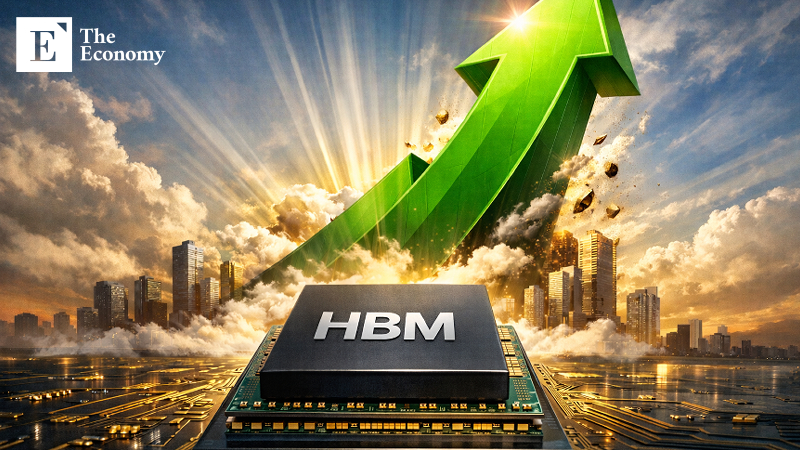
The global semiconductor industry is being reshaped around artificial intelligence, as Big Tech ramps up spending on AI infrastructure and demand surges for memory products such as high-bandwidth memory (HBM), fueling a new supercycle. The market increasingly expects the boom to last at least several years, with some analysts arguing that Micron—relatively less constrained by U.S. government restrictions—could emerge as the biggest beneficiary.
Memory boom led by HBM
According to the semiconductor industry on the 23rd, the memory market has moved beyond a simple rebound and into a phase of explosive growth. Memory used to be a cycle-sensitive business that rose and fell with PC and mobile demand, but structural growth led by AI servers and data centers is now taking hold. In particular, HBM—an essential input for AI infrastructure—is increasingly seen as a strategic asset, sending its value sharply higher.
HBM’s importance is evident in the rapid performance gains posted by major memory makers. SK hynix, for one, has become a de facto linchpin in the supply chain by supplying HBM3 to Nvidia’s key AI accelerator product lines. According to Counterpoint Research, SK hynix holds about 57% of the global HBM market by revenue as of the third quarter of 2025. Against that backdrop, the company’s results have surged, as HBM is a high value-added product that typically commands a higher price than conventional DRAM. Gartner’s preliminary “2025 global semiconductor revenue ranking” estimates that SK hynix overtook Intel last year to take third place in the industry.
Samsung Electronics is also moving aggressively to expand its position. After losing ground in the race for HBM leadership from 2024 through early 2025, Samsung is said to have regained competitiveness from the second half of 2025. Industry sources say the company has been expanding supplies of products such as HBM3E to major global GPU makers since the second half of last year, though it has not officially disclosed whether it has cleared Nvidia’s quality tests or the scale of its shipments.
Samsung is targeting the HBM market with a “turn-key” strategy. As an integrated device manufacturer (IDM) that has capabilities across memory, foundry, and advanced packaging, Samsung can offer a turn-key solution within a single company. Some market researchers forecast that Samsung’s HBM production capacity will begin translating into a meaningful expansion in influence this year, potentially pushing its market share into the 30% range. Some even project that, as Samsung steps up efforts in the next battlefield of HBM4, operating profit at its Device Solutions (DS) division could reach more than about $82 billion this year.
Uptrend to persist over the long term?
The prevailing view is that this memory supercycle will last at least several years. Fortune Market Insights (FMI) projects that the global memory semiconductor market will more than double, growing from about $199 billion last year to roughly $410 billion by 2035. Macquarie said current supply constraints are likely to delay or reschedule AI data center projects, further tightening supply. “This environment of shortages and rising prices favors DRAM suppliers and could translate into margin expansion over multiple years,” the bank said.
SEMI (the Semiconductor Equipment and Materials International) also assesses that the semiconductor market is not entering a typical downturn, but instead is maintaining a prolonged upward trajectory. SEMI forecasts that investment in HBM manufacturing equipment will rise 15% year on year in both 2025 and 2026, while NAND investment is expected to jump 45% in 2025 and continue growing through 2026 and 2027. Clark Tseng, head of market intelligence at SEMI, said the current silicon cycle surrounding DRAM does not follow the traditional four-year up-and-down pattern. “Based on past cycles, a slowdown might be discussed for 2027–2028, but SEMI sees a low likelihood of a clear slowdown during that period,” he said.
Sebastien Naji, an analyst at investment bank William Blair, said in a research note that the memory shortage is likely to persist through at least 2027, suggesting the current AI-driven supercycle could last a minimum of two more years. He rated Micron—one of the memory industry’s Big Three—as “outperform,” strongly recommending the stock. As major Wall Street firms continue to turn increasingly bullish on Micron, William Blair has now joined that camp.
Bullish calls build around Micron
Wall Street firms have been rushing to raise their price targets for Micron. KeyBanc on the 13th (local time) and Cantor Fitzgerald on the 14th both recommended increasing exposure to Micron, setting a price target of $450. On the 15th, Barclays, RBC Capital, and Wells Fargo also issued overweight calls, with price targets of $450, $425, and $410, respectively. Rosenblatt on the 20th set a $500 target while reiterating a buy rating, and TD Cowen the same day also maintained a buy and set a $450 target.
The reason Wall Street is focusing particularly on Micron among the memory “Big Three” (Samsung Electronics, SK hynix, and Micron) is the view that Micron’s shares remain materially undervalued. Micron’s revenue for fiscal 2026 first quarter (September–November 2025) came in at $13.64 billion, up 57% year on year and well above the market estimate of $12.9 billion. Adjusted EPS was $4.78, more than 20% above the consensus of $3.90, and operating margin climbed to 47%. Despite the strong numbers, Micron’s forward P/E is around 11x, far below the computer integrated systems industry average of 17.89x, implying the stock remains relatively inexpensive versus its earnings growth.
U.S. policy is also being cited as a factor that could further boost Micron’s appeal. The Trump administration on the 14th announced the start of negotiations over semiconductor tariffs, signaling a new trade strategy aimed at major chip powers including Korea and Taiwan. On the 16th, U.S. Commerce Secretary Howard Lutnick, speaking at Micron’s New York groundbreaking ceremony, stepped up the pressure, saying chipmakers have two choices: “pay a 100% tariff or produce in the United States.”
Samsung Electronics and SK hynix, which do not have U.S.-based memory fabs, are once again facing heightened tariff risk. Samsung currently runs foundry-focused production in Austin and Taylor, while SK hynix’s Indiana facility is a back-end line intended for HBM packaging. Nomura said in a report on the 19th that Samsung and SK hynix may need to invest about $74 billion to $89 billion in the U.S. between 2027 and 2030 to secure tariff exemptions—an amount it said is roughly twice the scale of Samsung’s Pyeongtaek P4 plant. On top of that, production costs at U.S. sites are expected to be at least 40% higher than in Korea, sharply increasing cost burdens.
By contrast, Micron, as a U.S. company, is seen as relatively less exposed to such constraints. On the 19th, Micron signed a letter of intent to acquire Taiwan-based PSMC’s “P5” plant for $1.8 billion, securing an already completed 28,000-square-meter cleanroom and planning to expand DRAM production from the second half of 2027. An industry source said that the more Korean firms are forced to shoulder higher costs from U.S. investment, the more Micron—freer from U.S. regulatory pressure and positioned to benefit from policy support—could strengthen its price competitiveness, potentially emerging as the biggest winner of the memory boom.
Similar Post