Death Toll Disputed at “3,000 vs. 30,000” as Iran Protests Enter an ‘Out-of-Control’ Phase

Niamh O’Sullivan is an Irish editor at The Economy, covering global policy and institutional reform. She studied sociology and European studies at Trinity College Dublin, and brings experience in translating academic and policy content for wider audiences. Her editorial work supports multilingual accessibility and contextual reporting.
Authored On
Modified
Communications blackout limits assessment of casualties
Economic squeeze gives way to military limits, grievances accumulate
Scenarios of regime collapse and prolonged turmoil coexist
Conflicting figures over the number of victims in Iran’s anti-government protests have drawn attention, underscoring the scale of the crisis. A major U.S. outlet reported estimates suggesting that as many as 30,000 people may have died over just two days when clashes peaked, while Iranian authorities put the figure slightly above 3,000. Statements from human rights groups and officials at international organizations have further highlighted why an accurate tally remains elusive and how grave conditions are on the ground.
Erosion of the regime’s control over security and administration
On the 25th the U.S. newsweekly Time cited two senior Iranian health ministry officials as saying that “an estimated 30,000 people were killed over the two days of the 8th and 9th of this month, when Iran’s anti-government protests reached their peak.” According to the accounts, deaths surged amid a harsh crackdown by security forces, exhausting body-bag supplies and forcing the use of ordinary trucks to transport bodies due to a shortage of ambulances—signs that on-site response capacity had reached its limits. The 8th marked the point at which Iranian authorities imposed a nationwide internet shutdown, a period identified as one in which a communications blackout blocked both external information flows and the dissemination of internal conditions while bloodshed intensified.
By contrast, the Iranian government’s official death toll for the protests, announced on the 21st, stands at 3,117. State broadcaster IRIB cited the national forensic organization in presenting the figure, but provided no breakdown by region, time period, or cause of death. Compared with Time’s estimate, the official count amounts to roughly one-tenth, a gap widely interpreted as evidence that the administrative and security environment required for accurate accounting is itself failing to function normally.
The U.S.-based Human Rights Activists News Agency (HRANA) offered a separate estimate using a different methodology. Compiling information from medical personnel, eyewitnesses, and internal sources, HRANA said it had confirmed 5,137 deaths to date and was investigating an additional 12,904 cases. It also reported at least 7,402 additional people suffering serious injuries. Even so, HRANA acknowledged that the inability to conduct independent on-the-ground verification means its figures should be viewed as an ongoing tally rather than definitive totals.
Comments from officials at international organizations have further amplified the uncertainty. In an interview with Al Jazeera, Mai Sato, the United Nations special rapporteur on human rights in Iran, said that “based on reports from doctors inside Iran, the death toll could reach 20,000.” Taken together, figures released by international bodies, human rights groups, Iranian authorities, and foreign media range from the low 3,000s to as high as roughly 30,000. With communications blackouts and media controls persisting, cross-checking locations and timing of casualties remains constrained, leaving estimates as the only available measures.
Legitimacy weakened by civilian casualties
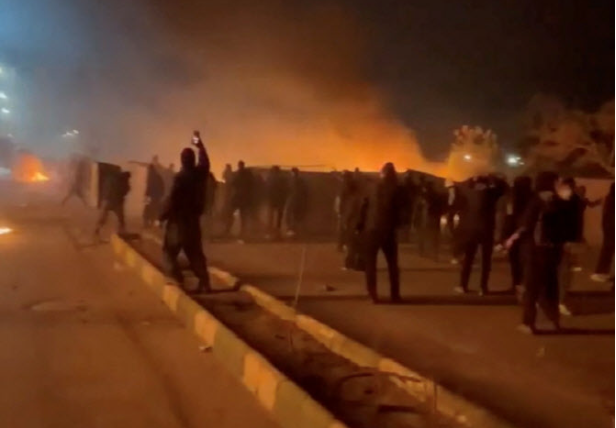
The protests, sparked by an economic crisis on the 28th of last month, spread nationwide within three days, moving beyond Tehran into large-scale anti-government demonstrations across the country. In the capital, protests expanded to eight universities, including the University of Tehran, as well as major markets, while simultaneous rallies erupted in cities such as Isfahan, Shiraz, Mashhad, and Yazd. CNN described the unrest as “the largest protests since the 2022 demonstrations that followed the death of Mahsa Amini, who died at age 22 after being detained by the morality police over her hijab,” adding that “what began as economic grievances erupted nationwide within days, releasing pent-up anger at the system all at once.”
Slogans and targets shifted quickly. Initial protests focused on livelihoods and surging exchange rates, but over time criticism extended beyond President Masoud Pezeshkian to Supreme Leader Ali Hossein Khamenei. Student and youth protesters spanning their teens to their 30s marched through the streets chanting “Death to the dictator,” signaling a shift from criticism of economic policy to a broader challenge to the governing system itself. The trajectory suggests the situation has moved beyond what can be contained through policy adjustments or short-term relief measures.
Accumulated shocks in the military and diplomatic arenas also contributed to the protests’ spread. After years of enduring stringent Western sanctions and economic blockades over its nuclear program, Iranians have felt the costs in declining living standards. The exposure of military limitations during clashes with Israel in June last year, followed by precise U.S. strikes that reportedly damaged nuclear facilities and security assets, was enough to undermine the regime’s long-cultivated image of a “strong Iran.” As external confrontations failed to demonstrate the expected defensive capabilities, the rationale for maintaining the system eroded more sharply.
This context explains why protesters’ demands expanded to foreign and security policy. According to Iran International, an opposition-leaning outlet, chants such as “Neither Gaza nor Lebanon—my life for Iran” emerged at campuses including Tehran’s Sharif University of Technology, reflecting calls to prioritize domestic livelihoods over support for groups such as Hamas and Hezbollah. President Pezeshkian said on social media platform X (formerly Twitter) that he was “planning measures to preserve citizens’ purchasing power” and had “instructed the interior minister to listen to protesters’ demands,” but prevailing sentiment holds that without near-term economic improvement, calming public anger will be difficult.
Absence of an alternative power center, de facto governance vacuum
Efforts to soothe public sentiment through limited measures that worked in the past have shown little effect this time, leading the international community to take a dim view of the regime’s durability. During the 2022 hijab protests, Iranian authorities managed the situation by adjusting enforcement intensity and loosening certain institutional practices. This time, however, the convergence of economic crisis, external conflict, and mass casualties has rendered such fine-tuning ineffective. Even as protests temporarily subside, measures such as lifting school closures or restoring internet access have not followed, leaving underlying political tensions unresolved.
Iranian authorities have sought to rally internal cohesion by blaming external forces for the unrest. Supreme Leader Khamenei claimed that “the United States, Israel, and foreign armed groups incited the protesters,” framing the bloodshed as the result of outside interference. He dismissed the protests’ legitimacy by saying they were driven by “ignorant and poorly informed agents led by malicious, trained forces,” an interpretation widely seen as an attempt to deny that the movement stems from economic hardship and systemic distrust.
U.S. President Donald Trump likened Khamenei to “a sick person” and criticized Iran’s violent suppression of protesters, saying it was “time to find new leadership.” He added that “a massive, powerful fleet is moving toward Iran just in case,” leaving open the possibility of military intervention. Subsequent reports showed the aircraft carrier USS Abraham Lincoln, U.S. destroyers, and fighter jets redeploying from the Asia-Pacific to the Middle East, while Washington said it was considering deploying additional air defense systems to the region. The moves suggest that the prospect of a power vacuum inside Iran is spilling over into an international security variable.
The central problem is the absence of a clear alternative power center even as the existing regime weakens. Opposition forces lack organizational cohesion and unified leadership, and no focal point has emerged within the religious establishment to replace the Khamenei system. The military, for its part, would face simultaneous international sanctions and domestic backlash if it moved to the political forefront. Some voices have called for the return of the Pahlavi monarchy ousted in the 1979 revolution, but the prevailing view internationally is that such a restoration is highly unlikely. Calls to revert to the past, critics argue, merely reflect the lack of a realistic alternative for what might follow the current system.
Niamh O’Sullivan is an Irish editor at The Economy, covering global policy and institutional reform. She studied sociology and European studies at Trinity College Dublin, and brings experience in translating academic and policy content for wider audiences. Her editorial work supports multilingual accessibility and contextual reporting.
Similar Post