Trump Accuses South Korea of Failing to Implement Agreement, Weighs Restoring 25% Reciprocal Tariffs

Authored On
Modified
South Korea–U.S. investment legislation cited as point of contention
Potential tariff nullification depending on U.S. court ruling
Move to secure “implementation-stage international agreement” logic
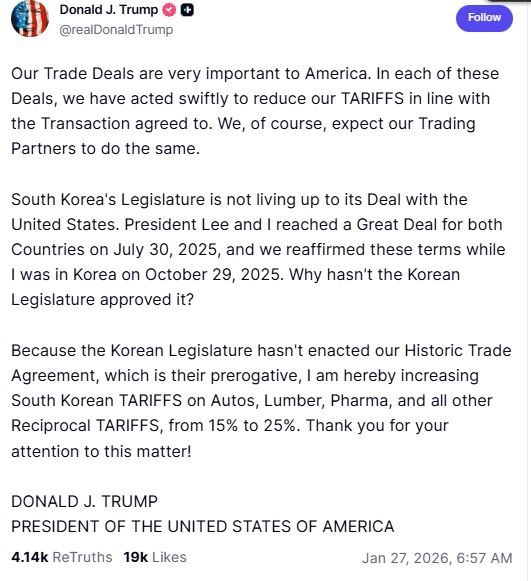
U.S. President Donald Trump has directly singled out South Korea, warning that reciprocal tariffs on key products, including automobiles, could be restored to 25%. The core of his remarks rests on the assertion that an agreement between the two countries’ leaders has already been concluded and reaffirmed, with responsibility for implementation lying on the South Korean side. The move appears designed not only to elevate implementation issues to the center of trade pressure, but also to unfold alongside domestic legal variables surrounding tariff policy in the United States. With a U.S. Supreme Court ruling pending, analysts see the remarks as an attempt to establish implementation failure as a given, separate from the legal fate of the tariffs themselves.
No formal executive order or gazette notice yet
On the 26th, Trump wrote on his social media platform Truth Social that “the South Korean legislature is not honoring the agreement with South Korea,” adding that he would therefore raise reciprocal tariffs on automobiles, lumber, pharmaceuticals, and all other affected goods from 15% back to 25%. He said that he had reached a “mutually beneficial agreement” with President Lee Jae-myung on July 30 last year and reaffirmed it during a visit to South Korea in October, but that the South Korean National Assembly had failed to approve it. Framing the tariff rollback as a matter of reciprocity, Trump placed responsibility squarely on the South Korean legislature.
The reference to parliamentary approval is widely interpreted as pointing to a proposed “Special Act on Strategic Investment Management Between South Korea and the United States,” intended to facilitate the implementation of outbound investment commitments. According to a joint fact sheet released by the two governments, South Korea pledged $350 billion in investment in the United States, while Washington agreed to reduce tariffs on South Korean automobiles. The package also included U.S. support or approval for South Korea’s uranium enrichment, spent nuclear fuel reprocessing, and the introduction of nuclear-powered submarines. The two sides signed a memorandum of understanding reflecting these terms on November 14 last year, after which the United States retroactively lowered tariffs on South Korean automobiles to 15%.
The sticking point has been the legislative process in South Korea. The special investment bill was introduced as a lawmaker-sponsored measure in late November last year, but has remained stalled for two months amid difficulties in deliberations at the National Assembly’s fiscal and economic planning committee. Political parties remain divided over whether parliamentary ratification is required. The ruling party has questioned whether an MOU necessitates ratification equivalent to a free trade agreement, while the opposition argues approval is mandatory. Trump has characterized this situation as a delay in implementing the agreement.
Even so, observers note that Washington likely anticipated that legislative procedures would take time, given that the United States itself often requires six months or more to secure congressional confirmation for appointments, not to mention technical delays caused by legislative calendars and partisan gridlock. As a result, Trump’s remarks are widely seen as a pressure tactic rather than an immediate policy shift. No formal executive order or publication in the Federal Register has followed, leaving the precise contours of any tariff increase unconfirmed.
Should higher tariffs materialize, the impact would extend across major export sectors. The automobile industry, which has previously absorbed the effects of higher tariffs, is particularly alert. During the period last year when a 25% U.S. tariff was in force, Hyundai Motor and Kia recorded combined losses of about $3.25 billion. While Hyundai plans to mitigate tariff exposure by expanding local production, including at its Georgia-based Metaplant America facility, analysts say offsetting the full impact of higher tariffs in the short term would be difficult. Concerns are also spreading to parts suppliers, raising broader industry anxiety.
Tariff policy tied to judicial review
A key variable is that the presidential authority underpinning reciprocal tariffs is itself awaiting judgment by the U.S. Supreme Court. The Court began final deliberations last April on the legality of country-specific reciprocal tariffs imposed by Trump under the International Emergency Economic Powers Act (IEEPA). The central issue is whether IEEPA grants the president authority not only to regulate imports, but also to impose tariffs by executive order. Trump argues that trade imbalances pose a serious threat to national security and the economy, justifying the use of IEEPA, while 12 U.S. states and corporate plaintiffs counter that tariff authority constitutionally resides with Congress and cannot be exercised under emergency powers.
Both the district and appellate courts ruled that Trump’s reciprocal tariffs were unlawful. In August last year, the U.S. Court of Appeals for the D.C. Circuit held that while IEEPA authorizes the president to “regulate” imports, it does not extend to imposing tariffs by executive order. The Trump administration responded that the ruling endangered ongoing overseas negotiations and threatened the framework of existing agreements, warning that if upheld it would undermine U.S. defenses and invite retaliatory trade measures by other countries. It promptly appealed to the Supreme Court.
The Supreme Court has repeatedly delayed its decision, prolonging uncertainty. Legal observers had expected rulings on the 9th or 14th of this month, but both sessions addressed unrelated cases. On the 20th, the Court issued decisions in three routine cases, again excluding the tariff dispute. As the Court does not announce ruling dates in advance, legal uncertainty surrounding tariff policy continues, imposing burdens on both tax authorities and taxpayers.
The Trump administration has openly discussed post-ruling scenarios. In an interview with The New York Times, U.S. Trade Representative Jamieson Greer said that if the Supreme Court invalidates reciprocal tariffs, Washington would “immediately move to introduce alternative tariffs,” adding that a range of options is available to address issues the president has identified. The comments suggest a “Plan B” using legal authorities other than IEEPA, indicating that trade pressure tools are being prepared in parallel even as the current policy remains under judicial review.
Prospect of longer-term strain on South Korea–U.S. trade order
Trump’s remarks pressing South Korea on agreement implementation also appear aimed at preparing for the post-ruling environment. This is evident in his repeated emphasis not on tariff rates themselves, but on the claim that an agreement has been reached and reaffirmed, yet remains unapproved on the South Korean side. In international trade practice, domestic legislative steps required for implementation often take time, but Trump has focused solely on the lack of approval, laying the groundwork for maintaining a noncompliance narrative. Analysts see this as an effort to preserve justification for future tariff adjustments or additional measures without regard to a partner country’s internal procedures.
This approach aligns with a broader trade strategy anticipating the Court’s decision. If reciprocal tariffs under IEEPA are ultimately ruled unlawful, existing measures would be difficult to sustain. However, framing bilateral commitments as already concluded and reaffirmed could allow the U.S. administration to reconstruct similar actions on alternative grounds. Repeated statements by Greer and other officials about introducing substitute tariffs even if current measures are invalidated underscore an intent to maintain trade pressure irrespective of judicial outcomes.
Experts warn that such pressure could impose medium- to long-term burdens on the South Korea–U.S. trade relationship. Chung In-kyo, a professor of international trade at Inha University, noted that even if tariffs are ruled unlawful, the process does not automatically result in refunds or immediate normalization. If the Trump administration reimposes tariffs using other legal authorities, he said, legal stability and predictability would be further undermined. Trump’s effort to treat implementation as a settled fact before a ruling, critics argue, risks deepening trade friction rather than managing uncertainty.
Similar Post