U.S. Carrier USS Abraham Lincoln Enters Middle Eastern Waters, Raising Pressure on Iran—What Is Washington Really Signaling

Authored On
Modified
Full-scale deployment of USS Abraham Lincoln, warning of tougher action against Iran
U.S. moves to fill force gaps while reinforcing political justification
Military pressure, sanctions, and information warfare converge as interpretations of U.S. intent diverge
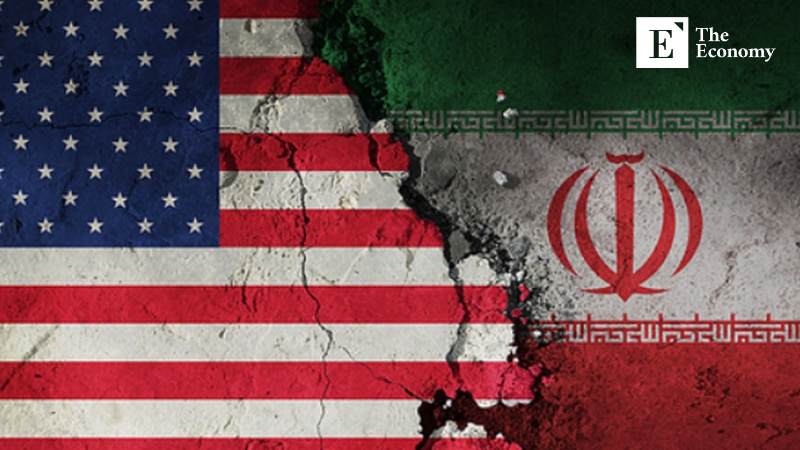
As the U.S. Navy’s Nimitz-class aircraft carrier USS Abraham Lincoln enters Middle Eastern waters, military pressure on Iran has intensified markedly. Against the backdrop of violent crackdowns inside Iran, Washington is expanding its operational options in the region while simultaneously elevating diplomatic pressure through the carrier’s deployment. Interpretations remain divided, however, over whether this move signals an intent extending as far as regime change in Tehran.
U.S. Carrier Strike Group Approaches Middle East, Iran Warns of All-Out War
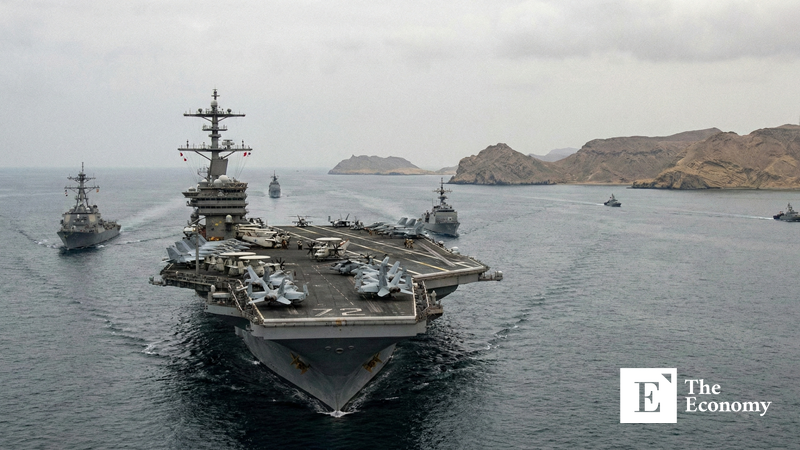
According to Reuters and other foreign media on the 26th (local time), a U.S. carrier strike group comprising the USS Abraham Lincoln and three destroyers has entered Middle Eastern waters under the jurisdiction of U.S. Central Command (CENTCOM), formalizing a significant escalation in military pressure. The deployment follows President Donald Trump’s announcement on Air Force One on the 22nd that a naval force would be dispatched, now translated into action. The Lincoln is equipped with advanced carrier-based aircraft, including F-35C stealth fighters and F/A-18 Super Hornets, placing it in immediate readiness for precision strike operations. As the strike group moves into its operational area, it is expected to integrate with littoral combat ships and destroyers already deployed around Bahrain and the Persian Gulf, further strengthening the interoperability of U.S. naval forces in the region. Bloomberg reported that the deployment has “added weight to speculation that President Trump’s warnings directed at Iran’s top leadership could translate into actual military action.”
Washington has cited Iran’s internal bloodshed as the immediate catalyst for the escalation. Protests triggered by economic hardship, including inflation and drought, spread nationwide into an anti-government movement after erupting on the 28th of last month. Iranian authorities responded on the 8th of this month by shutting down communications networks and launching a forceful crackdown. The White House has raised concerns over the potential mass execution of more than 800 protesters. Tehran has categorically denied the allegations, but Washington has treated the situation as an urgent threat warranting military measures. Time magazine, citing an Iranian Health Ministry official, estimated that as many as 30,000 people may have been killed. Volker Türk, the United Nations High Commissioner for Human Rights, stated that thousands, including children, had lost their lives and urged an immediate halt to the violent repression.
Facing what it perceives as an existential threat to regime survival, Iran has responded with fierce rhetoric, vowing not to rule out all-out war. Amid speculation that Supreme Leader Ayatollah Ali Khamenei has retreated to a fortified underground shelter, one of his close aides told Reuters that “any form of attack will be regarded as a declaration of full-scale war against us, and we will respond in the strongest possible manner.” This tone contrasts sharply with the restraint shown during last June’s Iran–Israel conflict, known as the “12-Day War,” when both sides avoided escalation after sharing information and preserving political justification. This time, the Iranian leadership appears prepared to pursue comprehensive military retaliation, reflecting a perception that it has little room left to retreat.
Filling Capability Gaps and Raising Pressure, the Expansion of a ‘War of Justification’
The Center for Strategic and International Studies (CSIS), a U.S. think tank, has assessed that Washington’s military pressure signals both a willingness to keep all options—including strikes—on the table and a sophisticated coercive strategy aimed at maximizing negotiating leverage. This assessment stems in part from the fact that the deployment addresses a prolonged capability vacuum in the Middle East since October of last year. The USS Gerald R. Ford returned to the Caribbean, while the USS Nimitz redeployed to the U.S. West Coast, creating gaps that had constrained the Trump administration’s military options vis-à-vis Iran. Politico reported that the relocation of forces and vessels under President Trump’s command had left Washington with fewer choices than a year earlier, a view echoed by the Guardian, which pointed to tangible operational constraints. In this context, the Lincoln’s arrival represents more than a routine reinforcement; it restores previously limited operational capacity and materially expands the range of executable military options.
Operational realities on the ground have also driven the decision to deploy a carrier strike group. Large-scale U.S. operations would require cooperation from bases in Qatar, Bahrain, and the United Arab Emirates, yet the risk of Iranian retaliation places significant strain on those host countries. Despite having suffered substantial degradation of its air defenses during the earlier “12-Day War,” Iran still maintains roughly 2,000 ballistic missiles concentrated in mountainous terrain and retains close ties with regional proxy forces such as Hezbollah and the Houthi movement. These capabilities constitute asymmetric threats that could directly target allied states hosting U.S. forces. By deploying a carrier strike group, Washington reduces its reliance on land bases, secures independent maritime strike and air-defense options, and seeks to alleviate allied concerns over exposure to Iranian reprisals.
With physical capabilities reinforced, President Trump is now intensifying efforts to secure political justification and conduct psychological operations. Iran, as a United Nations member state and a pivotal Middle Eastern actor, presents legal and diplomatic challenges for military intervention on the grounds of internal repression or human rights abuses alone. Conscious of this, Trump has broadened the narrative, invoking both the violent suppression of protests and the risk of renewed nuclear development, reframing potential military action from a narrow response to a nuclear agreement breach into a comprehensive security imperative encompassing human rights protection and nonproliferation. Reuters reported on the 14th that the U.S. military had advised some personnel at its Qatar base to withdraw, a move reminiscent of troop evacuations conducted just before strikes on Iranian nuclear facilities last June. Jang Ji-hyang, director of the Middle East Center at the Asan Institute for Policy Studies, observed that “President Trump, since beginning his second term, has accumulated successful experiences ranging from strikes on Iran to pressure on Europe and operations in Venezuela,” adding that “given his skill in propaganda, the possibility remains that he could employ a diversionary deception strategy—drawing attention elsewhere before striking at a vulnerability—as he approaches a potential attack on Iran.”
Escalating Pressure on All Fronts, Toward a Regime Change Debate
Amid these developments, a growing number of foreign policy and security experts argue that Washington’s ultimate objective extends beyond deterring Iranian military provocations. The U.S. Congressional Research Service (CRS), in a recent report, outlined a range of options Congress could consider, including authorizing military action, revisiting the nuclear agreement, and supporting internet access inside Iran. Such measures suggest a phased pressure campaign designed to narrow Tehran’s choices by leveraging military tension alongside diplomatic and institutional tools to induce systemic change. Many in the international community interpret these moves as effectively targeting regime change in Iran. At the United Nations Security Council, Russia’s representative accused the United States of planning airstrikes with regime change in mind, while Tehran has countered that Western intelligence agencies, led by Washington, are orchestrating the anti-government protests.
From a geopolitical standpoint, the establishment of a pro-U.S. government in Iran would represent a central strategic lever against China. China currently relies on Iran and Venezuela for roughly 30–35% of its crude oil imports, a figure that approaches 70% when combined with supplies from U.S.-aligned producers such as Saudi Arabia. Should pro-U.S. governments emerge in both Iran and Venezuela, the Trump administration would gain powerful leverage over China’s energy security. This would extend beyond supply volumes to the dismantling of China’s yuan-denominated oil settlement system, known as the petro-yuan, and the reinforcement of dollar dominance through a renewed petro-dollar framework.
In line with this broader strategy, U.S. pressure appears poised to expand from the military sphere into the economic domain. President Trump has previously warned that countries trading with Iran could face tariffs of up to 25%, signaling the potential activation of secondary boycotts. Reuters noted that such measures would primarily target Iran’s key trading partners, including China, India, and Türkiye, raising the prospect that sanctions against Tehran could spill over into wider global trade conflicts. This approach would simultaneously constrict Iran’s financial lifelines to curb nuclear development and serve as a multifaceted move to counter the expanding influence of China and Russia through Iran.
Similar Post