China’s Auto Export Pivot Accelerates, Expanding Beyond EVs to Gasoline Models Worldwide

Siobhán Delaney is a Dublin-based writer for The Economy, focusing on culture, education, and international affairs. With a background in media and communication from University College Dublin, she contributes to cross-regional coverage and translation-based commentary. Her work emphasizes clarity and balance, especially in contexts shaped by cultural difference and policy translation.
Authored On
Modified
Seeking overseas breakthroughs amid domestic slowdown
Canada, EU, UK tariff easing on Chinese EVs adds momentum
Local production and supply-chain partnerships deepen global influence
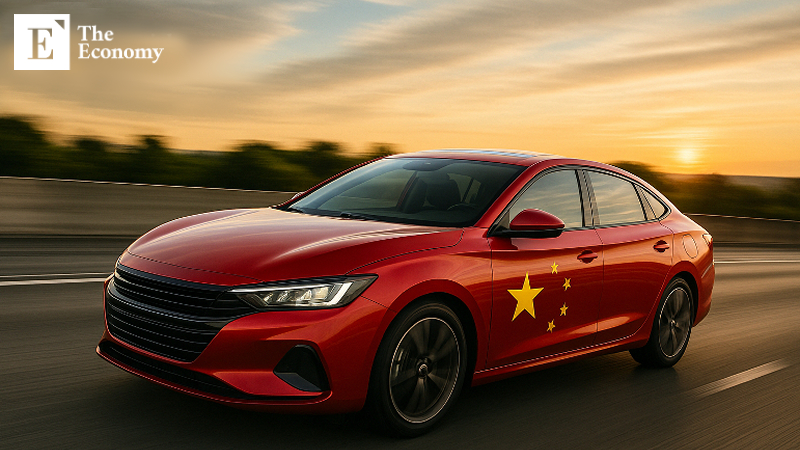
China’s automobile industry, grappling with sluggish domestic demand and intensifying competition at home, is increasingly turning to overseas markets to accelerate its global expansion. Exports now extend beyond new energy vehicles led by electric cars to include gasoline-powered models that have lost ground in the domestic market, broadening the industry’s external footprint. Export destinations are also diversifying away from a traditional focus on Russia, Mexico, and the Middle East toward North America, Europe, and Southeast Asia, alongside simultaneous expansion of exports, local production, and supply-chain cooperation.
Rising Export Share Across All New Energy Vehicle Segments
According to the China Passenger Car Association (CPCA), China exported 8.32 million vehicles last year, a 30% increase from the previous year. Of this total, new energy vehicles—including electric cars—surged 70% year on year to 3.43 million units, underscoring robust growth momentum. By destination, Mexico ranked first with 625,187 units, followed by Russia with 582,738 units and the United Arab Emirates with 571,937 units. The United Kingdom (335,551 units), Brazil (322,076), Saudi Arabia (302,189), Belgium (300,103), Australia (297,382), the Philippines (256,681), and Kazakhstan (211,545) rounded out the top ten.
New energy vehicles expanded their export share across all categories, driving overall export growth. Electric vehicles accounted for 28% of exports, up two percentage points from a year earlier, while plug-in hybrids rose eight percentage points to 13%, and hybrids increased two percentage points to 6%. Gasoline vehicles, by contrast, fell 11 percentage points to 43%. Belgium emerged as the largest importer of Chinese new energy vehicles with 284,921 units, followed by the United Kingdom (231,181), Mexico (221,027), Brazil (200,825), and the Philippines (200,544). Thailand, Australia, Indonesia, and India also entered the top ten, reflecting rapidly expanding EV demand in emerging markets.
CPCA projects that China’s auto exports will grow by 20% this year, driven by BYD’s expansion, with export markets extending beyond Mexico, the Middle East, and Russia to North America, Europe, and major Asian economies. UBS, the European financial group, offered a similar outlook, forecasting a 25% year-on-year increase in exports. By segment, gasoline vehicle exports are expected to grow just 4%, while electric vehicle exports are projected to surge more than 50%, leading overall growth. Total exports are expected to approach 10 million units by 2030, nearly double the 2024 level.
Australian Market Share Expands Tenfold in Six Years
Global automakers increasingly view the sharp rise in Chinese vehicle exports as an “exit strategy” to absorb excess production capacity accumulated in China. A steep contraction in domestic demand has intensified competition among automakers, and China’s decision to scale back EV subsidies and tax incentives from this year is expected to further heighten competition in an already saturated market. In response, Chinese manufacturers are rapidly expanding production bases and sales networks overseas, focusing on major markets outside the United States. BYD, Great Wall Motor, Chery Automobile, SAIC Motor, GAC Group, and Geely Automobile—the so-called “Big Seven” Chinese automakers—now collectively operate 31 overseas production facilities.
Canada has emerged as a new market in the global EV landscape, where China maintains the largest market share. On the 19th, the Canadian government announced that up to 49,000 Chinese-made vehicles annually would be subject to a most-favored-nation tariff rate of 6.1%. Prime Minister Mark Carney said this quota could rise to as many as 70,000 units within five years. Tesla is widely seen as the biggest beneficiary, having established China-based production tailored to Canadian specifications. Since retooling its Shanghai plant in 2023 to produce Canada-bound models, Tesla has exported Model Y vehicles to Canada, driving a 460% year-on-year jump in Chinese-made vehicle imports through Vancouver—the country’s largest port—to 44,356 units.
Chinese automakers are also rapidly gaining ground in Australia. Their market share climbed from 1.7% in 2019 to 17% in 2025, a tenfold increase. Supply disruptions and market restructuring around the COVID-19 pandemic allowed Chinese brands to capitalize on price competitiveness and rapid delivery. Their dominance is particularly pronounced in the EV segment: 77% of EVs sold in Australia last year were made in China, including China-produced models from global brands such as Tesla. Chinese brands alone accounted for 41% of the EV market, offering more than 30 models across 22 brands. In the plug-in hybrid segment, BYD led decisively with a 68% market share.
As China’s domestic market pivots toward EVs and plug-in hybrids, gasoline vehicles that have lost ground at home are also being redirected overseas, as manufacturers push out remaining inventory and utilize idle capacity through export drives. Notably, the export push is being led by traditional state-owned automakers such as SAIC, Chery, and Changan—companies that once anchored China’s domestic market through joint ventures with Volkswagen, GM, and other global players. Chery’s growth stands out: its global sales rose from 730,000 units in 2020 to 2.6 million units in 2024, with gasoline models accounting for 80%. These vehicles are targeting so-called secondary markets—Eastern Europe, Latin America, Africa, and Southeast Asia—where charging infrastructure remains limited, rapidly displacing European and U.S. brands.
Replacing Japanese Automakers in Southeast Asia
Regulatory easing for Chinese vehicles is also emerging in Europe. According to the Financial Times, the UK government is in talks with China over allowing Chery to use one of Jaguar Land Rover’s UK plants as a production base. Details are expected to be discussed during the upcoming summit between UK Prime Minister Keir Starmer and Chinese President Xi Jinping. Earlier, the European Union scrapped tariffs of up to 35.3% on Chinese EVs and replaced them with a minimum price mechanism, effectively loosening import restrictions that had been a core trade dispute.
Supply-chain collaboration with European automakers is also expanding. Geely’s integration with Volvo and Polestar—sharing key components and processes—has unified production systems and reduced development costs through its SEA architecture platform. Cooperation with Renault further illustrates Geely’s strategy: by sharing components, platforms, and development processes, the companies have accelerated global market entry. The recently unveiled Renault Twingo EV, built using Chinese supply chains, significantly shortened development time and reduced costs.
In Southeast Asia—long dominated by Japanese automakers—Chinese brands are rapidly gaining ground on price competitiveness. Across six ASEAN markets—Indonesia, Malaysia, Thailand, the Philippines, Vietnam, and Singapore—Japanese automakers’ market share fell from an average of 77% in the 2010s to 62% last year, while China’s share rose to 5%. In Indonesia, the region’s largest market, Chinese vehicle sales continued to grow even as overall demand softened. With BYD and other Chinese manufacturers moving into local production, their price advantage is expected to strengthen further.
Siobhán Delaney is a Dublin-based writer for The Economy, focusing on culture, education, and international affairs. With a background in media and communication from University College Dublin, she contributes to cross-regional coverage and translation-based commentary. Her work emphasizes clarity and balance, especially in contexts shaped by cultural difference and policy translation.
Similar Post