Fed Chair Succession Race Narrows to “Rieder vs. Warsh,” With Private-Sector Card Gaining the Edge

Authored On
Modified
Internal Fed candidates lose momentum
Rate views and policy outlook shaped by experience
Limited rate-cut outlook tied to the Kevin Warsh option
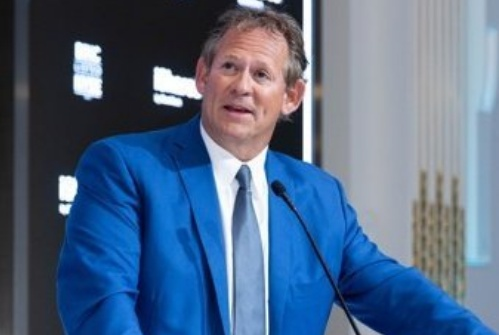
Market attention around the selection of the next chair of the U.S. Federal Reserve (Fed) is rapidly crystallizing, led by movements in prediction markets. On betting platforms, market veteran Rick Rieder has emerged as the frontrunner, reshaping a field that had centered on internal Fed officials. As the decision point approaches, the interplay between his past remarks and market-implied probabilities has fueled assessments that the race has entered a consolidation phase. At the same time, the presence of Kevin Warsh—who served as a Fed governor during a crisis period—continues to carry meaningful weight, adding another focal point to the evolving selection dynamics.
Nomination probability approaches one-half
As of the 27th (local time), prediction-market platform Kalshi showed Rick Rieder, Chief Investment Officer for Global Fixed Income at BlackRock, with a nearly 48% probability of being nominated as the next Fed chair. The figure has surged within weeks from single-digit levels earlier this month. By contrast, Kevin Warsh, long cited as another leading contender, slipped to 31%, while current Fed Governor Christopher Waller stood at 8% and White House National Economic Council Director Kevin Hassett at 6%.
The sharp rise in Rieder’s odds accelerated alongside evaluative comments from U.S. President Donald Trump. At a White House event on the 17th, Trump described Rieder as “very impressive,” after which betting-market curves climbed steeply. Trump later told reporters that the choice for the next Fed chair was “almost down to one person,” signaling a narrowing field. While he did not name a specific individual, probability shifts ultimately favored the private-sector option.
Markets interpreted the sidelining of internal Fed candidates as reflecting calculations around political trust and policy distance. Trump has previously voiced public dissatisfaction with Fed Chair Jerome Powell, whom he personally appointed, remarking that “they change once they sit in the chair.” While those comments were widely read as complaints about a loss of White House control, Wall Street drew a different inference: that the frustration could paradoxically translate into greater autonomy for the next chair’s policy judgments.
Concerns surrounding the confirmation process and the Fed’s independence also pushed market attention toward a private-sector figure. Investigative issues involving Powell injected uncertainty into Senate confirmation dynamics, elevating political distance as a key evaluative variable. Against that backdrop, candidates with careers rooted in global financial and bond markets were viewed as a step removed from partisan interests. Rieder’s rapid ascent suggests that this perception has begun to translate from abstract speculation into a tangible selection prospect.
Arguing for rate cuts to support the recovery
Rieder is a non-bureaucratic figure who did not rise through the Fed, academia, or the Treasury. He began his career at Lehman Brothers, where he spent more than two decades focused on bonds and interest rates, building a market-centered résumé. He later founded and ran R3 Capital Partners, which was acquired by BlackRock in the wake of the 2009 global financial crisis, bringing him into the firm. This path, distinct from central-bank promotion tracks, has underpinned assessments that he “has felt the real-world impact of rate policy firsthand.”
That assessment lends a rationale to his views on interest rates and the policy environment. In an interview with Bloomberg last year, Rieder said the U.S. housing market was effectively “stuck,” emphasizing how rate levels transmit household burdens through transactions, supply, and borrowing costs. He framed housing as a primary real-economy transmission channel for fixed-income markets, arguing that policy shocks surface there first when rate conditions shift.
In an investor note earlier that August, Rieder wrote that the case for rate cuts was “repeatedly confirmed” by Labor Department employment reports, adding that the debate should move from whether to cut rates to how large the cuts should be. If monthly job gains continued to fall below 100,000, he said, the Fed would have little alternative to easing. These remarks gained traction for tying policy constraints to cumulative trends and distributions in medium-term economic data.
Later, in posts shared on social media platform X toward the end of last year, Rieder argued that aggregate U.S. growth indicators fail to fully capture household financial realities, pointing out that the top 10% of income earners spend more than the combined consumption of the bottom 40%. While acknowledging that growth increasingly depends on high-income consumers and investment, he criticized restrictive Fed rates for placing strain on large segments of the population and economy, concluding that rate cuts are essential to restoring social balance and broad-based economic resilience.
Warsh emphasizes institutional continuity
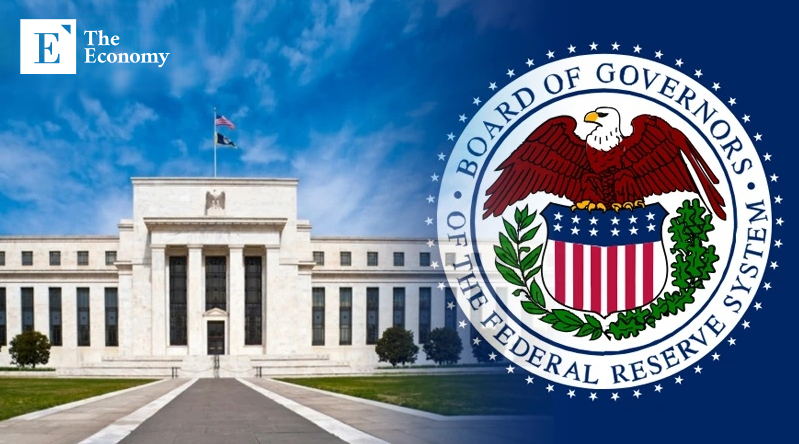
Despite Rieder’s rise, markets continue to assign a meaningful probability to Kevin Warsh’s return to the Fed. Warsh served as a Fed governor from 2006 to 2011, a period that largely overlapped with the global financial crisis and the launch of quantitative easing. During that time, the Fed cut rates to near zero and embarked on large-scale asset purchases, with Warsh present at the policy table as markets stabilized and longer-term side effects emerged. After leaving the Fed, he joined UPS and now serves on the board of Coupang Inc., a background that has reinforced his reputation as someone who values crisis experience and institutional continuity.
Kevin Warsh’s views on monetary policy have been relatively consistent across his past remarks. He has repeatedly said that “the Fed should not be the star of the news” and that “a central bank should be boring and predictable.” These statements rest on the premise that monetary policy functions as an institutional commitment designed to sustain market confidence. Warsh has also argued that “inflation is better understood as the result of policy choices than of external shocks or temporary factors,” adding that “central banks should not amplify uncertainty through excessive intervention.” Taken together, this perspective reflects an approach that places policy credibility and predictability at the top of the priority list.
That orientation is reflected in rate-path expectations. In a CNBC survey of Wall Street economists, most respondents said that if Warsh were nominated as Fed chair, rate cuts this year would likely total 50 basis points, delivered in two 25-basis-point steps. The federal funds rate (FRR) would be lowered to around 3% and held there through the end of next year. Those projections stand well above the roughly 1% level publicly urged by Trump.
The expectation of limited easing is grounded in relatively resilient macro indicators. According to the CNBC survey, U.S. GDP growth this year is projected at 2.4%, slightly above what the Fed typically views as potential growth. At the same time, consumer price inflation is forecast to ease to 2.7% by year-end and 2.5% in 2027, trending toward target over the medium term. Unemployment is also expected to rise modestly to 4.5% by year-end before edging lower next year. In such an environment, options that emphasize maintaining policy credibility over aggressive rate cuts gain traction.
Similar Post