U.S. Cuts India Tariffs From 50% to 18% in Deal Tied to Halt of Russian Crude Imports

Oliver Griffin is a policy and tech reporter at The Economy, focusing on the intersection of artificial intelligence, government regulation, and macroeconomic strategy. Based in Dublin, Oliver has reported extensively on European Union policy shifts and their ripple effects across global markets. Prior to joining The Economy, he covered technology policy for an international think tank, producing research cited by major institutions, including the OECD and IMF. Oliver studied political economy at Trinity College Dublin and later completed a master’s in data journalism at Columbia University. His reporting blends field interviews with rigorous statistical analysis, offering readers a nuanced understanding of how policy decisions shape industries and everyday lives. Beyond his newsroom work, Oliver contributes op-eds on ethics in AI and has been a guest commentator on BBC World and CNBC Europe.
Authored On
Modified
Tariffs Slashed to 18% as India Agrees to Suspend Russian Oil Purchases
U.S. Pressure Forces Shift in India’s Neutral Stance, Russia’s Position Shaken
High Replacement Costs and Infrastructure Constraints Cast Doubt on Execution
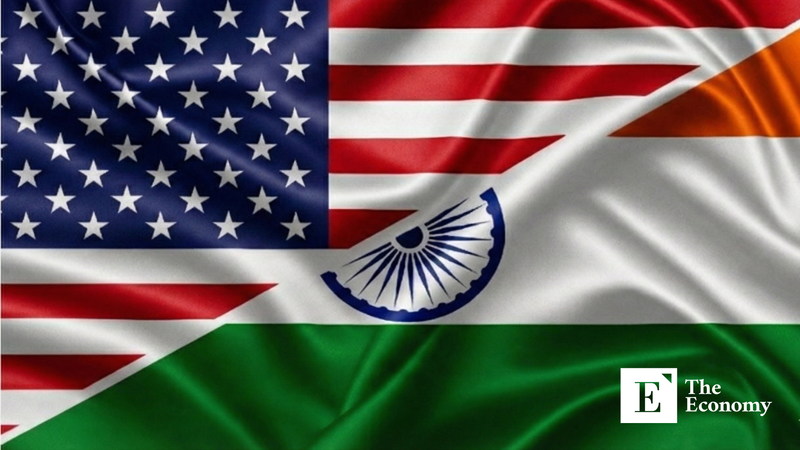
The United States has agreed to sharply cut tariffs on Indian goods from as high as 50% to 18% in exchange for India’s commitment to halt imports of Russian crude oil and to purchase up to 500 billion dollars’ worth of U.S. products going forward. The sweeping agreement marks a strategic realignment, with India—long committed to a non-aligned foreign policy—revising its stance under mounting economic pressure from the Trump administration and aligning more closely with Washington’s energy security agenda. For the United States, the deal tightens the squeeze on Russia’s war financing while reinforcing U.S. dominance in global energy markets. Markets, however, remain cautious, citing the high cost of replacing discounted Russian crude and the ambitious scale of the purchase commitment as potential sources of friction during implementation.
Trump Tariff Pressure Breaks India’s Neutrality, U.S.–India Mega Deal Sealed
On the 2nd, President Donald Trump announced via his social media platform Truth Social that he had spoken with Indian Prime Minister Narendra Modi and agreed to slash reciprocal tariffs imposed on India from 50% to 18%. The reduction grants India a more favorable export environment than competitors such as Pakistan at 19% and Vietnam and Bangladesh at 20%. The move contrasts sharply with Trump’s recent warning that tariffs on automobiles could be raised to 25% over delays in South Korea’s passage of a U.S. investment-related bill. While formal White House documentation has yet to be released, the agreement is widely expected to ease bilateral frictions.
India’s decision to recalibrate its long-standing non-aligned diplomacy reflects sustained economic pressure from Washington. Despite being a core partner in the Quad security framework aimed at countering China, India had faced cumulative tariffs of 50%—a base rate of 25% plus an additional 25% in punitive measures—over its continued purchases of Russian crude. U.S. senators had even floated legislation proposing tariffs of up to 500% on buyers of Russian oil, prompting criticism that excessive pressure on a key strategic partner could prove counterproductive.
In return for the tariff relief, President Trump stated that Prime Minister Modi agreed to halt Russian crude purchases and replace them with U.S. oil, potentially supplemented by Venezuelan supplies. Trump framed the move as a direct blow to Russia’s war financing and a contribution to ending the conflict in Ukraine. Modi welcomed the tariff cut on X, though he refrained from explicitly addressing the sensitive issue of suspending Russian oil imports.
India Wavers Under 50% Tariff Wall, Russian Finances at Risk
Analysts view the agreement as evidence that the threat of sustained 50% tariffs and additional sanctions left India little room to maneuver. Ajay Srivastava, founder of the Global Trade Research Initiative, argued that India’s refinery sector could no longer sustain its “strategic gray zone” approach to Russian oil without exacerbating economic vulnerabilities.
The policy shift also intersects with domestic political considerations. According to the Institute of International Education, more than 360,000 Indian students were studying in the United States during the 2024–2025 academic year. Any deterioration in bilateral relations that spilled over into student visas or employment opportunities would pose a direct risk to the Modi government’s middle-class and elite support base.
The Korea Institute for International Economic Policy assessed that while India initially sought to offset tariff shocks through domestic demand, the deep integration of its IT and services elites with the U.S. market made a strategic pivot unavoidable. With the Trump administration also signaling an additional 25% tariff on countries trading with Iran, India moved to avoid being grouped with anti-U.S. blocs while securing tangible economic gains.
A halt in Indian purchases of Russian crude would deal a significant blow to Moscow’s finances. China and India together account for roughly 80% of Russia’s oil exports, and India’s withdrawal—previously importing around 1.5 million barrels per day—would accelerate the erosion of oil and gas revenues that comprise about a quarter of Russia’s federal budget. The timing is notable, coming just a week after the European Union and India finalized a free trade agreement. Arvind Subramanian noted that Washington likely moved quickly to prevent U.S. firms from being disadvantaged by preferential EU access to the Indian market, blending economic competition with security objectives.
The backdrop has also shifted in Washington’s favor. With global oil supplies expanding and prices falling to around 60 dollars per barrel—roughly 20 dollars lower than average levels during the Biden administration—the risk of inflationary fallout from tougher energy sanctions has diminished. The International Energy Agency projects global oil supply growth of 2.5 million barrels per day in 2026, well above demand, enabling the United States to pursue aggressive measures against Russian energy exports without destabilizing prices.
Experts argue that such economic pressure may prove more effective and less risky than military escalation. At the same time, the United States secures India as a stable export destination for its record production of roughly 13.2 million barrels per day, further consolidating its global energy influence. Trump has repeatedly emphasized that India’s pledge to purchase more than 500 billion dollars in U.S. energy and technology products will deliver substantial benefits to the U.S. economy and trade balance.
Barriers to Halting Russian Oil, Questions Over the 500 Billion Dollar Target
Despite the headline agreement, skepticism over execution remains widespread. CNN reported that a complete and immediate cessation of Russian oil imports by India appears unlikely. Data from energy analytics firm Kpler show that India has continued importing about 1.5 million barrels per day of Russian crude, accounting for more than one-third of its total oil imports. Kpler estimates that India saved roughly 12.6 billion dollars by purchasing Russian crude at discounts of about 16 dollars per barrel, underscoring the cost pressures of a rapid shift to alternative suppliers.
Doubts also surround the feasibility of the 500 billion dollar purchase commitment. U.S. Commerce Department data indicate that American exports to India totaled just 42 billion dollars last year. Pratik Dattani, founder of Indian think tank Bridge India, argued that reaching Trump’s stated target would be unrealistic given current trade volumes. Nicolas Köhler-Suzuki of the Jacques Delors Institute similarly questioned whether India would significantly lower tariffs on politically sensitive agricultural products, suggesting that extensive follow-up negotiations will be required for the deal to translate into concrete policy.
Reuters noted that Indian refiners face contractual and technical constraints, including long-term supply agreements with Russia and refinery configurations optimized for Russian crude grades, making an abrupt transition impractical. Logistics costs and refining margins further complicate the competitiveness of U.S. oil. While India’s reliance on Russian crude is expected to diminish over time, analysts agree that the ultimate success of the agreement will hinge on whether U.S. and Venezuelan oil can meet market requirements on price and quality as implementation unfolds.
Oliver Griffin is a policy and tech reporter at The Economy, focusing on the intersection of artificial intelligence, government regulation, and macroeconomic strategy. Based in Dublin, Oliver has reported extensively on European Union policy shifts and their ripple effects across global markets. Prior to joining The Economy, he covered technology policy for an international think tank, producing research cited by major institutions, including the OECD and IMF. Oliver studied political economy at Trinity College Dublin and later completed a master’s in data journalism at Columbia University. His reporting blends field interviews with rigorous statistical analysis, offering readers a nuanced understanding of how policy decisions shape industries and everyday lives. Beyond his newsroom work, Oliver contributes op-eds on ethics in AI and has been a guest commentator on BBC World and CNBC Europe.
Similar Post