Crude Tanker Rates Surge Amid U.S.–Iran Tensions, While Container Freight Slides on China’s Deflation Risk

As one of the youngest members of the team, Tyler Hansbrough is a rising star in financial journalism. His fresh perspective and analytical approach bring a modern edge to business reporting. Whether he’s covering stock market trends or dissecting corporate earnings, his sharp insights resonate with the new generation of investors.
Authored On
Modified
Rising Middle East Tensions Driven by U.S.–Iran Conflict Send Crude Shipping Rates Soaring
Stalled Bilateral Talks Leave Scope for Military Confrontation Intact
China’s Economic Slowdown Deals a Direct Blow, Pushing Container Freight Rates Lower Across All Routes
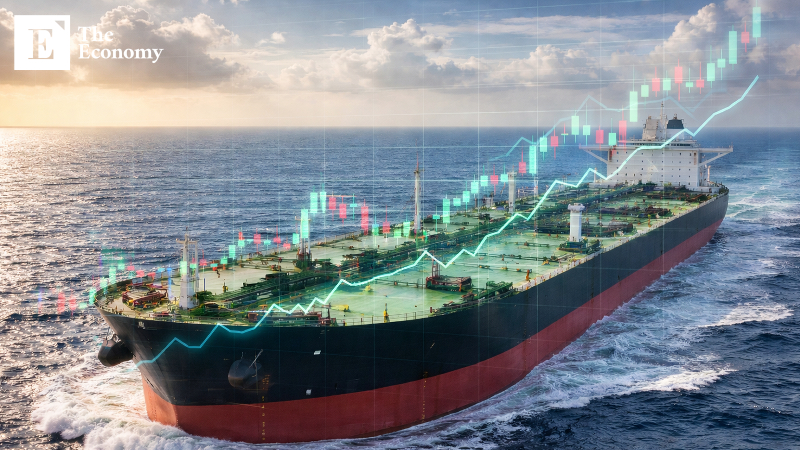
Crude oil maritime freight rates have turned highly volatile. As the administration of U.S. President Donald Trump intensifies pressure on Iran, citing anti-government protests and other issues, geopolitical risk across the Middle East has escalated. With the possibility of military confrontation between the two countries becoming increasingly pronounced in recent weeks, transportation costs—including war-risk insurance premiums—have surged. In contrast, container shipping rates are showing a clear downward trajectory, weighed down by China’s economic slowdown.
Crude Oil Shipping Costs on an Upward Curve
According to a report by Bloomberg on the 3rd, citing data from the Baltic Exchange in the United Kingdom, daily freight rates for very large crude carriers (VLCCs) transporting oil from the Middle East to China surged to as high as $129,000 as of the 2nd. This marked a 5.1% increase from the previous day and the highest level since November 2025.
The primary driver behind the spike in VLCC rates is the escalating confrontation between the United States and Iran, the third-largest crude oil producer within the Organization of the Petroleum Exporting Countries as of 2025. President Trump has for weeks warned the Iranian regime to halt the mass killings of civilians participating in anti-government protests, while publicly signaling that “help is on the way” to the Iranian people suffering under violent crackdowns—moves widely seen as building justification for potential military intervention. Official Iranian figures put protest-related deaths at more than 3,000, while human rights groups such as the Human Rights Activists News Agency estimate the true toll exceeds 17,000.
On the 28th of last month, President Trump posted on his social media platform Truth Social that “a massive fleet led by the great aircraft carrier Abraham Lincoln is heading toward Iran,” adding that it was “far larger than what was sent to Venezuela.” He further warned that, as in the Venezuela case, the fleet was “ready, determined, and fully capable of swiftly and decisively employing overwhelming force to complete its mission if necessary,” while urging Iran to return promptly to the negotiating table to strike a “fair and equitable deal beneficial to all.”
Military Tensions Between the Two Sides Intensify
Following these remarks, a series of unusual U.S. military movements were detected across the Middle East. The nuclear-powered aircraft carrier strike group centered on the USS Abraham Lincoln, previously deployed in the Indo-Pacific region, altered course and entered the Gulf. The carrier strike group reportedly operates around 70 aircraft, including F-35C stealth fighters designed to penetrate enemy radar systems, and is accompanied by three destroyers equipped with Tomahawk cruise missiles, as well as a nuclear-powered submarine.
A buildup of air power has also become increasingly evident. According to the BBC and other outlets, squadrons of U.S. F-15 fighter jets and aerial refueling tankers arrived in the Middle East last week. In airspace near Iran, activity by early-warning and reconnaissance assets—including P-8 Poseidon maritime patrol aircraft, RC-135 signals intelligence planes, and E-11A and E-3G airborne command and control platforms—has surged. Satellite imagery has also confirmed expanded air defense systems and new construction at the perimeter of Al Udeid Air Base in Qatar, where roughly 10,000 U.S. troops are stationed.
Although President Trump suggested on the 1st that the situation could de-escalate by stating that the United States was “engaged in serious talks with Iran,” the fragile diplomatic effort has already shown signs of strain before formal negotiations even began. Iran abruptly demanded changes to the venue and agenda of the talks and reportedly provoked U.S. forces with drone activity. While Washington has indicated it will proceed with the talks as scheduled, it has warned that military options remain on the table if negotiations collapse. In effect, the risk of military confrontation has yet to be removed. As a result, shipowners remain on heightened alert, and elevated maritime transport costs and war-risk insurance premiums show little sign of easing.
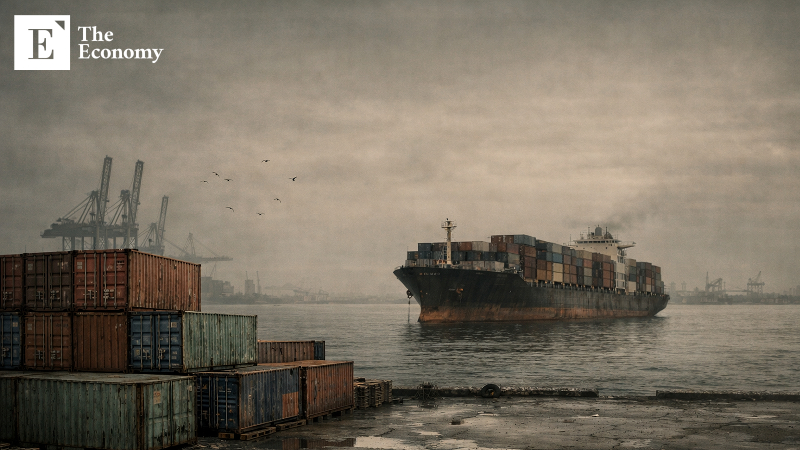
Container Shipping Market Sinks Alongside China’s Economy
While crude oil shipping rates have surged on geopolitical risk, the container shipping market is facing strong headwinds. According to the Korea Ocean Business Corporation, the Shanghai Containerized Freight Index stood at 1,316.75 points as of the 3rd, down 9.7% from the previous week, marking the fourth consecutive weekly decline. Freight rates fell across all major routes, including the U.S. East Coast, Europe, the Mediterranean, and the Middle East, with declines hovering around double-digit percentages. Even the traditionally strong seasonal boost from China’s Lunar New Year has effectively vanished.
The weakening of container demand is largely attributed to China’s economic slowdown. The Chinese economy remains weighed down by deflationary pressure stemming from a prolonged property market downturn. Nearly four years after the construction slump began in earnest, unsold or vacant housing units still number close to 80 million. Excess inventory has exerted downward pressure across the housing market—dragging down prices, transaction volumes, new starts, and completions—and has dealt a direct blow to consumer sentiment. As housing prices corrected sharply, consumers curtailed spending amid a negative wealth effect driven by falling asset values.
Consumers have increasingly focused on cutting expenditures and hoarding cash, while companies have turned to workforce reductions and price cuts to stay afloat. This process has led to declines in imports of raw materials, intermediate goods, and consumer products, reduced factory utilization rates, and falling export volumes—conditions that inevitably suppress demand for container shipping. An industry official noted that when China’s economy cools, cargo volumes on core Asia–U.S. and Asia–Europe routes contract sharply, adding that even as volumes fall, shipping capacity cannot be adjusted quickly, forcing carriers into intensified price competition and further freight rate declines.
As one of the youngest members of the team, Tyler Hansbrough is a rising star in financial journalism. His fresh perspective and analytical approach bring a modern edge to business reporting. Whether he’s covering stock market trends or dissecting corporate earnings, his sharp insights resonate with the new generation of investors.
Similar Post