[AI Bubble] “Surpassing Alibaba and Tencent in Market Capitalization” — SK hynix and Samsung Electronics Secure Asia’s AI Leadership Amid Memory Boom, Chinese Big Tech Left Playing Catch-Up

Authored On
Modified
Samsung Electronics and SK hynix Overtake Alibaba and Tencent in Market Capitalization for the First Time
Asia’s AI Investment Axis Shifts from Platforms to Infrastructure
Chinese Big Tech Turns to AI for Survival, but Global Leadership Remains Distant
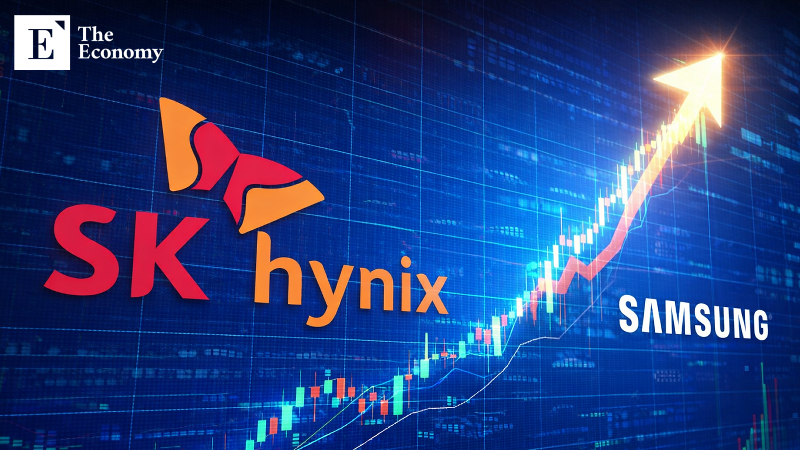
The combined market capitalization of Samsung Electronics and SK hynix has, for the first time, surpassed that of China’s largest technology companies, Alibaba and Tencent. As the epicenter of the artificial intelligence (AI) investment boom migrates from platforms to infrastructure, South Korea’s semiconductor champions are rapidly emerging as pivotal players in Asia’s technology landscape. Meanwhile, Chinese big tech firms, whose influence has waned, are intensifying investments in AI and other advanced industries in a bid to secure new growth engines.
Korean Semiconductors Power Ahead on the Back of a Supply Crunch
On February 3, Bloomberg reported under the headline “Samsung and SK hynix Surpass China Duo in Value on AI Boom” that the combined market capitalization of Samsung Electronics and SK hynix stood at $1.14 trillion as of that date. This comfortably exceeded the combined valuation of Alibaba and Tencent, which totaled $1.07 trillion. It marked the first time the two Korean semiconductor makers had outpaced their Chinese counterparts in market capitalization. Amid an unprecedented boom in the memory market driven by the AI frenzy, valuations of Samsung Electronics and SK hynix—key suppliers of critical memory components—have surged sharply.
Memory semiconductor prices have recently skyrocketed amid an acute supply crunch. TrendForce, in its latest report, projected that PC DRAM prices would jump by more than 100% quarter-on-quarter, while server DRAM and low-power LPDDR products would rise by around 90%. NAND flash prices are forecast to increase by 55–60%, and enterprise SSD prices by 53–58%. TrendForce characterized the trend as “a structural surge driven by supply shortages rather than a simple recovery,” adding that “the first-quarter DRAM price increase is set to mark the highest quarterly rise on record.”
This environment represents a major windfall for memory manufacturers. The current memory market is firmly a seller’s market, with buyers effectively lacking pricing power. In practical terms, memory products are being sold at whatever price suppliers set. Against this backdrop, Samsung Electronics and SK hynix are reported to have raised server DRAM prices for cloud customers such as Microsoft, Amazon Web Services, and Google by as much as 70% compared with the fourth quarter of last year. This pricing momentum has translated directly into equity gains: since the start of the year, Samsung Electronics shares have risen by about 34%, while SK hynix has climbed 37%.
Seller’s Market Expected to Persist
Major players across the supply chain expect these conditions to endure for some time. During a conference call on January 29, SK hynix stated that “AI infrastructure investment continues to expand, driving explosive growth in memory demand, while industry supply capacity is failing to keep pace, resulting in severe supply-demand imbalances.” The company added that “most customers are struggling to secure sufficient memory volumes and are continuously requesting supply increases, while overall customer inventory levels appear to be declining.” SK hynix further projected that tight inventory conditions centered on server DRAM would persist throughout the year, with stock levels falling progressively further in the second half.
Micron, another core memory manufacturer alongside Samsung Electronics and SK hynix, echoed this view. A senior executive from Micron’s mobile and client business said last month that “considering fab construction timelines, customer qualification, and yield stabilization, the current memory supply shortage is unlikely to be resolved before 2028.” The executive cited production bottlenecks stemming from the need to meet stringent certification requirements and simultaneously supply multiple capacity configurations demanded by AI customers. As clients request a wider range of memory specifications, the burden of process transitions increases, ultimately reducing overall productivity.
Nvidia CEO Jensen Huang, whose company is a dominant “whale” customer in the memory market, also weighed in following meetings with Taiwanese supply-chain executives on January 31. “AI requires memory, and this year we will need a very significant amount of memory,” Huang said. “For performance, high-bandwidth memory is essential, and LPDDR is required for low-power applications.” He added that “memory demand will be much higher this year, putting the memory supply chain under considerable strain.”
A New Growth Strategy for Chinese Big Tech
As the axis of Asia’s technology market pivots toward infrastructure amid the AI boom, China’s former platform-centric champions are finding themselves increasingly cornered. The platform businesses that once powered their growth have structurally lost momentum. With domestic consumption weakening, e-commerce gross merchandise value growth has slipped into single digits, while advertising growth has slowed sharply as advertisers rein in spending. In gaming and content, new user inflows have decelerated, and traffic growth is no longer explosive.
In response, these companies are turning aggressively toward AI. Alibaba is doubling down on enterprise AI cloud services built on its proprietary large language model, Qwen. Tencent has deployed its Hunyuan model across gaming, advertising recommendation systems, and software-as-a-service offerings. Baidu is focusing on AI cloud and enterprise generative AI services powered by its ERNIE model. Investment in these areas is accelerating rapidly. Alibaba is reviewing plans to raise capital expenditure on AI and cloud infrastructure to as much as $67 billion over the next three years, while ByteDance, TikTok’s parent company, plans to spend about $14 billion this year alone on purchases of Nvidia AI chips.
Even so, industry consensus holds that Chinese big tech firms are unlikely to secure global AI leadership in the near term. U.S. export controls have constrained access to high-performance GPUs, imposing tangible limits on technological advancement. With access to cutting-edge semiconductors restricted, achieving comparable outcomes requires significantly greater inputs of chips, power, and time. Moreover, China’s AI strategy has been geared toward sectors with immediate commercialization potential, such as healthcare and logistics. While this approach can deliver rapid, tangible results, it is widely viewed as ill-suited to frontier competition centered on the development of artificial general intelligence.
Similar Post