“Protecting infrastructure in orbit” — EU formalizes a ‘space shield’ targeting Russian satellite activity

Stefan Schneider brings a dynamic energy to The Economy’s tech desk. With a background in data science, he covers AI, blockchain, and emerging technologies with a skeptical yet open mind. His investigative pieces expose the reality behind tech hype, making him a must-read for business leaders navigating the digital landscape.
Authored On
Modified
EU brings satellite-based infrastructure into the security domain
Early warning without interception contrasts with the U.S.-style space shield
Debate over strategic autonomy expands into the space domain

The European Union (EU) has moved to establish an integrated monitoring system known as a “space shield,” formally identifying Russian satellite interference activities as a direct security threat. With satellite navigation and communications infrastructure now central to both economic activity and security, the EU has explicitly incorporated the protection of space assets into the national security domain.
Europe’s accumulated experience of cooperation with the United States through the North Atlantic Treaty Organization (NATO) is expected to provide a foundation for securing a minimum level of independent monitoring and early-warning capability. Against this backdrop, Europe’s move is widely interpreted as an effort to expand its own room for judgment and response before reducing its reliance on U.S. security guarantees.
Risk of deviation from orbit and possible re-entry
According to the Financial Times (FT) on the 5th (local time), European Commission President Ursula von der Leyen recently formalized the launch of a “space shield,” an integrated defense framework combining cyber and physical security. The initiative reflects a judgment that space assets—where satellite navigation, communications, and government and military communications converge—constitute the backbone of modern economies and security, and that the risk of Russian satellite eavesdropping and interference represents a tangible threat. “Attacks in space could paralyze the global economy, disrupt transport systems, and put many lives at risk,” von der Leyen said, adding that Europe is facing “a new form of hybrid warfare.”
European space and intelligence authorities assess that Russia is testing European satellite networks through a combination of signal jamming, sensor disruption, and location spoofing. In particular, they point to indications that Russia’s Luch-1 and Luch-2 satellites have repeatedly conducted close-proximity maneuvers near European communications satellites in geostationary orbit, engaging in signals intelligence collection. Satellites in geostationary orbit—approximately 35,000 kilometers above Earth—are critical infrastructure responsible for communications and broadcasting across Europe as well as parts of Africa and the Middle East. European officials warn that insufficient encryption of command links could ultimately lead to orbital deviation or even re-entry and loss.
This assessment has translated into the institutionalization of deterrence and defense beyond simple monitoring. The European Commission plans to unveil a “space strategy for security and defense” in the second half of the year, integrating 24-hour surveillance with early warning, threat assessment, and response procedures. Taking into account the blurred boundary between civilian and military satellite assets, the plan envisions a package approach that simultaneously addresses the protection of communications, navigation systems, and ground stations. The participation of major European aerospace companies—including Airbus, Thales Alenia Space, and OHB—has also been signaled.
Member states are accelerating their own responses as well. Germany has publicly warned of the possibility of Russian sabotage against Western satellites and announced plans to invest $41.3 billion in space defense by 2030. The concern stems from incidents around Russia’s 2022 invasion of Ukraine, when interference with communications satellite networks caused disruptions to 5,800 wind turbines in Germany—highlighting how satellite vulnerabilities can directly impact the real economy, including energy and logistics. German Defense Minister Boris Pistorius described satellite networks as “the Achilles’ heel of modern society,” underscoring the need to establish space-based deterrence.
United States reaches ‘surveillance–warning–response’ maturity
The United States is often cited as the foremost example of treating space as an independent security domain and steadily building defensive capabilities. Rather than a short-term reaction to specific events, the U.S. approach reflects the continuation of a long-term strategy dating back to the Cold War. The Strategic Defense Initiative (SDI), proposed by the Ronald Reagan administration in 1983—often dubbed the “Star Wars” program—failed to materialize due to technological constraints, but it embedded the concept of space as a forward layer of missile defense within institutional thinking. Since then, the United States has progressively combined early-warning satellites, missile-tracking radars, and interceptors, accumulating a multilayered space defense framework.
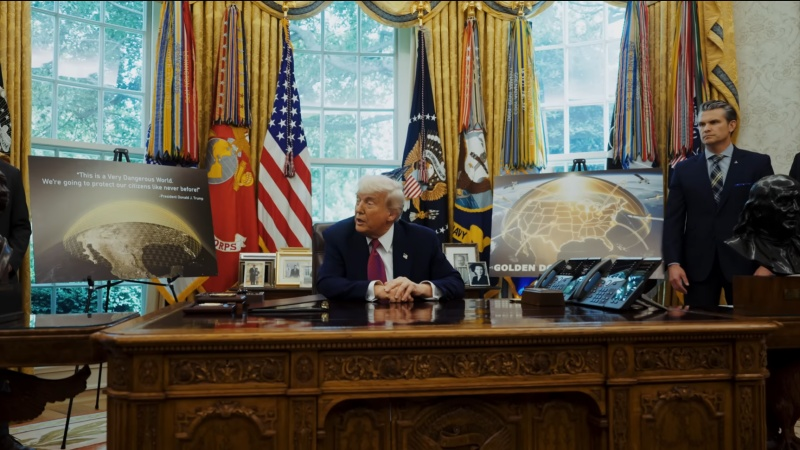
The renewed U.S. space shield concept has emerged from this same trajectory. Shortly after returning to office last year, President Donald Trump signed an executive order directing the development of a space shield, formally expanding missile defense beyond the ground and atmosphere into space. He subsequently unveiled a space-based missile defense system dubbed “Golden Dome,” pledging a total investment of $175 billion. The concept envisions a multilayered defense network using space-deployed surveillance satellites and interceptors to track and neutralize missiles from launch through terminal phase.
The challenge, however, lies in the simultaneous technological and economic constraints facing such plans. Academic experts identify the feasibility of laser-based interception as the largest uncertainty. Neutralizing a ballistic missile with a laser would require securing an effective range spanning hundreds of kilometers during the boost phase, which lasts only three to five minutes—something current technology struggles to achieve reliably. Energy constraints pose another hurdle: satellites equipped with missile-intercept lasers would require power output comparable to small nuclear reactors, yet propulsion and power technologies capable of sustaining such output in orbit over long periods have yet to reach maturity.
Technological uncertainty directly translates into cost concerns. Even as early as 2012, the U.S. National Academy of Sciences estimated that at least 650 satellites would be required to build a limited-capability space defense system, at a cost of $300 billion. Factoring in maintenance, operations, personnel, and subsequent inflation, total expenditures would likely be far higher. Still, the prevailing assessment holds that the United States—having already accumulated substantial early-warning satellite networks, space surveillance assets, and an associated industrial ecosystem—starts from a fundamentally different baseline than Europe, which is only now entering the design phase for a new surveillance, warning, and response system.
Focus on minimum deterrence and early-warning capability
The EU plans to construct its own space defense framework by leveraging satellite intelligence and space surveillance cooperation experience accumulated alongside the United States within NATO. While Europe has long relied heavily on U.S.-led information and warning systems for space security, repeated reports of Russian satellite interception and interference have pushed the need for a minimum level of autonomous response capability to the forefront of policy debates. The EU’s commitment to establishing a 24-hour monitoring system through the space shield reflects a calculation that existing NATO-based technical and operational experience can be converted into an independent system.
In practice, European countries already jointly utilize satellite-based reconnaissance, communications intelligence, and early-warning data through NATO. Since the outbreak of the Russia–Ukraine war, efforts to supplement U.S.-provided intelligence with European assets have also intensified. Satellite networks centered on France and Germany have been deployed not only for military purposes but also for civilian communications and the management of energy and logistics infrastructure. The EU-level plan for an independent monitoring system amounts to a declaration of intent to institutionalize these experiences and create a foundation for immediate response to external threats.
Nevertheless, Europe’s level of preparedness remains limited compared with that of the United States. Since establishing the U.S. Space Force in 2019, Washington has steadily reinforced satellite tracking and warning-response systems, positioning satellite defense as an independent theater of security operations. By contrast, the EU’s space shield remains at an early stage, prioritizing surveillance and warning rather than full interception or offensive capabilities. As a result, even within Europe the initiative is widely regarded as a pragmatic choice aimed at securing minimum deterrence and early-warning capacity rather than a comprehensive space defense architecture.
Stefan Schneider brings a dynamic energy to The Economy’s tech desk. With a background in data science, he covers AI, blockchain, and emerging technologies with a skeptical yet open mind. His investigative pieces expose the reality behind tech hype, making him a must-read for business leaders navigating the digital landscape.
- Previous [Bio Power Rivalry] “On the Front Line of Clinical Trials and Drug Development” China’s Biotech Surge on State Backing Raises Doubts Over U.S. Containment Effectiveness
- Next [Vietnam Rare Earths] “Leveraging Domestic Reserves” Vietnam Throws Down the Gauntlet in the Global Rare Earth Supply Chain, Accelerating Resource Development Through Partnerships With Major Powers
Similar Post