From China’s Pinglu to Cambodia’s Funan Techo, a Canal Strategy Linking ASEAN

Authored On
Modified
China Reviews Shanggui Canal Following Pinglu Waterway, Expanding Inland–ASEAN Logistics Corridor
Cambodia Advances Funan Techo Canal With China to Reduce Reliance on Vietnam
Security Controversy Intensifies Amid Concerns Over Potential Military Use
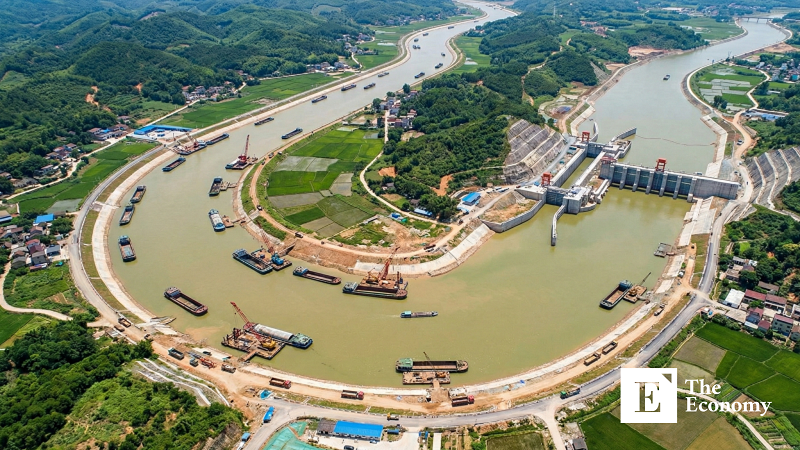
China advances the construction of the domestic Pinglu Canal while participating in Cambodia’s Funan Techo Canal project, accelerating the expansion of its logistics network. The Pinglu Canal, scheduled for completion later this year, aims to connect inland China directly with ASEAN (the Association of Southeast Asian Nations), while the Cambodian canal reflects converging interests between Phnom Penh’s effort to reduce dependence on Vietnam and Beijing’s push to extend its reach toward the South China Sea. At the same time, these development plans have sparked debate over economic viability, environmental damage, and the potential for military repurposing, raising concerns among neighboring countries.
Pinglu Canal Nears Completion, Xianggui Canal Under Review to Accelerate ASEAN Outreach
According to foreign media including the South China Morning Post (SCMP) on the 9th (local time), China is accelerating construction of the Pinglu Canal linking Nanning, the capital of the Guangxi Zhuang Autonomous Region, with the Beibu Gulf (known in Vietnam as the Gulf of Tonkin), with an opening targeted for the end of this year. Stretching 134 kilometers, the Pinglu Canal is a mega national project with total investment of approximately $10.2 billion. The project diverts the flow of the West River, which runs from Yunnan Province in the west to Guangdong Province in the east, southward to directly connect Nanning with the Beibu Gulf. Launched in 2022, the canal is approaching completion after four years of construction.
Guangxi Daily reported that 89.7% of the overall investment plan has already been executed, with key works—including three large double-line ship locks and 27 bridges—entering their final stages. Thirteen bridges have already opened. Once completed, the canal will be able to accommodate vessels of up to 5,000 tons, positioning it as a core transport artery for coal, minerals, cement, grain, construction materials, and other key resources.
The Pinglu Canal goes beyond a simple waterway connection and is being evaluated as a strategic piece of infrastructure that physically integrates inland industrial zones with ASEAN markets as a central pillar of China’s western development strategy. Upon opening, cargo from inland provinces such as Yunnan and Guizhou will be able to reach overseas markets directly via the Beibu Gulf without detouring through Guangdong or the Pearl River Delta, shortening transport distances by an average of 560 kilometers. This logistics expansion aligns with a rapidly shifting trade landscape in which exports to the United States have weakened while ASEAN has emerged as China’s largest trading partner. Ultimately, the Pinglu Canal represents a core strategy to cut logistics costs for inland enterprises, enhance price competitiveness, and accelerate penetration of Southeast Asian markets.
Beyond this, China is already outlining the next phase of logistics expansion by reviewing plans for the “Xianggui Canal” as an extension of the Pinglu project. The Xianggui Canal is envisioned as a mammoth undertaking spanning roughly 300 kilometers with an estimated cost of about $21 billion—more than double the investment in the Pinglu Canal. China’s ultimate objective is to complete the 3,200-kilometer “Han–Xiang–Gui Corridor,” a vertical inland waterway cutting through four provinces—Shaanxi, Hubei, Hunan, and Guangxi. Once completed, factories in China’s inland core will gain direct access to southern seas and global maritime routes without relying on eastern coastal hubs. This corridor is expected to underpin a broader manufacturing shift inland, supported by lower land and labor costs. Rui Chang, a professor at Changsha University of Science and Technology, noted that “the opening of the Pinglu Canal makes this the right moment to advance the project,” adding that inland shipping development would “dramatically reduce logistics costs and drive economic activation in central and western regions.”
Given the scale of investment required, the final approval of the Xianggui Canal is likely to hinge on whether it is included in the 15th Five-Year Plan (2026–2030), scheduled for deliberation at the National People’s Congress in March. Local governments are already moving quickly. Hunan Province has submitted proposals calling for the project’s inclusion in national plans, while Hubei Province has aligned by incorporating its segment of the Han–Xiang–Gui Corridor into its next five-year plan. In parallel, authorities are pushing ahead with the expansion of ship capacity at the Three Gorges Dam and upgrades to the Han River waterway to allow 2,000-ton vessels, accelerating the buildout of an inland shipping system.
Cambodia Partners with China on the Funan Techo Canal
China’s canal strategy is also extending beyond its borders through Cambodia’s Funan Techo Canal project. The canal will run approximately 180 kilometers from the autonomous port of Phnom Penh, through the Bassac River and the Kottam area, to Cambodia’s Kep Province on the Gulf of Thailand. Designed with a width of 100 meters and a depth of 5.4 meters, the project carries a total cost of $1.7 billion, equivalent to roughly 4% of Cambodia’s GDP. Most of the construction financing will be provided by the Chinese side. Upon completion, ownership will be split with the Cambodian government holding 51% and China Road and Bridge Corporation (CRBC) holding 49%. CRBC will retain exclusive operating rights for 40 to 50 years to recoup its investment and profits before transferring operations to Cambodia.
For Cambodia, the Funan Techo Canal represents a strategic bid to reduce dependence on Vietnam. According to Reuters, Cambodia has long relied on Vietnamese ports along the lower Mekong River for a large share of its trade flows. Once operational, the canal is expected to connect Phnom Penh directly to the sea, potentially cutting reliance on Vietnamese ports by up to 70%. The Cambodian government plans to secure logistics cost reductions and greater diplomatic autonomy by operating an independent waterway capable of handling vessels of up to 3,000 deadweight tons, enabling direct shipment of agricultural products, textiles, and other key exports.
This outcome reflects the convergence of Cambodia’s policy direction—seeking distance from Vietnam’s influence—and China’s ambition to secure inland footholds across Southeast Asia. Through the canal, China would gain an alternative route toward the South China Sea, reinforcing its Belt and Road Initiative linking land and maritime trade corridors. Analysts suggest that once completed, the canal could help China diversify away from dependence on the Strait of Malacca while integrating with existing rail and road projects to complete a multimodal logistics network across ASEAN.
Nevertheless, skepticism over the project’s effectiveness remains widespread. Critics argue that the canal’s relatively short length and low vessel turnover limit logistics efficiency and profitability, and that Cambodia is unlikely to secure a clear competitive edge against established Vietnamese ports such as Cat Lai and Hai Phong, which are already deeply embedded in global shipping networks.
Environmental concerns are also mounting. Construction through the Mekong basin raises fears of ecosystem disruption and changes in water levels that could exacerbate droughts and flooding. Nguyen Hung, a supply-chain expert at RMIT University Vietnam, warned that the project could trigger population displacement and losses of farmland and wetlands. Brian Eyler, director of the Stimson Center’s Southeast Asia Program, cautioned that it could reduce water resources critical to Vietnam’s industrial rice production.
Cambodian officials have pushed back strongly. Deputy Prime Minister Sun Chanthol argued that compared with the Mekong River’s discharge of 8,000 cubic meters per second, the canal’s maximum outflow of 5 cubic meters per second is negligible, dismissing concerns by saying the canal is “no bigger than a straw.” He emphasized that improved irrigation would benefit 1.6 million residents along the route and pledged close monitoring of impacts on Mekong water resources.

Logistics Artery or Military Corridor, Rising Security Risks
Debate over canal construction is increasingly extending beyond economics into the realm of security. The United States and Vietnam are closely watching the possibility that the Funan Techo Canal could eventually serve as an inland access route for Chinese naval vessels. Particular attention is focused on the canal’s proximity to Cambodia’s Ream Naval Base, which China has helped modernize, raising speculation that Chinese naval power could be projected inland across the Indochina Peninsula or that the canal could function as a logistical supply line in a contingency. The foreign affairs magazine The Diplomat has noted that Belt and Road projects often align with geopolitical chokepoints, suggesting that strategic intent linked to China’s South China Sea claims may be embedded in the initiative.
Cambodia has formally denied any potential for military use. Prime Minister Hun Manet stated that the canal’s 5.4-meter depth makes naval operations impractical and emphasized that Cambodia’s constitution prohibits the stationing of foreign troops. Senate President Hun Sen likewise criticized external concerns as distorted perceptions. However, Western intelligence officials and military experts maintain that the canal’s depth and width would be sufficient for smaller warships or supply vessels, arguing that expanding China–Cambodia cooperation could still generate security risks.
The United States and Vietnam are responding with calibrated approaches. Washington lifted its arms embargo on Cambodia last November as part of efforts to manage relations, while continuing to demand transparency regarding the Ream base and the canal. Vietnam, situated downstream along the Mekong, must balance security concerns with environmental risks such as changes in river flow and saltwater intrusion. Rather than outright opposing the canal, Hanoi has reportedly adopted a pragmatic stance, seeking to minimize negative impacts through data sharing and participation in environmental impact assessments.
Similar Post