“Clouds Still Hanging Over the Housing Market This Year” China Weighed Down by Property Slump, High-Tech Boom Fails to Fill Economic Void

As one of the youngest members of the team, Tyler Hansbrough is a rising star in financial journalism. His fresh perspective and analytical approach bring a modern edge to business reporting. Whether he’s covering stock market trends or dissecting corporate earnings, his sharp insights resonate with the new generation of investors.
Authored On
Modified
S&P Slashes China’s New-Home Sales Forecast, Warning of Prolonged Downturn
Rapid Expansion of Advanced Industries Falls Short of Replacing Growth Engine
“Growth Could Falter at Any Moment” China’s Economy Balances on a Knife’s Edge
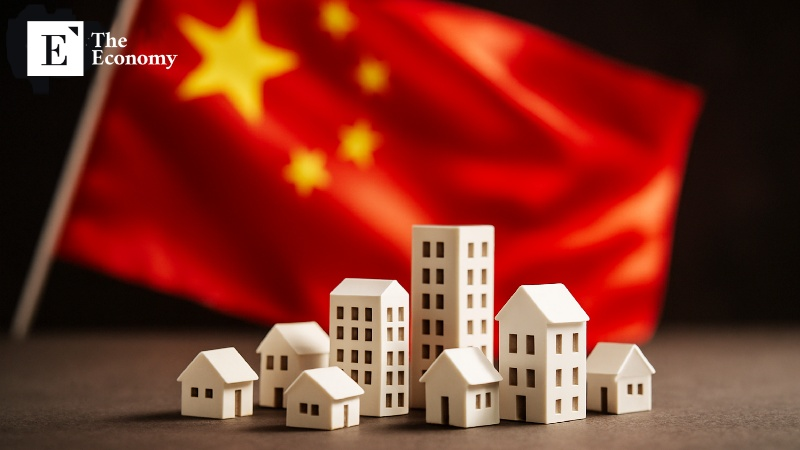
International credit rating agency S&P Global Ratings (S&P) has lowered its forecast for China’s property sales this year. With real estate investment and transactions across the country frozen and the downturn becoming entrenched, pessimism is mounting that conditions will improve anytime soon. While the Chinese government is pushing for a structural shift away from property-led growth, tangible results capable of filling the gap left by real estate have yet to materialize. Against this backdrop, market expectations are increasingly converging on the view that China’s economic growth this year will fall short of the government’s 5% target.
China’s Frozen Property Market
According to CNBC on the 9th (local time), S&P said in a report that China’s new-home sales are expected to decline by 10–14% year on year in 2026. This represents a marked deterioration from its previous forecast in October last year, which projected a 5–8% decline. S&P noted that the downturn has become structurally entrenched, leaving the government as effectively the only actor capable of absorbing excess inventory. While proposals have been floated for authorities to purchase unsold homes and convert them into public or affordable housing, S&P said such efforts remain sporadic and limited in scope.
China’s property market has remained mired in contraction since Evergrande Group defaulted in 2021, followed by Country Garden’s default in 2023. Last year, China’s real estate development investment totaled approximately $1.15 trillion, down 17.2% from a year earlier. Of this, residential investment amounted to about $880 billion, a 16.3% decline. The floor area of new-home transactions fell 8.7% year on year to 8.81 million square meters, while transactions in existing homes contracted by 9.2%. The value of new-home sales dropped 12.6% to roughly $1.17 trillion, and existing-home transaction value slid 13%.
As market activity froze, housing prices also fell more sharply. In December last year, prices of new homes nationwide declined 2.7% year on year, the steepest drop in five months. Prices of existing homes, widely viewed as a more accurate gauge of real-time housing demand, fell 7% in top-tier cities and 6% in second- and third-tier cities. S&P warned that oversupply-driven downward pressure could push housing prices down a further 2–4% this year.
Beijing’s Attempt at Restructuring Growth
In response to the property slump dragging down the broader economy, the Chinese government has embarked on an ambitious push to restructure its growth model. In the 15th Five-Year Plan, covering 2026–2030, Beijing has placed “sustainable growth” at the center of its policy framework and signaled its intent to overhaul the real estate sector. Key pillars of the plan include sustainable development, environmentally conscious industrial transformation, and high-quality growth centered on citizens’ livelihoods. The strategy aims to move away from an infrastructure- and mass-housing-driven model toward an economy anchored in education, healthcare, childcare, and other public services.
Advanced technology industries are also being positioned as new engines of growth. In recent years, the Chinese government has elevated high-tech development to a top national priority, channeling massive public funds into the sector. Government spending on science and technology last year is estimated at around $56 billion, while total investment including private capital is believed to have reached approximately $560 billion. Backed by this aggressive support, Chinese firms have begun to demonstrate tangible results. Chinese AI chatbot DeepSeek sent shockwaves through the global artificial intelligence market, while electric vehicle maker BYD overtook Tesla in sales, rewriting industry records.
The challenge, however, is that the pace of expansion in advanced industries remains insufficient to propel the overall economy. According to a report released last month by U.S. research firm Rhodium Group, new industries such as AI, robotics, and electric vehicles contributed only 0.8 percentage points to China’s GDP growth between 2023 and 2025. Rhodium Group estimates that for China to achieve its annual growth target of 5%, these sectors would need to expand sevenfold over the next five years, generating around 2 percentage points of investment-led growth annually. That would require additional investment of roughly $390 billion this year alone.
Growth Outlook and Risk Factors
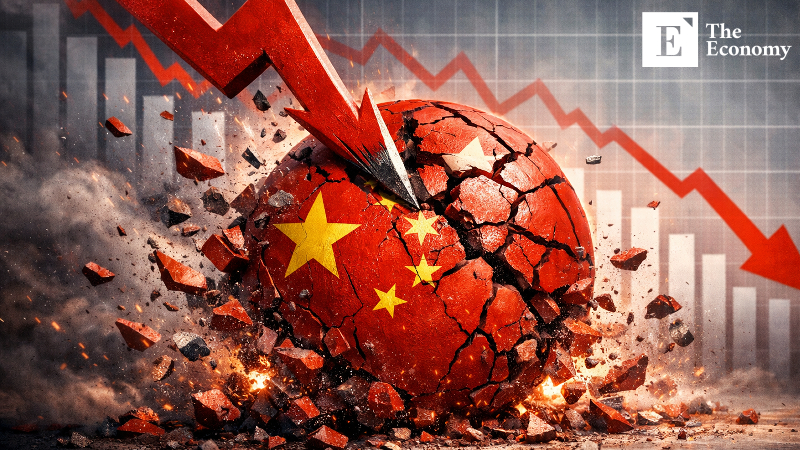
Amid these dynamics, pessimistic assessments of China’s growth outlook are proliferating. Zhou Tianyong, former deputy director of the Central Party School’s Institute of International Strategy and now a senior researcher at Dongbei University of Finance and Economics’ National Economic Engineering Laboratory, recently wrote on WeChat that China’s long-term growth trajectory hinges on the introduction of market-oriented reforms. Absent such measures, he warned, China’s potential growth rate could average just 2.5% annually during the 15th Five-Year Plan period and the following decade. Zhou stressed the need for a clear rebound in total factor productivity and a meaningful expansion in household consumption, arguing that China must identify new sources of productivity and demand as it confronts slowing growth and the erosion of traditional drivers such as infrastructure investment.
The International Monetary Fund (IMF), by contrast, has offered a somewhat more upbeat view, raising its forecast for China’s economic growth this year to 4.5%. While still below Beijing’s official target, the revised outlook is 0.3 percentage points higher than the IMF’s October projection of 4.2%. The IMF said that despite U.S.-led trade tensions and economic uncertainty, the global economy continues to display resilience, with much of global growth expected to come from the United States and China.
Some analysts argue that the IMF’s optimism is rooted in historical precedent. China has repeatedly defied predictions of decline. In 2013, the IMF warned that without urgent economic reforms, China’s growth rate could fall into the 4% range by 2018. In reality, China’s economy expanded 6.6% that year, far exceeding the forecast. Similarly, in 2024 the IMF projected that China’s growth in 2025 would hover around 4%, yet actual growth came in closer to 5%.
How long such resilience can persist remains uncertain. The property slump continues to exert direct and severe downward pressure on the economy. A cooling housing market simultaneously weakens construction and related industries, accelerates investment slowdown, strains local government finances through reduced land sales, and dampens household consumption as asset values decline. One market expert warned that China’s economy could see its growth trajectory abruptly reverse if the downturn drags on or financial instability becomes visible, adding that the current expansion more closely resembles an “unstable equilibrium” than a durable recovery.
As one of the youngest members of the team, Tyler Hansbrough is a rising star in financial journalism. His fresh perspective and analytical approach bring a modern edge to business reporting. Whether he’s covering stock market trends or dissecting corporate earnings, his sharp insights resonate with the new generation of investors.
Similar Post