Trump’s ‘State of the Union Spectacle’ Ahead of Midterms: Miscalculation or Strategic Gambit

Siobhán Delaney is a Dublin-based writer for The Economy, focusing on culture, education, and international affairs. With a background in media and communication from University College Dublin, she contributes to cross-regional coverage and translation-based commentary. Her work emphasizes clarity and balance, especially in contexts shaped by cultural difference and policy translation.
Authored On
Modified
108 Minutes, the Longest Presidential Address in History
Emphasis on Economic, Tariff, Immigration, Diplomatic, and Military Achievements
Hardline Stance Likely to Persist with Midterm Milestone in View
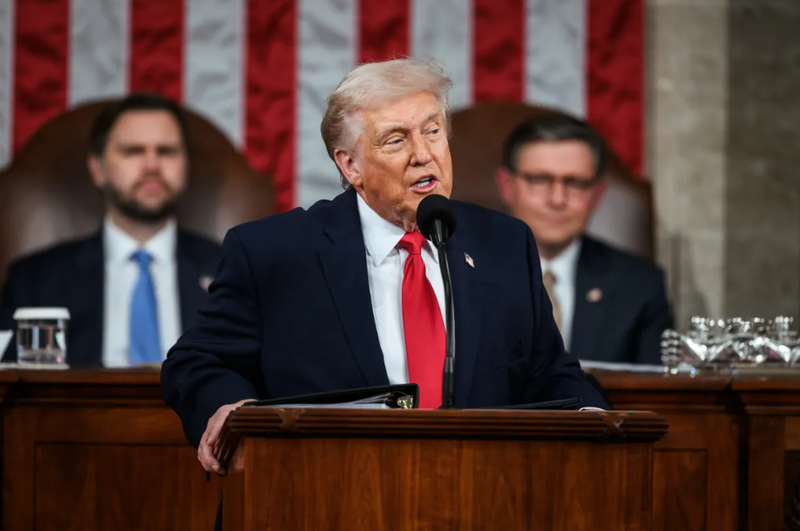
President Donald Trump’s first State of the Union Address since returning to office can be distilled into a declaration of unwavering commitment to his governing doctrine of “America First.” After enumerating a broad array of domestic and foreign policy achievements over the past year since the launch of his second-term administration, he made clear that his tariff and immigration policies, along with a foreign and security strategy anchored in “peace through strength,” would remain firmly intact. While many of these policies have generated significant controversy and contributed to declining approval ratings, he made no reference to any potential recalibration or policy adjustment. The address signaled his intent to stake his political fortunes in the upcoming midterm elections on the performance and outcomes of this agenda.
“America Is in a Golden Age,” Economic Achievements Highlighted
According to Reuters and other international media outlets on the 24th (local time), President Trump delivered his first State of the Union address of his second term for 1 hour and 48 minutes at the U.S. Capitol in Washington, D.C. The speech surpassed the previous record of 1 hour, 28 minutes, and 49 seconds set by former President Bill Clinton in 2000 by nearly 20 minutes, making it the longest in history. He devoted the largest portion of his remarks to praising his economic record. Emphasizing that he had corrected within a year what he described as economic contraction, inflation, illegal immigration, and crime inherited from former President Joe Biden, Trump characterized his tenure as having ushered in “unprecedented reform and historic transformation.”
He went on to assert that “over the past 12 months, our administration has reduced core inflation to its lowest level in more than five years,” adding that “in the final three months of last year, it fell to 1.7%.” Declaring that “America is now in a golden age—bigger, more prosperous, wealthier, and stronger than at any time before,” he cited enhanced border control, price stabilization, rising incomes, economic expansion, and restored deterrence abroad in rapid succession.
Investment attraction was also presented as a central message. Trump stated, “The previous administration secured less than $1 trillion in new investment over four years, but in just 12 months I have secured more than $18 trillion in investment commitments from around the world.” He described this as “the difference that leadership makes,” adding that the United States had become “the hottest and most attractive investment destination on Earth.”
“Hundreds of Billions of Dollars from Tariffs,” Self-Congratulation Continues
Following his review of economic achievements, President Trump addressed the Supreme Court’s ruling that invalidated his reciprocal tariffs. Calling the decision “deeply regrettable,” he added that “virtually every country and company wants to maintain the agreements they have already reached.” He asserted that “given the legal authorities vested in the president, they understand that new terms could prove far more unfavorable,” and expressed confidence that cooperation would continue within the framework of negotiations conducted prior to the Court’s intervention. While criticizing the ruling that found his reciprocal tariffs imposed under the International Emergency Economic Powers Act unlawful, he effectively reaffirmed his determination to continue tariff measures through alternative mechanisms.
Trump reiterated his longstanding position on the burden and impact of tariffs. “Tariffs are paid by foreign countries,” he said, arguing that tariff revenue could substantially offset the modern income tax system and ease the burden on American households. He further contended that tariff policy would continue to draw factories, jobs, investment, and trillions of dollars into the United States, describing tariffs as “one of the primary reasons our nation has achieved the greatest economic turnaround in its history.” Repeating his assertion that other countries had exploited the United States for decades, he claimed that tariffs had generated “hundreds of billions of dollars,” enabling the United States to secure favorable economic and national security agreements.
However, many of the figures cited by the president have drawn scrutiny for lacking clear sourcing or diverging from prevailing data. While he maintained that he inherited a nation in economic crisis, although Americans were dissatisfied with rising prices at the time, the economy was not in a recessionary phase marked by contracting gross domestic product. In fact, U.S. economic growth stood at 2.8% in 2024, 0.6 percentage points higher than the 2.2% recorded in 2025, the first year of Trump’s second term.
Similarly, although Trump claimed that Americans’ incomes had surged and that the economy was experiencing unprecedented prosperity, real income growth in 2025 increased by only 0.9% year-on-year, markedly slower than the 2.2% growth recorded in 2024 during the Biden administration. Questions also arose regarding foreign direct investment, closely linked to economic activity and employment. While Trump asserted that he had secured commitments exceeding $18 trillion from around the world, the White House website lists foreign investment in the United States at $9.6 trillion.
Another striking element of the speech was his renewed and explicit hostility toward immigrants. Referring to the Somali immigrant community in Minnesota, he claimed they had “looted” an estimated $19 billion from American taxpayers, adding that the actual figure was “far higher.” His remarks also targeted senior voters, as he pledged to “protect Social Security and Medicare.” Trump further reiterated his commitment, outlined in last year’s National Security Strategy, to strengthening American dominance in the Western Hemisphere. “We are restoring security and supremacy in the Western Hemisphere,” he said, vowing to safeguard national interests and protect the country from violence, drugs, terrorism, and foreign interference.
Trump’s Political Fate Hinges on November Midterms
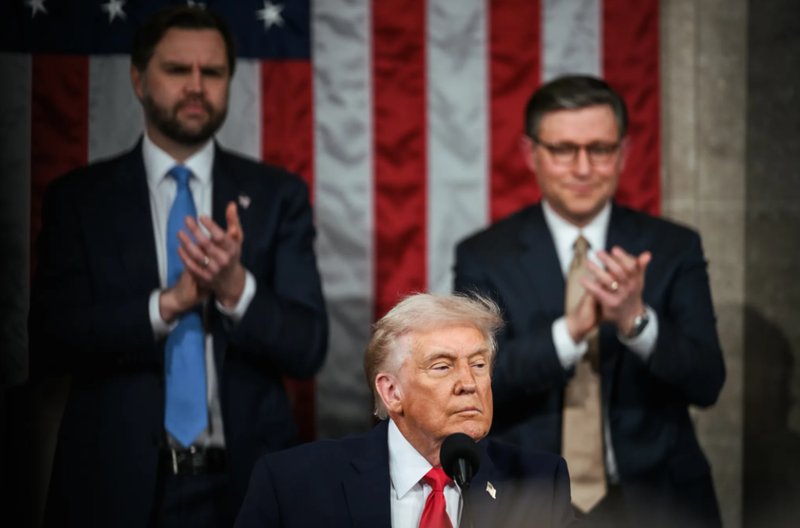
In political circles, the address is widely viewed as a calculated appeal to voters ahead of the November midterm elections. Trump’s concern over the midterms is unsurprising; the elections represent a decisive inflection point for the continuation of the “Trump era.” Should the administration suffer defeat, Democrats would have a strong chance of reclaiming control of the House of Representatives, positioning them to block Trump’s authoritarian-leaning policies and potentially initiate impeachment proceedings.
Trump has consistently displayed deep aversion to impeachment. In recent private meetings with Republican lawmakers, he reportedly warned that electoral defeat would likely trigger renewed impeachment efforts. Although the current Senate composition presents significant obstacles to ultimate conviction, Trump has twice experienced how even House-led impeachment proceedings alone can destabilize a president’s political standing. Congressional impeachment efforts would not only weaken his political authority but could also inflict substantial damage on the broader business interests of the Trump family.
Accordingly, Trump has mobilized fully for a midterm victory. After suffering a series of setbacks in key elections last year and additional defeats in traditionally Republican strongholds this January, he appears to have adopted an all-in posture. His recent move to advance a “national voter identification” initiative without congressional approval reflects this urgency. On the 13th, via Truth Social, Trump declared that he would implement a voter identification requirement in the midterms regardless of congressional action. He stated that he had been studying legal arguments not yet publicly disclosed or tested and would soon present irrefutable justification.
The move effectively revives his longstanding narrative of election fraud. Since his defeat in the 2020 presidential election, Trump has persistently alleged electoral manipulation, frequently asserting that the United States uniquely permits mail-in voting and that a particular political party engages in systematic fraud. In the same vein, he has urged Congress to pass the Safeguard American Voter Eligibility (SAVE) Act before the midterms, which would require proof of citizenship at voter registration and mandate identification at the polls.
Although the bill passed the House last year under Republican leadership, its prospects in the Senate remain slim. As a result, Trump is understood to be exploring executive action to circumvent Congress. The intensity of these efforts underscores the stakes he attaches to the midterm elections. This year’s contests will determine 35 of the 100 Senate seats and all 435 seats in the House of Representatives. The current balance stands at 53 Republicans to 47 Democrats in the Senate, and 218 Republicans to 214 Democrats, with three vacancies, in the House—narrow margins that underscore Republican fragility. Should Democrats secure a majority in either chamber, a wide array of Trump’s policy initiatives would likely face significant obstruction.
Siobhán Delaney is a Dublin-based writer for The Economy, focusing on culture, education, and international affairs. With a background in media and communication from University College Dublin, she contributes to cross-regional coverage and translation-based commentary. Her work emphasizes clarity and balance, especially in contexts shaped by cultural difference and policy translation.
Similar Post