Two Tracks, One Country: Fixing the Thailand education divide

Ethan McGowan is a Professor of AI/Finance and Legal Analytics at the Gordon School of Business, SIAI. Originally from the United Kingdom, he works at the frontier of AI applications in financial regulation and institutional strategy, advising on governance and legal frameworks for next-generation investment vehicles. McGowan plays a key role in SIAI’s expansion into global finance hubs, including oversight of the institute’s initiatives in the Middle East and its emerging hedge fund operations.
Authored On
Modified
Thailand faces a structural education divide between elite training and mass foundational skills
Both tracks must be redesigned together and tightly linked to real labor market demand
Without coordinated reform, talent will leave and average productivity will stall

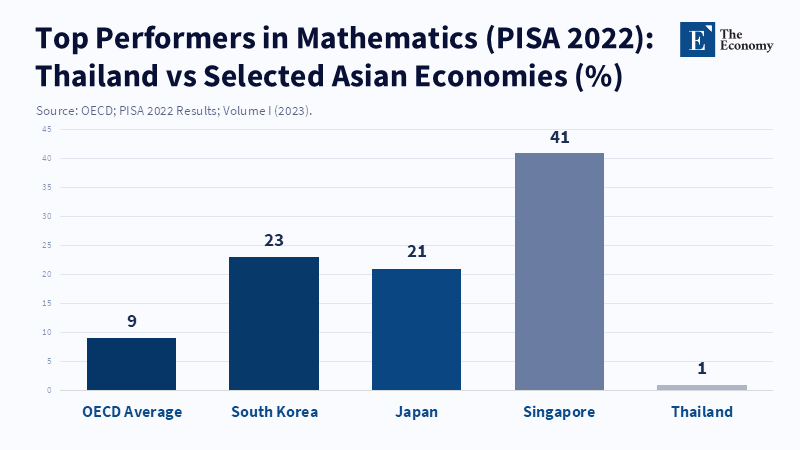
The fact that only 1% of Thai students achieved the highest proficiency levels in international mathematics testing in the PISA 2022 assessment should bring any discussion about educational changes to an immediate halt. This statistic reveals that top-tier academic excellence is extremely uncommon. In addition, it shows a basic problem: Thailand's educational system is split into two paths. One path aims to produce a small number of globally competitive individuals, while the other seeks to ensure that the majority of the population possesses basic literacy, numeracy, and job-related skills. This division has a considerable effect on prospects in life, family choices, and economic Expansion in Thailand. If top-tier training is not supported by sufficient opportunities in the domestic job market, graduates may seek employment abroad or find themselves unemployed. The economy's average productivity cannot grow if basic education is inadequate. Thailand must implement two well-coordinated educational routes: high-quality foundational education for the majority and precisely designed pathways for the elite, all of which must be aligned with actual employment demands, according to this analysis.
The Need for Now Regarding the Thailand Education Divide
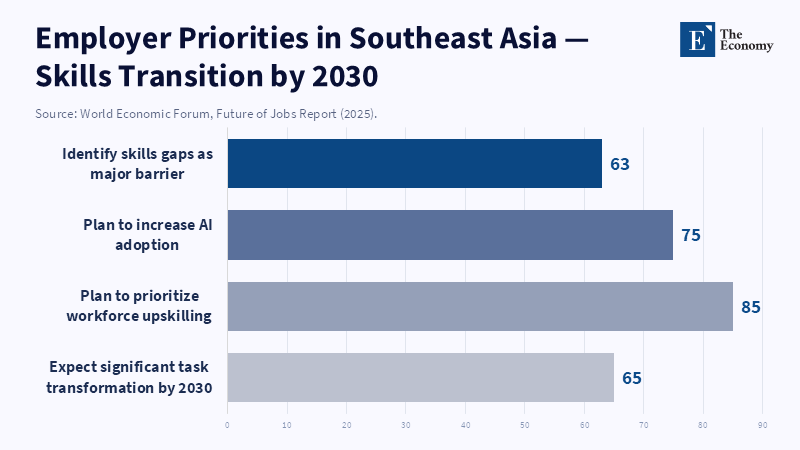
The first step in redefining the issue is to comprehend the demand signal. Employers in Southeast Asia are reporting that the talent they want is rapidly changing. According to the World Economic Forum's Future of Jobs research (2025), a considerable number of businesses anticipate shifts in fundamental responsibilities and talent combinations by 2030, and upskilling is seen as vital to remaining competitive. At the same time, Thailand's supply side is unbalanced. A small number of students attain world-class competency, while a sizable proportion of adults lack essential abilities. The end result is a double bind. A select few highly skilled graduates encounter fierce competition for limited promotions. Meanwhile, most people face limited job opportunities and are unable to keep up with rising living expenses. The political economy underpins the Thai education divide. It is both immediate and restricts social mobility and investment choices, thereby raising the political cost of change.
The data used in this study come from recent employer surveys and from easily accessible public datasets. The proportion of 15-year-olds who perform at the highest levels, as reported by PISA 2022, is the clearest indicator of readiness for the top tier. Employer surveys conducted by the World Economic Forum in 2025 give short-term insights into the skills needed and the priorities for upskilling. According to the PISA 2022 Results from the OECD, the report focuses on student performance and educational equity, but it does not specifically address the use of top-performer percentages or their reliability as baselines for adult education indicators or elite-role openings. These comparisons of proportions highlight the magnitude of the disparity without giving a misleading impression of numerical accuracy.
The Mechanics of Two Tracks in the Thailand Education Divide
The elite track is successful only when several factors are in place. To begin with, selection must accurately identify students with great potential rather than those who just excel at test-taking for brief assessments. Second, instructors in top streams need strong mentoring skills and a command of their subjects. Third, resources should be allocated to the areas that matter most, such as project funding, industry mentors, and labs. Fourth, the job market needs to be sufficiently robust to both absorb and reward specialized training. Elite schooling turns into credential inflation when one of these components is absent. In this case, a small group seeks prestige without finding matching employment prospects locally. Thailand is experiencing this problem right now. Although there are pockets of excellence, the labor market has not kept up, and sophisticated training frequently sends talent overseas or into underused areas.
The mass track follows a different pattern. The immediate goals for the majority are straightforward: digital familiarity, basic arithmetic, reliable literacy, and financial awareness. These abilities improve household resilience and boost adaptability as jobs change. The delivery model for mass skills needs to prioritize routine diagnostic evaluation, early-grade teacher coaching, and brief remedial treatments that quickly address learning deficits. According to international data, these actions produce significant per-dollar returns and accelerate average learning. To put it simply, a higher level of basic skills strengthens the country's resilience and increases the output of future elite investments since businesses will be able to locate and train more talented junior personnel.
Thailand Education Divide: Practical Policy Solutions
A two-track national strategy is both viable and economically sound. The goals are achievable in the basics. Increase the use of diagnostic testing in the early grades nationwide so that districts may address achievement differences each year. Support a substantial increase in in-service teacher training in reading and math. Introduce brief, focused remedial programs that are effective throughout the school year or after school. These are practical improvements. They make better use of teachers' time and facilities. According to the OECD, while access to education in Thailand has improved in recent decades, there is still room for further progress in educational quality. Political risk can be reduced, and rapid gains that win public support can be achieved with phased funding and trials.
The elite path has to be explicitly market-oriented and to include conditions. According to an OECD report, rather than focusing investment in one flagship institution, Thailand should establish a network of regional centers of excellence. These centers should receive initial public funding, with continued subsidies tied to specific commitments such as offering internships, collaborating on supervised projects, contributing equipment, and meeting placement targets. Establish research collaborations and short-term return requirements for scholarship recipients in industries where domestic markets are weak, so that talent returns to national enterprises. Industry co-financing lessens financial strain and compels curriculum designers to respond to actual work demands. Public reporting of placement rates, wage premiums, and graduate outcomes will ensure accountability at the top.
Instead of duplication, execution calls for intelligent governance. According to the OECD, establishing pilot regional centers with clear milestones and dedicated start-up budgets can help drive education reform. The report also highlights the importance of integrating key changes into regular education budgets and recommends using public scorecards that provide standardized graduate placement data and learning outcomes to enhance transparency and informed decision-making. Independent evaluators ought to examine the outcomes of pilots, and the government ought to replicate any initiatives that raise learning or placements. Grants from donors and public-private partnerships can cover start-up expenses, while domestic budgets can support profitable, sustainable initiatives. Clear metrics and public dashboards make progress quantifiable and politics manageable.
Thailand Education Divide: Anticipating Critiques and Rebuttals
A key criticism is that tracking will deepen privilege: the underprivileged will be abandoned while the affluent will buy their way into seats. That risk exists. However, good planning may prevent it. Capture is lessened by nationwide, unbiased diagnostic checkpoints. Active outreach and talent identification in underrepresented areas broaden the candidate pool. Scholarships based on need and bridge programs, these intensive catch-up workshops allow late bloomers from underperforming schools to join the elite stream. The talent management literature cautions that top systems can erode cohesion if they are exclusive; writing equity into the funding and selection architecture is the solution. Inclusion is effective when policy intentionally fosters it.
A second line of argument is that Thailand cannot afford parallel routes because to fiscal realities. This is a misunderstanding of investment returns. Inexpensive teacher training, diagnostics, and remediation can quickly raise average learning rates. These gains improve productivity and lower long-term social costs. According to the OECD, government spending on education in Thailand has significantly decreased over the past decade, with its share dropping from 16.9 percent in 2014 to 11.2 percent in 2022. This decline highlights the need for new funding approaches for elite investments, such as conditional industry co-funding for labs and internships, modest pilots supported by development finance, and phased public support only for proven initiatives. Practical models could include reallocating low-impact subsidies, securing industry commitments, and attracting donor seed funds. These techniques reduce political risk while maintaining a tight relationship between results, salaries, and occupations.
The political road will be difficult. However, design can lessen the hazards. Programs with open entry requirements, thorough outreach, transparent metrics, and conditional elite funding can improve excellence without sacrificing fairness. In the absence of such measures, there is sluggish erosion: talented personnel depart, average skills stagnate, and the economy misses its chance to move up the value chain.
The Thailand education divide is a clear policy issue, not simply a catchphrase. The PISA headline—1% at the top—ought to serve as a catalyst for action rather than a judgment of doom. Thailand needs two well-designed routes at once: better fundamental education for the majority and precisely designed elite pathways for the elite. Both must be related to actual employment demands, public accountability, and inclusive design. Start with teacher training and nationwide diagnostics. According to the OECD, while Thailand has taken important steps to strengthen youth skills in education, there is still considerable need to improve the quality and relevance of education and address inequities in outcomes. Regional elite centers could be piloted with strong industry involvement and open reporting, supported by donor or co-funding, with expansion focused on approaches that demonstrate clear improvements in student placement and learning. Transparency and public reporting are a part of the deal. Clear measures maintain political integrity and make progress visible. Take action now, and begin with trials. Now.
The views expressed in this article are those of the author(s) and do not necessarily reflect the official position of The Economy or its affiliates.
References
Assavanadda, A.J.M. (2024) 'Thailand’s Brain Drain Challenge: Trends and Implications', Pacific Forum.
CIPD (2017) A third of human capital in Asia Pacific is underutilised. Chartered Institute of Personnel and Development.
International Labour Organization (2024) Thailand Migration Report 2024. International Labour Organization.
Kwon, K. and Jang, S. (2022) 'There is no good war for talent: a critical review of the literature on talent management', Employee Relations, 44(1), pp. 94–120.
Li, R. and Shine, I. (2025) 'The Future of Jobs in South-Eastern Asia: upskilling dominates as technology and geoeconomic uncertainty change talent landscape', World Economic Forum.
Middleton, J. (2025) 'Southeast Asia most attractive region for human capital and labour costs – India lagging', Verisk Maplecroft.
OECD (2025), OECD Skills Strategy Thailand: Assessment and Recommendations, OECD Skills Studies, OECD Publishing, Paris,
OECD (2023) PISA 2022 Results: Country Note — Thailand. Organisation for Economic Co-operation and Development.
Raiser, M. (2023) 'South Asia’s human capital is the resilience it needs', World Bank.
Warr, P. (2026) 'Thailand’s economy faces a human capital problem', East Asia Forum.
Key sources for the most load-bearing facts (from web checks):
PISA 2022 top-performer share for Thailand (OECD PISA 2022 country note).
World Economic Forum, Future of Jobs 2025: employer upskilling and skill disruptions in South-East Asia.
Thailand brain-drain dynamics and youth intent to emigrate (Pacific Forum analysis).
Verisk Maplecroft analysis of human capital and labour costs in Southeast Asia.
Critical review on talent management highlighting the risks of exclusive talent systems (Kwon & Jang).
Ethan McGowan is a Professor of AI/Finance and Legal Analytics at the Gordon School of Business, SIAI. Originally from the United Kingdom, he works at the frontier of AI applications in financial regulation and institutional strategy, advising on governance and legal frameworks for next-generation investment vehicles. McGowan plays a key role in SIAI’s expansion into global finance hubs, including oversight of the institute’s initiatives in the Middle East and its emerging hedge fund operations.