The WFH wage premium is a mirage — but the split it hides is real

David O’Neill is a Professor of AI/Policy at the Gordon School of Business, SIAI, based in Switzerland. His work explores the intersection of AI, quantitative finance, and policy-oriented educational design, with particular attention to executive-level and institutional learning frameworks.
In addition to his academic role, he oversees the operational and financial administration of SIAI’s education programs in Europe, contributing to governance, compliance, and the integration of AI methodologies into policy and investment-oriented curricula.
Authored On
Modified
The WFH wage premium mostly reflects who was already highly paid before the pandemic
Remote work has split the labor market between high-skill earners and workers trading pay for flexibility
Policy must address this bifurcation instead of treating remote work as a universal wage benefit

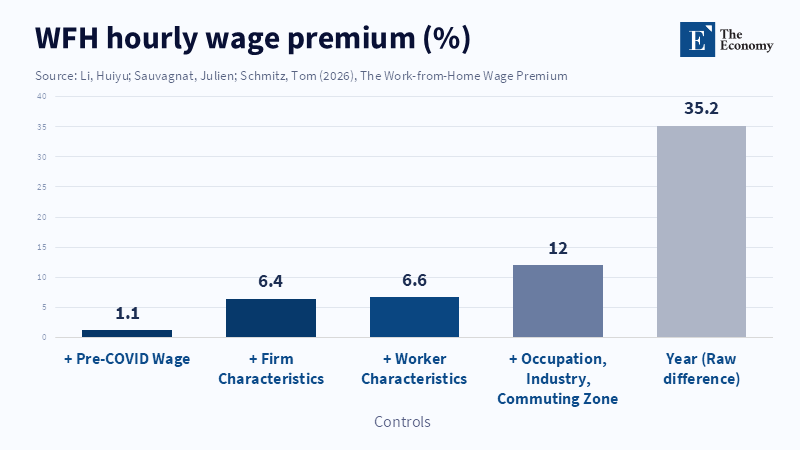
The idea of a work-from-home (WFH) wage increase seems appealing, but a closer look shows a more complex reality. It's true that people who work from home tend to earn more per hour than those who work on-site. Studies have shown this gap can be around 35%. A closer analysis shows that the gap narrows when accounting for factors such as job type and education. It turns out a big chunk of that premium can be explained by how much these people were earning even before the pandemic. This isn't just a minor detail. It tells us that the labor market has changed since the pandemic. On the one hand, there are highly skilled people who have kept their high salaries and now enjoy more freedom and less commuting. On the other side, many people are willing to accept lower wages to keep working remotely or in a hybrid way because it fits their family needs and where they live. The term WFH wage increase sounds simple and neat, but it can be misleading because it conflates two very different situations: one in which people have power and privilege, and another in which they have to make tough choices and compromises. Educators, leaders, and politicians need to understand this difference rather than treating remote work as a catch-all solution, either controlling or encouraging it.
The Numbers Behind the Headlines
A common claim is that remote workers earn much more than on-site workers, but this difference disappears when researchers account for factors such as job titles, industries, and locations. According to a study by the Federal Reserve Bank of San Francisco, within the same occupation, industry, and commuting area, workers who work from home earn on average 12 percent higher hourly wages than those who work entirely on site. But when they considered job type and education, that difference dropped to about 12%. And after considering factors like the worker's skills and the company's performance, it fell even further to around 6–7%. What's important is that when they included the workers' average wages from before the pandemic (2018–19), the increase disappeared almost completely. This suggests that those who are now working from home were already earning more before remote work became widespread.
This pattern makes sense, as jobs that allow remote work often require highly skilled workers. These workers already had good pay because of their expertise, their company's reputation, and the nature of their work. According to a study by the Federal Reserve Bank of San Francisco, workers whose jobs require them to be physically present or to interact directly with customers generally do not receive the remote-work wage premium, which, on average, gives work-from-home employees 12% higher hourly pay than those working fully on-site. As a result, for these on-site workers, remote work does not translate into additional income. Instead, it reflects the fact that higher pay and remote flexibility often go hand in hand. Policies that assume this increase applies to everyone risk overlooking the benefits that actually exist.
The Trade-Offs: Who Gains, Who Sacrifices?
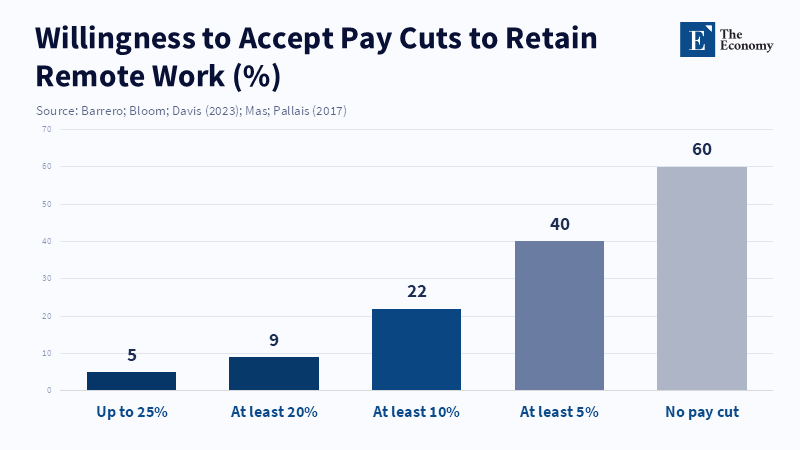
While some people enjoy the benefits of remote work without sacrificing any pay, many others are willing to accept a lower salary to avoid commuting. Surveys and studies indicate that a substantial number of workers are willing to trade income for flexibility. For example, one worker survey found that 40% would accept a pay cut to continue working remotely, and around 9% would give up 20% or more. This isn't just empty talk. Subsequent studies and nationwide analyses have shown that hybrid entirely remote arrangements have been linked to somewhat lower earnings for many workers. For instance, an Australian study using HILDA microdata estimates that hybrid workers earned almost 6% less than similar employees who did not work from home.
These numbers aren't contradictory, but complementary. They show two things. First, some workers, in areas such as tech and professional services, value the time they save from commuting and the ability to manage family needs or personal projects. For them, the decision to trade pay for flexibility is a well-thought-out calculation. Second, for lower-paid workers or those with less bargaining power, remote options may be one of the few ways to better balance their lives. For parents, a small pay cut in exchange for fewer hours spent commuting can improve their family's well-being. This is a real benefit, but it's not an income increase in the traditional sense. It's a swap of money for time and caregiving ability.
Rethinking the Discussion
If we agree that WFH outcomes vary by pay and job type, then our discussion needs to shift from whether remote work raises wages. To which workers profit, and which trade income for time? This change in perspective alters both the questions we ask and the solutions we seek. For schools, vocational programs, and higher education, the message is to create programs that expand access to skills that are useful for remote work. While this isn't a perfect solution, targeted training in computer skillsal litadvanced problem-solvingsolving, and client communication gives workers more options in a hybrid job market. For companies and unions, it's essential to be open about how location and flexibility affect compensation. Employers should state whether remote positions are compensated differently and explain why. Government policy shouldn't treat remote work as a uniform perk that automatically reduces inequality. Instead, it must consider the fact that the benefits tend to concentrate among those who are already privileged. The OECD's research on the geographical distribution of remote jobs shows that remote-friendly jobs are clustered in specific cities and industries, which further increases regional inequality unless addressed.
To address this, we can implement practical changes. Income support for caregivers and transportation subsidies can soften the negative effects when workers accept lower pay but gain time for care. Investments in broadband and local co-working spaces can expand access to well-paying remote jobs for more people. It's important to avoid blanket return-to-office mandates, as these risk forcing high-value remote workers back into commutes while leaving others stuck in low-paying, in-person jobs. The important question is: what combination of training, infrastructure, and equitable labor policies will enable more workers to turn WFH into real earning opportunities rather than forced trade-offs?
Practical Steps for Key Players
Educators should include practical telework skills in core programs, not treat remote work as an afterthought. Courses in working together online, meeting deadlines, and managing remote clients should be widely available. Employers should identify tasks that can be safely performed remotely and create clear pay scales for each position that reflect the job's requirements, rather than outdated stereotypes about location. When companies see increased output from remote work, this should be reflected in pay structures. Government leaders need to recognize that remote work is a part of the labor market, not just an office logistics issue. This means funding short-term retraining programs and supporting regional hubs that connect local talent to remote job openings in higher-paying industries. Data from surveys and employment records show that these actions are reasonable because the option to work remotely is not evenly distributed across jobs and locations.
Some might argue that training and hubs can't address deeply rooted issues with wages or hiring practices. That's a fair point. Training alone rarely changes what companies want. But combining efforts to increase the supply of skilled workers (through training, broadband, and local hubs) with incentives for companies to hire remotely (slike tax breakseaks for companies that offer remote apprenticeships and requirements for pay transparency in remote positions) and social support (such as childcare subsidies and transportation vouchers) increases the likelihood that remote access will translate into income gains rather than sacrifices. The policy approach needs to be comprehensive; single solutions won't be enough.
According to research from the Federal Reserve Bank of San Francisco, workers who work from home earn on average 12% higher hourly wages than their on-site counterparts within the same occupation, industry, and commuting area. This means that, for many professionals, remote work provides a significant pay advantage in addition to their existing high salaries. For many others, remote options represent a compromise with less money in exchange for time and flexibility, which is important for managing their households. If we treat the increase as universal, our policies will be misguided. Instead, we should focus on the split: expand access to remote skills and infrastructure, require pay transparency for remote positions, and support caregiving and local services that allow lower-paid workers to maintain their earnings while reducing their time costs. According to a 2026 article by Huiyu Li and colleagues, workers who work from home earn on average 12 percent higher hourly wages than fully on-site workers within the same occupation, industry, and region. While these steps cannot guarantee that remote work will universally lead to higher wages, they could help transform remote work from a privilege into a means for reducing wage inequality. The challenge now is to develop that instrument effectively.
The views expressed in this article are those of the author(s) and do not necessarily reflect the official position of The Economy or its affiliates.
References
Aksoy, C.G., Barrero, J.M., Bloom, N., Davis, S., Dolls, M. and Zarate, P., 2024. How and why work-from-home rates differ across countries and people. VoxEU.org.
Bartik, A., Cullen, Z., Glaeser, E.L., Luca, M.J. and Stanton, C.T., 2024. The Rise of Remote Work: Evidence on Productivity and Preferences from Firm and Worker Surveys. Journal of Economics & Management Strategy, 34(3), pp.759–772.
CEDA (Committee for Economic Development of Australia), 2025. Australians are taking a pay cut to work from home. CEDA Research Report.
Glaeser, E.L., (co-author in Bartik et al. paper), 2024. (see Bartik et al. 2024).
INSEE (Institut national de la statistique et des études économiques), 2025. Hybrid work in France: telework statistics, first half 2024. INSEE Statistical Release.
Li, H., Sauvagnat, J. and Schmitz, T., 2026. The Work-from-Home Wage Premium. CEPR Discussion Paper 20996 / VoxEU Column (February 24, 2026).
Mas, A. and Pallais, A., 2017. Valuing Alternative Work Arrangements. American Economic Review, 107(12).
OECD (Organisation for Economic Co-operation and Development), 2023. The New Geography of Remote Jobs? Evidence from Europe. OECD Policy Report.
Pabilonia, S.W. and Vernon, V., 2025. Remote work, wages, and hours worked in the United States. Journal of Population Economics, 38.
David O’Neill is a Professor of AI/Policy at the Gordon School of Business, SIAI, based in Switzerland. His work explores the intersection of AI, quantitative finance, and policy-oriented educational design, with particular attention to executive-level and institutional learning frameworks.
In addition to his academic role, he oversees the operational and financial administration of SIAI’s education programs in Europe, contributing to governance, compliance, and the integration of AI methodologies into policy and investment-oriented curricula.