Why Taiwan’s defence readiness is unraveling at the seams

Keith Lee is a Professor of AI/Finance at the Gordon School of Business, part of the Swiss Institute of Artificial Intelligence (SIAI). His work focuses on AI-driven finance, quantitative modeling, and data-centric approaches to economic and financial systems. He leads research and teaching initiatives that bridge machine learning, financial mathematics, and institutional decision-making.
He also serves as a Senior Research Fellow with the GIAI Council, advising on long-term research direction and global strategy, including SIAI’s academic and institutional initiatives across Europe, Asia, and the Middle East.
Authored On
Modified
Taiwan defence readiness now depends more on political unity than on rising military budgets
Institutional paralysis weakens deterrence and makes allied support less certain
Without bipartisan reform, Taiwan defence readiness will remain fragile in the face of China
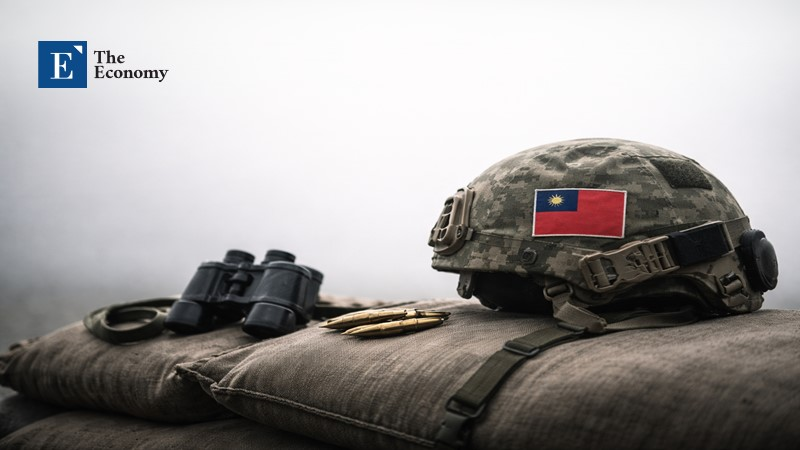
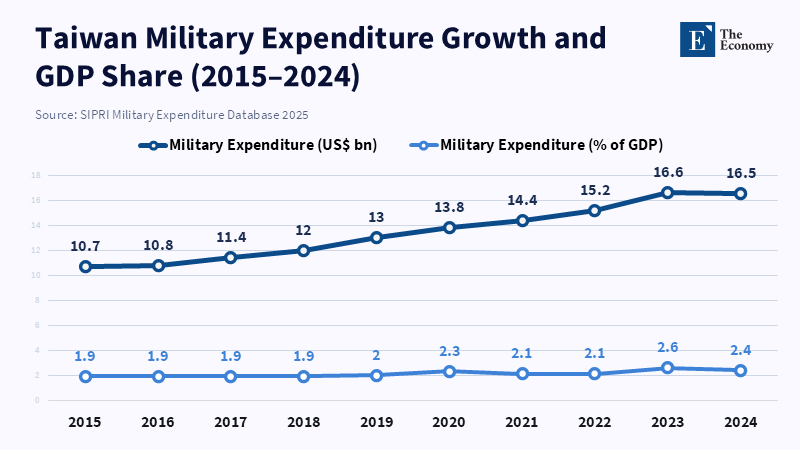
Over the last 10 years, the formal position of Taipei’s defense has grown stronger, but its practical application has weakened. To be precise, Taipei's military expenses increased to about $16.5 billion in 2024, up almost 50% from 2015. Despite this, the political structure that funds, manages, and supports these forces is visibly fragmented. This division is more than just internal disagreement. It puts Taiwan in a difficult position, caught between an assertive China, an unpredictable United States, and regional partners like Japan and South Korea, whose political strategies can quickly change. The situation poses a paradox: increased funding does not correlate with improved, coordinated capabilities when unity is most crucial. If the allocated budget cannot be turned into reliable, interoperable capabilities because institutions are stagnant or international allies question Taipei's political clarity, then verbal support from partners will not be sufficient to protect against coercion. It also will not offer much comfort to the soldiers who would have to fight if deterrence fails.
Taiwan’s Defense Readiness: Political Division Faces Strategic Reality
The central point is that defense readiness should be evaluated not just by looking at procurement or overall budgets, but by examining the political and fiscal factors that enable long-term defense improvement. For a long time, experts considered Taipei's defense spending trends as the main sign of resilience. This made sense when the political system was functioning correctly. That's not enough now. Higher budgets and the acquisition of advanced weapons provide options. However, they do not, by themselves, create trustworthy deterrence if the supply chain, mobilization plans, governmental coordination, and communication with allies are disrupted by a constitutional deadlock.
The constitutional crisis that emerged after Taiwan’s split election in 2024, with a divided executive and legislature leading to court gridlock and budget disputes, has resulted in delays in special defense funding, stalled procurement processes, and struggles to transform one-time arms sales into combat readiness. These are not simply hypothetical problems. They are real weaknesses that opponents observe and that foreign supporters consider during internal discussions.
The main challenge for Taipei is not whether it can purchase a group of missiles in any given year. Instead, the question is whether a government established through democratic mechanisms can establish a stable, consistent, and secure stream of funding and authority needed for planning, training, and maintenance. When the legislature refuses to approve budgets or when judicial gridlock paralyzes government functions, multi-year contracts are delayed, maintenance schedules fall behind, and incentives for recruitment and retention weaken. According to a report from AInvest, increased defense spending in Taiwan has led to greater political divisions and heightened disagreements over national priorities, which can make international partners more hesitant to engage in major deals that require steadiness and dedication.
Taiwan’s Defense Readiness: Why Allies Hesitate
Allied support is important in three main areas: weapons and supplies; joint operations, planning, exercises, and bases; and political support, including public and congressional willingness to act. The United States has been the main supplier of modern equipment to Taipei for many years and has a well-established legal and political structure—the Taiwan Relations Act and decades of defense cooperation—that forms this assistance. The U.S. assessment is not automatic. Congressional support, executive focus, and public opinion are all considered in light of one central question: Is Taipei united and reliable enough to justify the costs for allies? When Taipei’s internal politics show division, U.S. and allied lawmakers and officials question whether their votes, funds, and risks will lead to lasting deterrence or simply to equipment that cannot be used or maintained.
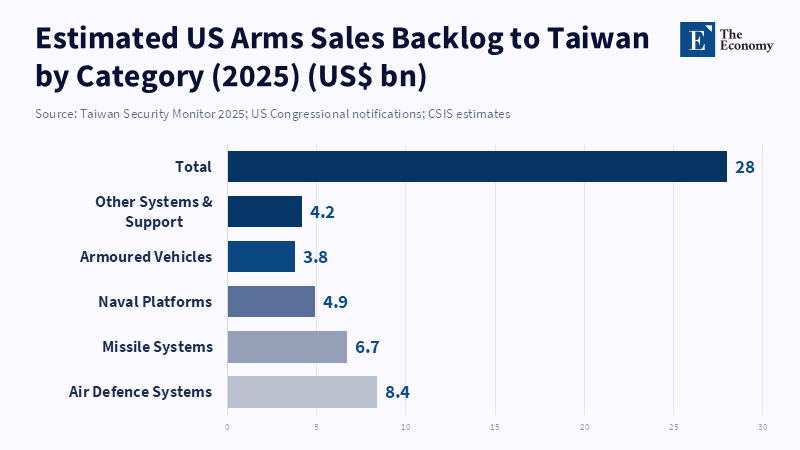
This concern has realistic results. There is a steadily growing backlog of arms sales because a notification does not guarantee delivery. Procurement processes, industrial capacity, and supply lines all require time and political consistency. The recent increase in arms notifications can be helpful, but only if the process from notification to deployment is consistent and well-funded.
Japan and South Korea are unpredictable factors in this situation. Tokyo has clearly increased its spending and strategic-oriented stance, but its political leaders focus on their own alliance calculations and domestic consensus. Seoul’s approach is even more dependent on conditions; its tactical focus is mainly on the Korean Peninsula, and its ties with Beijing can influence its stance toward Taipei. Both partners will assess the level of practical support against domestic political costs and the clarity of the U.S. commitment. Because of this, even if military equipment and moral support are promised, allied operational support in a crisis, which includes access to bases, logistical support, intelligence sharing, and intervention timelines, will be slower or more limited if Taipei’s leaders cannot show internal unity and a credible, bipartisan defense plan. The bottom line is obvious: divided domestic politics reduces allies' enthusiasm to escalate action on Taipei’s behalf.
Taiwan’s Defense Readiness: Policy Revisions That Impact Results
If credibility is what counts, then four changes will help regain it. The first is to protect defense budgets institutionally. Taiwan needs a system that guarantees long-term core defense funding, even during wider financial disputes. This could entail a constitutional or legal rule that protects basic defense appropriations and critical procurement timelines from periodic paralysis.
The second is a bipartisan agreement on capability priorities. Parties must turn verbal unity, which involves resisting China and defending Taiwan, into a short, agreed-upon list of essential capability improvements such as asymmetric missiles, mobile air defense systems, munitions stocks, distributed logistics, and reserve mobilization. These priorities should be politically untouchable and measured with clear, transparent metrics.
The third is to make allied integration plans that lower political friction. This would include specific, practiced plans for logistics, maintenance hubs, and joint training exercises that can be activated without needing new parliamentary votes. In practice, this requires more pre-positioned supplies, faster FMS-to-field timelines, and clearer guarantees about supply chains for key systems.
The fourth is to enforce civil-military resilience measures that make mobilization predictable and fair, including standardized conscription reforms with well-defined timelines, defined local government roles in exercises, and funding for reserve support. These four steps address funding and procurement, sending a bipartisan message, and enhancing operations through allied integration and mobilization.
Every step is achievable, but not easy. Protecting defense budgets will require political compromise and possibly legal evaluations. A bipartisan capability agreement requires leadership from officials willing to put aside short-term partisan gains. Allied pre-positioning and logistics need negotiation, as well as assurance from Congress that Taipei will fulfill its obligations. These are not vague ideas; the analysis of the arms backlog and recent arms packages shows that the industrial and monetary resources are available. What is missing is long-term political stability and the legal structure to keep funds and actions moving when normal partisan disagreements would otherwise stop progress.
Taiwan’s Defense Readiness: Expected Criticisms and Responses
Criticism 1: This argument exaggerates the result of politics; equipment and training are what matter most. Response: Equipment and training are important only if they can be maintained and included in a consistent deterrence plan. Delays that extend procurement delivery dates or cut maintenance budgets decrease operational readiness faster than individual procurement decisions can fix. Defense capability depends on the whole system. When governance fails, the entire system fails.
Criticism 2: Allies will step in regardless of whether democracies unite. Response: Allies take action through their domestic political institutions. Their willingness to risk military force depends on close scrutiny of costs and benefits. Continuing internal dysfunction in Taipei weakens these considerations and reduces the political support allies are willing to offer.
Criticism 3: Constitutional problems are a domestic issue. Response: In an era of international competition, domestic legal paralysis has international results. A frozen budget limits not only national defense but also the society-wide resilience needed for long-term deterrence and mobilization. This becomes an international problem when the stakes involve a major-power conflict.
Practical concerns can be addressed. Concerns about ceding too much parliamentary oversight can be addressed by narrow, well-defined exceptions for important multi-year defense needs, along with transparency and audit processes. Concerns about reliance on the U.S. can be reduced through regional logistics and maintenance agreements with Japan and other like-minded partners, which share the risks and involvement. These actions protect democratic accountability while protecting important functions from paralysis. They are technical changes that can greatly benefit politics, but only if political figures favor national survival beyond short-term benefits.
Taipei is spending more on defense than it did 10 years ago, but its political system now introduces uncertainty into something that money cannot buy: credibility. If those defending Taiwan are to have a chance to fight effectively, political leaders must treat defense as a non-partisan public need and reorganize institutions. This is necessary to ensure that important funding, procurement, and allied integration cannot be used as weapons in everyday politics. Allies can offer support, but only if Taipei demonstrates domestic unity consistent with its spending commitments. The key issue is not whether Taipei can purchase military systems; it is whether it can turn those buys into long-term, practical capabilities at scale and speed. Time is running out. The opportunities to reform legal processes, establish budget safeguards, and secure an allied-friendly support structure are limited. Once a crisis starts, making these changes becomes far more difficult and expensive. The best approach now involves bipartisan agreements, protected budgets, allied operational agreements, and civil-military resilience plans, all designed not to avoid politics but to make politics support national survival. The security of the Taiwan Strait depends on it.
The views expressed in this article are those of the author(s) and do not necessarily reflect the official position of The Economy or its affiliates.
References
Chen, Fang-Yu, Wu, Charles KS, Wang, Austin and Yeh, Yao-Yuan, 2026. Taiwan’s constitutional impasse is jeopardising defence resilience. East Asia Forum.
ConstitutionNet authors: Lee, Yi-Li; Lee, Shao-Man; Lin, Chien-Chih; Weng, Vivianne Yen-Ching, 2024. Taiwan's Constitutional Court at Risk: Political Maneuvering to Erode Judicial Independence. ConstitutionNet, International IDEA.
CFR: Masters, Jonathan and Merrow, Will, 2024. U.S. Military Support for Taiwan in Five Charts. Council on Foreign Relations.
Gomez, Eric and O’Connor, Joseph, 2025. Taiwan Arms Sale Backlog, December 2025 Update. Taiwan Security Monitor, George Mason University.
Hioe, Brian, 2025. With Constitutional Court Deciding Against Unfreezing Itself, Taiwan’s Constitutional Crisis Continues. New Bloom Magazine.
Weng, Dennis LC, 2025. Taiwan needs bipartisan defence consensus. East Asia Forum.
SIPRI authors: Xiao Liang; Nan Tian; Diego Lopes da Silva; Lorenzo Scarazzato; Zubaida Karim; Jade Guiberteau Ricard, 2025. Trends in World Military Expenditure, 2024. SIPRI Fact Sheet, April 2025.
Reuters: Ben Blanchard (reporting), 2025. Taiwan president ups defence spending target to 5% of GDP. Reuters.
Taiwan Ministry of National Defense, 2025. National Defense Report 2025. Ministry of National Defense (ROC).
Keith Lee is a Professor of AI/Finance at the Gordon School of Business, part of the Swiss Institute of Artificial Intelligence (SIAI). His work focuses on AI-driven finance, quantitative modeling, and data-centric approaches to economic and financial systems. He leads research and teaching initiatives that bridge machine learning, financial mathematics, and institutional decision-making.
He also serves as a Senior Research Fellow with the GIAI Council, advising on long-term research direction and global strategy, including SIAI’s academic and institutional initiatives across Europe, Asia, and the Middle East.