A Chinese Invasion of Taiwan Could Slash U.S. GDP by 11%, 2027 War Scenario and Concerns Over U.S. Military Disadvantage Resurface

Aoife Brennan is a contributing writer for The Economy, with a focus on education, youth, and societal change. Based in Limerick, she holds a degree in political communication from Queen’s University Belfast. Aoife’s work draws connections between cultural narratives and public discourse in Europe and Asia.
Authored On
Modified
U.S. GDP Projected to Evaporate in Event of Chinese Invasion of Taiwan
2027 War Scenario Reemerges, U.S.-Taiwan Joint Operational Posture Taking Shape
Warnings Over Fragile U.S. Combat Sustainability, Possibility of Defeat Raised
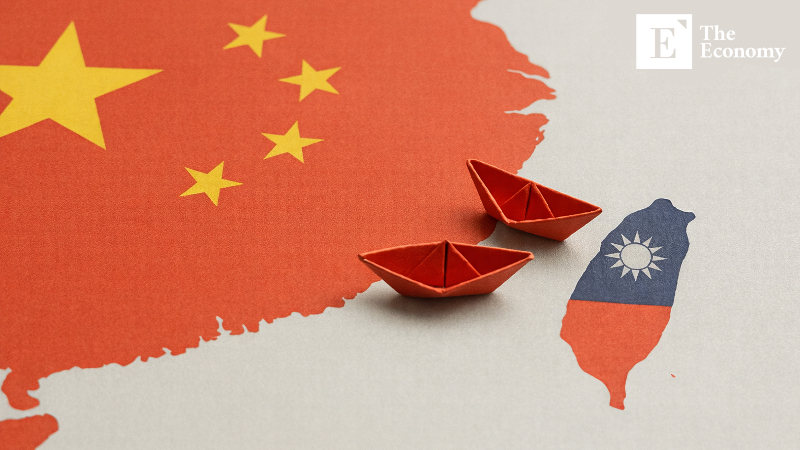
A projection has emerged that the U.S. economy could suffer a devastating blow in the event of a Chinese invasion of Taiwan. The disruption of Taiwan’s semiconductor supply chain, a linchpin of the advanced technology sector, would erode the competitiveness of major American big tech companies and potentially wipe out more than 10% of U.S. gross domestic product (GDP), according to the analysis. As scenarios pointing to a potential outbreak of war in 2027 and even the prospect of U.S. military inferiority gain traction, risks surrounding the Taiwan Strait are rapidly escalating from theoretical assumptions into tangible strategic variables.
Flashpoint in the Taiwan Strait
According to Taiwan News, an English-language outlet in Taiwan, on the 24th local time the U.S. Department of Commerce and the National Security Council recently convened leading global technology firms including Apple, Nvidia, AMD, and Qualcomm for a 2027 supply chain risk briefing. During the session, U.S. security officials shared simulation results indicating that a complete cutoff of semiconductor supplies from Taiwan could trigger a contraction of up to 11% in U.S. GDP. Such an impact would rival the Great Depression and amount to roughly twice the shock of the 2007–2009 financial crisis.
Bloomberg Economics, the research arm of Bloomberg, has likewise released a report outlining similar findings. The report projected that in the event of war triggered by a Chinese invasion of Taiwan, the global economy could forfeit $10,600,000,000,000—equivalent to 9.6% of global GDP—in the first year alone. U.S. GDP, given Washington’s near-certain involvement in such a conflict, was forecast to contract by 6.7%.
Bloomberg Economics further warned that a war would effectively sever the world from the semiconductor supply chain. TSMC, the cornerstone of Taiwan’s semiconductor industry, accounts for 70% of global foundry revenue and serves as the primary chip supplier to leading U.S. technology giants. The combined market capitalization of Nvidia, Apple, and other top ten TSMC clients stands at nearly $14,000,000,000,000. Any disruption to Taiwan’s semiconductor supply chain would therefore reverberate across global industry, with the United States at the epicenter. Given that these firms constitute the principal drivers of the U.S. equity market’s rally, financial markets would likely be engulfed in severe turbulence.
Will China Invade Taiwan in 2027?
Such projections are increasingly viewed as grounded in material risk. The pillars that have sustained peace in the Taiwan Strait since the establishment of diplomatic ties between the United States and China in 1979 are showing visible strain. The United States is gradually forfeiting its military edge, while China is signaling with growing candor its willingness to employ force to achieve unification. Simultaneously, Taiwan’s internal consolidation of a democracy-based distinct identity has further narrowed prospects for a peaceful compromise.
Amid these dynamics, renewed attention has focused on the possibility that China could launch an invasion in 2027, when President Xi Jinping’s third term concludes. In 2022, then-CIA Director William Burns stated that Xi was determined to pursue unification with Taiwan and had instructed the Chinese military to be prepared to successfully conduct an invasion by no later than 2027. Burns added that tensions in the Taiwan Strait were expected to intensify over the coming decade and that Xi was observing developments in the Ukraine war with “the eyes of a hawk.” Former CIA Deputy Director David Cohen, former U.S. Indo-Pacific Commander John Aquilino, and former Chairman of the Joint Chiefs of Staff Mark Milley have likewise identified 2027 as a critical juncture at which China could plausibly resort to force against Taiwan.
At present, the United States and Taiwan are establishing a joint operational posture with such scenarios in mind. Taiwan’s United Daily News reported on the 29th of last month, citing military sources, that the Taiwanese armed forces established a Joint Firepower Coordination Center last year to integrate command-and-control systems with U.S. forces. During Chinese military encirclement drills around Taiwan late last year, U.S. personnel were frequently observed entering and exiting the center to conduct joint operations with Taiwan’s Ministry of National Defense and General Staff. The newspaper further cited multiple sources as stating that a digital countdown clock has been installed at the center, marking “January 1, 2027” as the invasion “D-day” and ticking down in seconds.
U.S. Military Vulnerabilities
Some analysts have advanced a more pessimistic assessment, arguing that the United States could face defeat should a Chinese invasion of Taiwan materialize. Last month, the Heritage Foundation, a prominent U.S. conservative think tank, published a report assessing vulnerabilities in fuel and munitions under a scenario of a 365-day U.S.-China conflict in the Western Pacific. The report concluded that the United States confronts significant risks in terms of combat sustainability, warning that such weaknesses could prove decisive liabilities in a confrontation with China. Specifically, it cited limitations in at-sea refueling due to an aging tanker fleet, vulnerabilities in strategic sealift capacity, and an excessive dependence on a small number of “mega hubs” for fuel and munitions supply.
The Heritage Foundation cautioned that unless the United States acts to undermine China’s strategic petroleum reserves and long-range precision strike capabilities while prioritizing disruption at the outset of hostilities, it would fail to prevent a Chinese invasion of Taiwan or the fall of other nations within the First Island Chain, including Japan. It further warned that without fundamentally expanding alliances and scaling up production of long-range precision weapons, the United States would be unable to project or sustain influence in the Indo-Pacific.
These scenarios are casting a shadow over Taiwan’s economic ascent, which has been buoyed by the artificial intelligence boom. On the 13th, Taiwan’s Directorate-General of Budget, Accounting and Statistics sharply revised its GDP growth forecast for this year upward by 4.17 percentage points from 3.54% projected in November last year to 7.71%. It projected that Taiwan’s GDP would exceed $1,000,000,000,000 this year, with per capita GDP reaching $44,181. Economic optimism, for now, retains momentum. A market specialist noted, however, that as scenarios of a Chinese invasion of Taiwan become more concrete, confidence in the stability of Taiwan’s semiconductor production lines would inevitably erode, adding that if the semiconductor sector, the backbone of the economy, falters, Taiwan’s growth trajectory would swiftly lose momentum.
Aoife Brennan is a contributing writer for The Economy, with a focus on education, youth, and societal change. Based in Limerick, she holds a degree in political communication from Queen’s University Belfast. Aoife’s work draws connections between cultural narratives and public discourse in Europe and Asia.
Similar Post