Government Regulations and Move-In Cliff Deepen Seoul’s Jeonse Crunch, Signaling a Structural Reordering of the Rental Market

As one of the youngest members of the team, Tyler Hansbrough is a rising star in financial journalism. His fresh perspective and analytical approach bring a modern edge to business reporting. Whether he’s covering stock market trends or dissecting corporate earnings, his sharp insights resonate with the new generation of investors.
Authored On
Modified
Seoul jeonse listings plunge 15% in a month, supply-demand index hits highest level since 2021
Supply contracts under stringent regulations and declining move-in volumes
Property market enters a new phase of structural adjustment, with accelerated shift from jeonse to monthly rentals projected

Seoul is grappling with a persistent shortage of jeonse supply. Following the government’s October 15 measures announced last year, constraints on “trading up” into premium districts and gap investment across the greater Seoul area have tightened, while a decline in new move-ins has further curtailed available listings. Market participants warn that if this trajectory endures, the accelerating conversion of jeonse contracts into monthly rentals could trigger a broad-based restructuring of the rental market.
Dried-Up Jeonse Listings in Seoul
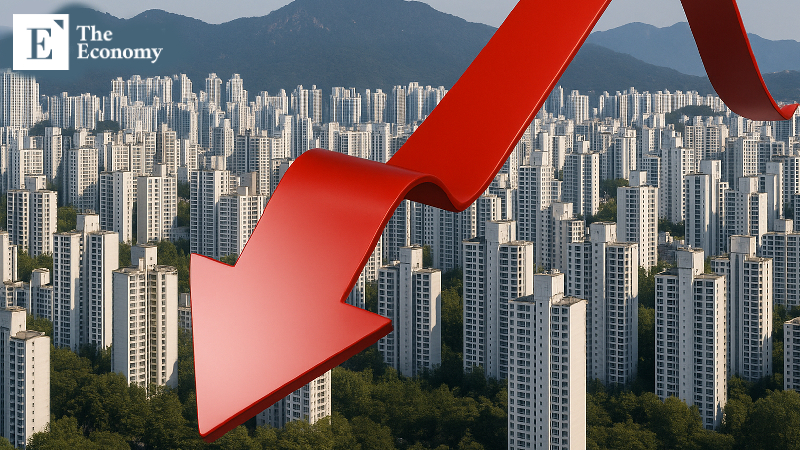
According to property data analytics firm Asil on the 25th, the number of jeonse listings for Seoul apartments stood at 18,683 as of the 23rd. This marks a 15.7% drop from a month earlier, when listings totaled 22,156. Dobong District posted the steepest decline at 34.8%, followed by Nowon District at 33.4%, Mapo District at 32.7%, and Gwanak District at 30.6%.
As listings contract, turbulence within the rental market is intensifying. KB Real Estate’s monthly jeonse supply-demand index, which stood at 125.20 in January last year, surged to 163.73 last month, the highest level since September 2021, when the market experienced a full-blown jeonse crisis and the index reached 167.65. A reading above the baseline of 100 indicates that demand outstrips supply.
On-the-ground conditions underscore the severity of the shortage. As of the 25th, Naver Pay’s real estate platform showed just two jeonse listings at Gwanak Dream Town in Bongcheon-dong, Gwanak District. Two months ago, more than ten listings had been available. For units with an exclusive area of 114 square meters, the jeonse deposit stands at $550,000, while 84-square-meter units are priced at $440,000. Gwanak Dream Town, a large-scale complex with 3,544 units, remains one of the most sought-after developments in Gwanak District, where rental demand is consistently robust.
At Raemian Gileum Centerpiece, a 2,352-unit complex in Gileum-dong, Seongbuk District, only two jeonse listings were available. The jeonse deposit for an 84-square-meter unit is $820,000, while a 59-square-meter unit commands $540,000. The 84-square-meter jeonse price hovered around $600,000 between June and November last year, before climbing rapidly and setting a record at $690,000 on the 10th of this month. Within just over ten days, asking prices have jumped by nearly $150,000 again.
Gap Investment Restrictions Severely Curtail Supply
The evaporation of Seoul’s jeonse listings is rooted in the government’s aggressive regulatory drive. In October last year, authorities unveiled the October 15 measures, capping mortgage loans at $300,000 for homes priced above $1.1 million and $150,000 for homes exceeding $1.9 million, thereby raising transaction barriers for high-end apartments. Investment and upgrade demand concentrated in prime districts such as Gangnam has since lost momentum. The stress debt service ratio was raised to 3%, and lending restrictions were broadened to encompass jeonse loans, interim payment loans, and relocation loans.
In addition, the government designated 27 areas as “triple-regulated zones”—covering all 25 districts of Seoul, including the three Gangnam districts (Gangnam, Seocho, and Songpa) and Yongsan, as well as 12 districts south of the Han River in Gyeonggi Province—subjecting them simultaneously to adjustment area status, speculative overheating district rules, and land transaction permit requirements. In land transaction permit zones, buyers must fulfill a two-year owner-occupancy obligation from the date of acquisition; violations may result in compulsory fines or permit revocation. The policy effectively eliminated the practice of purchasing homes with existing jeonse tenants in place, widely known as gap investment. As a consequence, the supply of apartment jeonse listings has contracted sharply.
Rising jeonse prices have also prompted more existing tenants to renew their contracts. According to KB Real Estate, the average jeonse price for Seoul apartments reached $500,000 last month, extending its upward streak to 30 consecutive months since August 2023. This represents a $28,000 increase from a year earlier, when the average stood at $470,000, and approaches the previous peak of roughly $500,000 recorded in 2022, when housing prices were at their apex.
Rental Market’s Center of Gravity Shifts Toward Monthly Leases
Market observers anticipate that the jeonse shortage is likely to persist. Declining move-in volumes are constricting absolute supply. Data from Real Estate R114 indicate that total apartment move-ins in the greater Seoul area this year, including rental units, are estimated at 112,064 units, down roughly 15% from last year’s 132,031 units. In Seoul, move-ins are projected to plunge 26% from 37,178 units to 27,620 units. Gyeonggi Province is expected to see a 10% decline from 74,760 to 67,115 units, while Incheon is forecast to contract 14% from 20,093 to 17,329 units. This downward trajectory is projected to continue through 2027, at 110,473 units, and 2028, at 104,356 units.
The temporary suspension of heavy capital gains tax surcharges on multiple homeowners is also nearing its end. Under the Income Tax Act, the basic capital gains tax rate ranges from 6% to 45% across eight progressive brackets, and multiple homeowners currently face only the base rate. However, under directives from President Lee Jae-myung, starting May 10, owners of multiple homes in designated adjustment areas who sell will incur an additional 20 percentage points for two-home owners and 30 percentage points for those holding three or more homes. A market expert noted that heightened tax burdens are likely to encourage multiple homeowners to retain properties in anticipation of long-term appreciation, rather than rush to sell. In that process, a shift toward monthly leases, semi-monthly deposit structures, or intergenerational transfers could further erode jeonse supply. In regulated districts where the use of jeonse deposits is constrained, the shortage may intensify more rapidly.
Some analysts project that the conversion of jeonse to monthly rental contracts across the greater Seoul area will gather further momentum. The current shortage reflects a confluence of policy constraints and supply dynamics that point to a deeper transformation of the housing market. The shift toward monthly leases is already spreading rapidly across Seoul. According to the Supreme Court’s registry information portal, 80,551 residential lease contracts—including apartments, villas, and multi-family homes—received fixed-date certification in Seoul in January. Of these, 55,461 were monthly rental contracts, accounting for 68.9% of the total. This figure exceeds the previous record set in December last year, when the share reached 67.1%, by 1.8 percentage points.
As one of the youngest members of the team, Tyler Hansbrough is a rising star in financial journalism. His fresh perspective and analytical approach bring a modern edge to business reporting. Whether he’s covering stock market trends or dissecting corporate earnings, his sharp insights resonate with the new generation of investors.
Similar Post