Panasonic Transfers U.S. and European TV Sales to Chinese Firm, Accelerating Global Market Realignment Driven by Chinese Offensive

Anne-Marie Nicholson is a fearless reporter covering international markets and global economic shifts. With a background in international relations, she provides a nuanced perspective on trade policies, foreign investments, and macroeconomic developments. Quick-witted and always on the move, she delivers hard-hitting stories that connect the dots in an ever-changing global economy.
Authored On
Modified
Panasonic’s U.S. and European TV Sales Business Handed to China’s Skyworth
Chinese Firms Command Over Half of Japan’s TV Market, Raising Alarm Over Panasonic’s Domestic Foothold
Samsung Electronics and LG Electronics Struggle Against China’s Rapid Expansion in the Volume Segment
Panasonic Holdings of Japan will transfer its television sales operations in the United States and Europe to a Chinese company. The move is intended to reduce fixed costs and operational risks in those regions while sharpening its focus on domestic sales and the development of premium models to bolster profitability. Market observers, however, contend that with Chinese manufacturers already leveraging aggressive pricing to dominate the global TV landscape, Panasonic’s restructuring strategy faces formidable headwinds.
Panasonic’s Strategic Realignment of Its TV Business
According to reports by Kyodo News and NHK on the 24th, Panasonic plans to hand over its TV sales operations in the U.S. and Europe to Chinese home appliance maker Skyworth beginning in April. While maintaining its proprietary TV brand, Panasonic will withdraw from direct sales in those markets to alleviate fixed-cost burdens. A Panasonic official stated that entrusting European and North American sales to Skyworth would reduce expenditures such as advertising and logistics costs while mitigating business risks stemming from intensifying price competition.
Panasonic has long categorized its TV division as a low-profit “challenge business” and has pursued structural reforms. Europe, now to be overseen by Skyworth, accounts for approximately 80% to 90% of Panasonic’s total TV revenue alongside Japan, serving as a core sales base. Yet escalating competition with Chinese rivals has led to a contraction in mid- and small-sized model lineups, resulting in a sharp decline in sales volume. In the U.S., Panasonic previously exited the market following the downturn of PDP products and re-entered in 2024, where its sales footprint remains limited.
Going forward, Panasonic plans to deepen cooperation with Skyworth in development and manufacturing. The company will concentrate on domestic sales and premium model production, while outsourcing the manufacturing of lower-priced overseas models to external partners. Currently, Panasonic produces most high-margin premium TVs at factories in Taiwan and Malaysia, while outsourcing production of small and mid-sized low-cost models and Europe-bound products to third parties such as China’s TCL Group. Skyworth is expected to assume responsibility for part of the production of models destined for Europe.
Chinese Dominance in Japan’s TV Market
Questions persist over whether Panasonic’s renewed focus on its home market can gain traction. Chinese companies are rapidly expanding their influence within Japan’s TV market as well. Last year, Regza—launched after China’s Hisense acquired Toshiba’s TV business—secured the top market share in Japan at 26.0%. Hisense’s own brand ranked third with a 16.6% share, while China’s TCL captured 10.2%. Combined, Chinese manufacturers surpassed a 50% market share in Japan for the first time on record.
The erosion of competitiveness among Japanese TV makers stands as a primary factor behind this shift. Japan’s dominance in the TV sector peaked during the 1970s and 1980s, when it commanded 70% to 80% of the U.S. electronic components market. Even American brands relied heavily on Japanese components to manufacture televisions. The global stature of Japanese TV brands such as Panasonic, Sony, and Toshiba extended through the 1990s. The competitive landscape shifted two decades ago as the market pivoted from cathode-ray tube TVs to LCD models, enabling Korean firms such as Samsung Electronics and LG Electronics to gain prominence. The 2010s saw further erosion of Japanese brands as OLED TVs led by Korean companies entered mass adoption.
Japanese manufacturers subsequently pursued volume-driven market share strategies, yet sustained profitability deteriorated under pressure from technologically advanced Korean rivals and aggressively priced Chinese competitors. Hitachi ceased domestic TV production in 2012, Toshiba sold its TV business to Hisense in 2018, and Mitsubishi Electric exited TV sales in 2024. Sony recently announced plans to separate its TV division and transfer it to a joint venture with China’s TCL. Panasonic now stands as the sole major Japanese electronics company maintaining in-house TV production.
Competitive Dynamics Between Korean and Chinese TV Makers
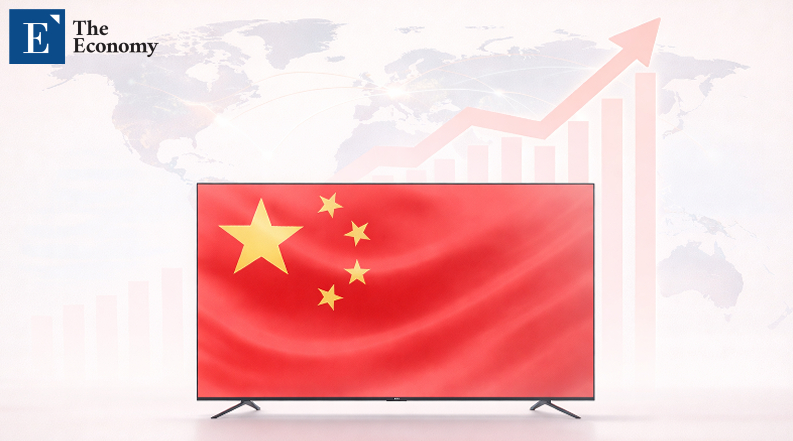
Chinese TV manufacturers are now extending their challenge beyond Japan to threaten the standing of Korean firms. According to Counterpoint Research, the combined global TV shipment share of China’s TCL and Hisense last year surpassed that of Samsung Electronics and LG Electronics. In December alone, TCL captured a 16% shipment share, overtaking Samsung to claim the top position. During the same period, Samsung’s share fell by 4 percentage points month-on-month to 13%.
This divergence reflects a fundamental transformation in market conditions. In advanced economies, rapid expansion of TV sales has become increasingly constrained due to high penetration rates and subdued demand. Chinese manufacturers have capitalized on emerging markets in Asia-Pacific, the Middle East, and Africa—regions characterized by lower penetration and stronger preference for affordable models—to expand their global footprint. Their strategy rests on control of the LCD panel supply chain, which accounts for roughly half of TV production costs, and on the internalization of key components including semiconductors, enabling formidable price competitiveness.
Korean firms are intensifying cost-cutting efforts to penetrate emerging markets while defending profitability in the premium segment through OLED and advanced LCD technologies. Yet rising component prices, including memory semiconductors, have driven up production costs, and Chinese competitors are encroaching upon the premium tier with increasingly sophisticated LCD offerings. In response, Samsung Electronics and LG Electronics have deployed substantial promotional spending to counter mounting pressures. While such measures may bolster short-term sales volumes, industry assessments suggest they offer limited prospects for reinforcing long-term competitive strength.
Anne-Marie Nicholson is a fearless reporter covering international markets and global economic shifts. With a background in international relations, she provides a nuanced perspective on trade policies, foreign investments, and macroeconomic developments. Quick-witted and always on the move, she delivers hard-hitting stories that connect the dots in an ever-changing global economy.
Similar Post