Formalization of France’s ‘Europeanization’ of Nuclear Deterrence, Dual Calculus of Deterring Russia and Securing Security Primacy

Authored On
Modified
Russia’s Expanding Military Capabilities Bringing All of Europe Within Nuclear Range
Modernization of France’s Nuclear Deterrent and Forward Deployment to Allied Territory
Establishment of a Europe-Centered Autonomous Deterrence Architecture Through Continental Security Leadership
The French government has formally unveiled a “forward deterrence” initiative aimed at reshaping Europe’s nuclear order. By signaling both the modernization of its nuclear arsenal and the potential deployment of strategic assets on allied territory, Paris has made clear its intention to broaden the scope of the French nuclear umbrella. With Russia’s advancing strategic weapons placing virtually all of Europe within nuclear range, the initiative is widely viewed as a calibrated move designed to simultaneously pressure an end to the war and recalibrate deterrence. It also aligns with France’s longer-term strategy to consolidate security leadership on the continent amid mounting defense-industrial frictions with Germany.
Announcement of France’s Nuclear Deterrence Initiative
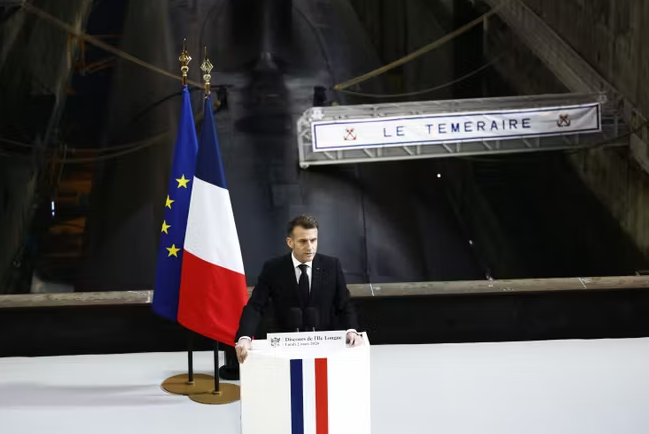
According to AP and other international media outlets on March 2 (local time), President Macron visited the Île Longue naval base in Brittany, western France, where he stated, “It is the responsibility of the President of the Republic to ensure that our nuclear deterrent maintains credible destructive power now and in the future,” adding that France would “continue to modernize and strengthen its deterrent capabilities.” The remarks are interpreted as signaling a potential policy shift from the post–Cold War trajectory of gradual reductions.
In 2020, Macron had proposed that European countries could participate in French nuclear deterrence exercises should they so wish, though the idea gained little traction at the time. The issue has resurfaced following renewed “strategic dialogue” on nuclear deterrence with European Union leaders, including German Chancellor Friedrich Merz, on the sidelines of the recent Munich Security Conference.
France is also reviewing measures to expand the scope of nuclear deterrence cooperation with European partners. Macron indicated that “depending on circumstances, certain strategic assets could be deployed on allied territory,” noting that such assets could include fighter aircraft and other nuclear-capable systems. The proposal is understood to encompass joint exercises, crisis response coordination, and the transmission of strategic signals to potential adversaries.
France reduced its nuclear arsenal from more than 500 warheads in the immediate aftermath of the Cold War to an estimated 300 at present. Alongside the United Kingdom, it remains the only nuclear-armed state in Europe. While France ranks fourth globally after Russia, the United States, and China, its stockpile remains far below that of Russia and the United States, each of which possesses more than 5,000 warheads. Other European countries continue to rely on the United States’ extended deterrence framework within NATO.
In a joint statement issued the same day with Chancellor Merz, Macron announced the establishment of a high-level nuclear steering group to coordinate doctrinal dialogue and strategic cooperation. Both sides reaffirmed their commitment to international legal obligations, including the Treaty on the Non-Proliferation of Nuclear Weapons (NPT). They underscored that nuclear deterrence remains a cornerstone of European security and emphasized that the new cooperation is intended to reinforce, rather than replace, NATO’s nuclear deterrence and sharing arrangements.
Erosion of Europe’s Nuclear Deterrence Under the ‘Moscow Shield’
Behind France’s expanded deterrence concept lies a calculation aimed at accelerating the conclusion of the war in Ukraine. By raising the level of direct strategic pressure on Russia, Paris appears intent on encouraging Moscow’s return to the negotiating table. At the same time, the initiative seeks to construct a durable shield against future Russian military expansion. Russia’s rapid advancement of asymmetric capabilities—including hypersonic missiles and nuclear-capable strategic bombers—has effectively brought the entirety of Europe within nuclear range.
According to the BBC, Russia’s Strategic Rocket Forces test-launched the Burevestnik missile, approximately 12 meters in length, on October 21 last year. The missile reportedly flew about 14,000 kilometers over roughly 15 hours. Valery Gerasimov, Chief of the General Staff of the Russian Armed Forces, formally notified the United States, the EU, and NATO of the test.
Around the same period, Russian President Vladimir Putin referenced the Poseidon nuclear torpedo, first developed in 2015, asserting that the nuclear-powered, nuclear-armed system had entered the final stage of development. Measuring approximately 20 meters in length, weighing 100 tons, and with a diameter of 2 meters, Poseidon is assessed to carry a yield of 2 megatons. Russia has emphasized that, if launched from the North Sea, the Barents Sea, or near Vladivostok, the weapon could simultaneously strike major U.S. ports, naval bases, and critical industrial infrastructure.
In December of last year, Russia also deployed Tu-95MS strategic bombers over neutral waters above the Norwegian and Barents Seas to conduct a planned flight mission. The operation lasted more than seven hours, with portions of the flight escorted by foreign fighter jets. Russian Navy Su-33 fighters accompanied the bombers. Conducted amid the protracted war in Ukraine and sustained military tensions with the West, these operations have heightened vigilance across Europe.
Geopolitical Elevation Amid Franco-German Defense Frictions
France’s nuclear strategy also carries a significant defense-industrial dimension. The next-generation fighter jet development program jointly pursued by France, Germany, and Spain faces the prospect of collapse. According to the German daily Die Welt, Berlin is exploring alternatives after negotiations over the Future Combat Air System (FCAS) stalled. Options under consideration include cooperation with Sweden’s Saab, manufacturer of the Gripen fighter, or joining the Global Combat Air Programme (GCAP) led by the United Kingdom, Italy, and Japan.
Italian Prime Minister Giorgia Meloni and Chancellor Merz reportedly discussed Germany’s potential participation in GCAP during talks in January. Saab CEO Micael Johansson recently stated in an interview with German media that the company is prepared to engage in joint fighter development with Germany, contingent upon a political decision. These developments suggest that Europe’s defense-industrial landscape is entering a phase of reconfiguration.
FCAS is designed as an integrated system combining a sixth-generation fighter aircraft, combat drones, and a combat cloud network into a manned-unmanned teaming architecture. With an estimated total cost exceeding $100 billion, it stands as the largest weapons project in European history. The initiative was first agreed upon in 2017 by President Macron and then–German Chancellor Angela Merkel, targeting operational deployment by 2040, with Spain joining subsequently.
Negotiations deteriorated last year after France’s Dassault Aviation demanded a majority stake in fighter development. Although the three countries had initially agreed to divide the industrial workload equally, Dassault insisted on leading design and core systems integration. Despite efforts to salvage the project, including setting a December deadline last year, the parties have yet to bridge their differences.
In this context, nuclear-sharing discussions may function as a strategic lever. Integrating Germany more deeply into a France-led security architecture could strengthen Paris’s bargaining position in fighter development and export markets. It would also advance France’s ambition to reshape European security sovereignty around a Paris-centered framework. This trajectory aligns with President Macron’s broader political objective of consolidating France’s leadership in European security and foreign policy, thereby advancing a more integrated Europe anchored by French strategic primacy.
Similar Post