[U.S.-Iran] ‘A High-Stakes Midterm Gamble’ — Trump’s Hardline Bet to Block a Radical Regime

Authored On
Modified
Retaliation Continues Despite Khamenei’s Death
“No Time Limit” Signal Delivered in Tandem
Bid to Recast U.S. Political Terrain Through Foreign and Security Policy
U.S. President Donald Trump has signaled the possibility of a prolonged campaign against Iran, jolting the geopolitical balance in the Middle East. Seizing on Tehran’s perceived internal and external fragility, he has effectively cast the dice in pursuit of installing a pro-U.S. government. The move is widely interpreted as an attempt to reassert American primacy in the Middle East, following similar efforts in Latin America, while simultaneously shoring up sagging approval ratings at home.
Trump Signals Willingness for Protracted Conflict
On the 2nd (local time), President Trump addressed the conflict with Iran at the White House, stating, “It doesn’t matter how long it takes. We will get it done,” adding, “We expected it to take four to five weeks, but we have the capacity to sustain it far longer.” It marked his first public remarks on the matter since U.S. forces, alongside Israeli troops, launched strikes against Iran on the 28th of last month.
In a phone interview with The New York Times the previous day, Trump said the operation had initially been planned for “four to five weeks.” His comments were widely interpreted as a clear declaration that Washington stands ready to endure a lengthier campaign, absorbing the necessary costs and burdens to achieve its military objectives.
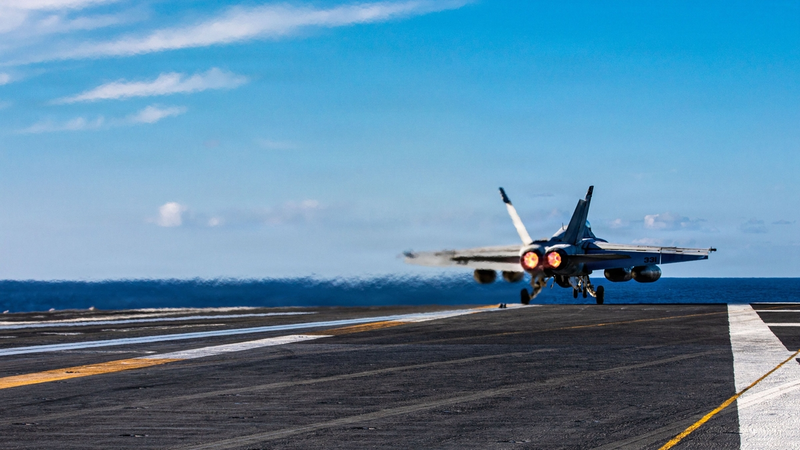
On the same day, Defense Secretary Pete Hegseth and Chairman of the Joint Chiefs of Staff Gen. Dan Caine indicated that additional troop deployments and logistical support were being directed to U.S. Central Command, underscoring preparations for an extended engagement. Hegseth emphasized that U.S. forces were striking “with precision, overwhelming force, and confidence,” while Caine noted that achieving the assigned military objectives would require time and entail arduous operations. “We anticipate the possibility of further losses and are working to minimize casualties on our side,” he said.
The Pentagon disclosed that thousands of troops, hundreds of fighter jets, and two carrier strike groups have been deployed, with tens of thousands of munitions dropped and more than 1,000 targets struck to date. Within two days of the campaign’s launch, the U.S. military claimed to have secured “localized air superiority” over Iranian airspace. Following the deployment of B-2 stealth strategic bombers from the U.S. mainland, B-1 bombers joined the operation the previous night. According to U.S. Central Command, Iranian command-and-control infrastructure, naval assets, ballistic missile sites, and intelligence networks have sustained severe damage. “Two days ago, the Iranian regime had 11 vessels in the Gulf. Today, it has none,” the command stated.
A Once-in-a-Generation Opportunity and a Midterm Calculus
While President Trump has framed the campaign as advancing the freedom of the Iranian people, some in Washington contend that the strategy also aims to consolidate his political base and project decisive leadership. In his interview with The New York Times on the 1st, Trump assessed that “even putting it mildly, Iran has been significantly weakened,” a remark widely viewed as signaling his perception of strategic opportunity amid Tehran’s vulnerability. Iran has been grappling with acute economic distress stemming from prolonged Western sanctions, fueling the largest anti-government protests in its history and exposing visible fissures within the regime.
Moreover, Tehran has struggled to mount a meaningful response following last year’s U.S. “Midnight Hammer” operation targeting Iranian nuclear facilities and subsequent clashes with Israel. Proxy forces including Hezbollah, Hamas, and Houthi militants have suffered substantial attrition in engagements with Israel, diminishing Iran’s regional leverage. According to The Wall Street Journal, Israeli Prime Minister Benjamin Netanyahu and Republican allies have urged Trump in recent months to seize what they described as a “once-in-a-generation opportunity,” arguing that the Iranian government is at its most vulnerable. Earlier this year, Trump authorized a military operation in Venezuela that resulted in the capture of President Nicolás Maduro, bolstering his confidence.
The domestic political landscape, however, presents a formidable challenge. With midterm elections looming in November, Trump’s approval ratings remain subdued. A Pew Research Center survey conducted on the 4th of last month found that 72% of respondents viewed the U.S. economic situation negatively. Analysts suggest that the administration is seeking to reset the political narrative through foreign and security policy, consolidating a weakened support base. Trump’s optimal scenario envisions transforming Iran into a pro-U.S., democratic government, a development that would expand American influence in the Middle East and enhance Washington’s negotiating leverage vis-à-vis China and Russia.
Skepticism persists over the feasibility of such ambitions. Although Iran’s conventional military capabilities have sustained heavy damage, its core power structure is widely assessed as intact. Tehran, for its part, has shown no indication of capitulation. Recent retaliatory strikes reportedly killed four U.S. service members and at least 11 people in Israel, with casualties mounting across other parts of the Middle East.
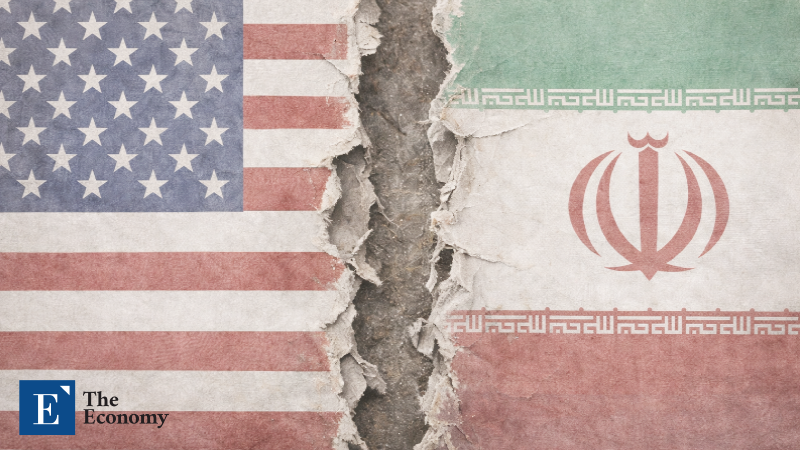
Iran has also dismissed prospects for dialogue with Washington. Following the death of Supreme Leader Ali Khamenei in a U.S. strike, Ali Larijani, Secretary of the Supreme National Security Council and now overseeing Iran’s military and security apparatus, posted on X that Iran would not negotiate with the United States. He sharply criticized what he called “Trump’s delusional fantasy” for plunging the region into turmoil.
Strait of Hormuz Paralysis and Mounting Oil Price Pressures
As the prospect of a protracted U.S.-Iran conflict intensifies, global financial markets have swung sharply. According to Reuters, the euro traded at 1.1769 dollars on the 1st in New York, down 0.4% from the previous Friday’s close. Against the Swiss franc, the euro fell 0.6% to 0.90391, its lowest level since 2015, reflecting heightened demand for safe-haven assets.
Crude prices have also surged. In after-hours trading on the 1st, Brent crude rose 8% to 10% from the previous Friday’s close, settling below 73 dollars per barrel. Oil prices have already climbed more than 20% this year, with market participants floating the possibility of an additional 5 dollars to 10 dollars per barrel increase. The spike followed Iran’s missile launches toward a neighboring state on the 2nd, effectively halting transit through the Strait of Hormuz, through which roughly one-fifth of global seaborne oil and gas flows. According to vessel-tracking firm Kpler, two ships near the strait’s entrance were struck. One was reportedly part of Iran’s so-called “shadow fleet,” while the other was a tanker transporting approximately 500,000 barrels of gasoline from Europe to Saudi Arabia.
Although the Organization of the Petroleum Exporting Countries (OPEC) and its allies under OPEC+ agreed last April to raise output by 206,000 barrels per day, experts caution that such an increase would be insufficient to calm markets if disruptions through the Strait of Hormuz persist. With the risk of Iranian retaliation looming after U.S. and Israeli airstrikes, escalating tensions across the Middle East and the prospect of a renewed oil shock have dampened investor sentiment amid fears of a broader global slowdown.
An oil-driven economic backlash poses a significant risk to President Trump. Should a blockade of the Strait of Hormuz trigger supply disruptions, elevate crude prices, roil financial markets, and fuel inflation, the operational momentum of the Iran campaign could erode. Trump’s earlier remark that the United States could either “take over all of Iran in a long war” or “end the attacks in two or three days” reflects this strategic calculus. Elliott Abrams, who served as special envoy for Iran and Venezuela during Trump’s first term, said, “President Trump wants to be remembered as a consequential historical figure,” adding that if the Islamic Republic established in 1979 were to end in any form, the Middle East order would be fundamentally reshaped. He predicted that a hardline posture would likely continue for the time being.
Similar Post