War’s Shadow Reaches Dubai, Cracks Appear in Gulf Safe-Haven Narrative

Stefan Schneider brings a dynamic energy to The Economy’s tech desk. With a background in data science, he covers AI, blockchain, and emerging technologies with a skeptical yet open mind. His investigative pieces expose the reality behind tech hype, making him a must-read for business leaders navigating the digital landscape.
Authored On
Modified
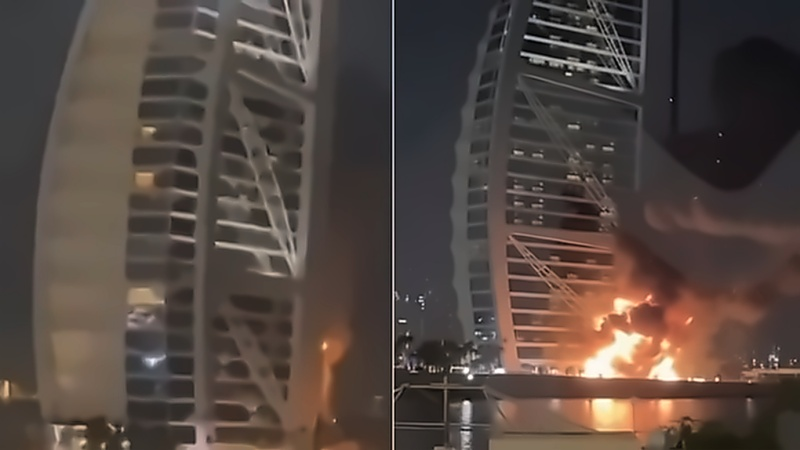
Dubai landmark fire, falling debris nearby
Strengthened defenses stir Middle East weapons market
Possible shifts in global capital flowing into Dubai
As military clashes centered on Iran continue across the Middle East, the impact of the conflict is spreading throughout the Gulf region. Cases have been confirmed in the United Arab Emirates (UAE) and Saudi Arabia where debris from intercepted drones and missiles fell in urban areas, prompting assessments that even the wealthy Gulf states have entered the indirect impact zone of the war.
Damage has occurred even in Dubai, which has developed as a hub for tourism and finance, raising questions about the region’s long-held perception as a “safe zone.” The situation is also drawing market attention as it increases the likelihood that capital flows could shift in the global competition among financial hubs.
Damage from Intercepted Drone Debris
Dubai’s Government Media Office announced on social media platform X on the 1st that “debris from one intercepted drone struck the exterior wall of the Burj Al Arab, causing a small fire,” adding that “fire authorities quickly extinguished the blaze and there were no casualties.” The Burj Al Arab, a seven-star hotel located on the artificial island of Jumeirah, where luxury resorts line the Persian Gulf coast, is widely regarded as one of Dubai’s most iconic landmarks. The office explained that “debris generated during the interception of an Iranian drone strike collided with the hotel’s exterior wall and caused the fire,” adding that “minor damage also occurred in part of a terminal hall at Dubai International Airport during the air-raid response.”
The incident unfolded as Iran launched a large-scale barrage of drones and missiles toward the Middle East in retaliation for airstrikes by the United States and Israel. Iran fired more than 1,000 missiles and drones toward Gulf states including Saudi Arabia, the UAE, Qatar, Bahrain, Kuwait, and Oman. At least seven people were reported killed during the attacks. In the UAE, debris from a missile intercepted by air defenses fell in the capital Abu Dhabi, killing one person, while an incident at Dubai International Airport injured four airport employees.
Damage from falling debris generated during interceptions was confirmed simultaneously in multiple areas. In the Palm Jumeirah district, considered one of Dubai’s most affluent residential areas, wreckage from intercepted missiles fell and damaged building exteriors and vehicles. When reporters from The New York Times visited the area on the 4th for coverage, the shock marks remained visible on building facades and shards of glass still lay scattered on the ground around the buildings. Observers noted that had the missile debris fallen in a slightly different direction, civilian casualties among people inside the buildings would likely have been unavoidable.
As cases emerge in which residential areas and other civilian facilities have fallen within the impact zone of debris generated during interception operations, the possibility of indirect war damage is increasingly being perceived as a tangible risk across the Gulf region. Dubai in particular has established itself as a tourism and financial hub on the foundation of regional stability, but the latest events demonstrate that the fallout from regional conflict can reach even there, creating visible cracks in the perception of the surrounding region as a stable haven. Cinzia Bianco, a Persian Gulf specialist at the European Council on Foreign Relations (ECFR), said, “Given that Dubai emphasizes its image as a ‘safe oasis’ in the midst of an unstable region, this incident represents something close to a worst-case nightmare.”
Signs of Expanded Missile Defense and Weapons Procurement
Against this backdrop, awareness is spreading across Gulf states that missile defense systems and the protection of urban infrastructure must be reassessed. Iran has broadened its retaliatory targets beyond Israel and U.S. military bases to include airports, hotels, and oil-refining facilities in Gulf countries, rapidly destabilizing the regional security environment. In Ras Tanura on Saudi Arabia’s eastern coast, an Iranian drone targeting Aramco facilities—home to one of the largest oil-refining complexes in the Middle East—was intercepted and destroyed. In the Strait of Hormuz, several civilian vessels were attacked after Iran’s Islamic Revolutionary Guard Corps (IRGC) declared a blockade of the waterway, resulting in casualties.
In response, the foreign ministers of the six Gulf Cooperation Council (GCC) states—the UAE, Bahrain, Saudi Arabia, Oman, Qatar, and Kuwait—held an emergency virtual meeting on the 1st to discuss countermeasures. During the meeting, the ministers described Iran’s airstrikes as a “treacherous attack” and warned of the possibility of military retaliation. Gulf countries have historically maintained relatively moderate relations with Iran despite sectarian rivalry, balancing geopolitical tensions with considerations tied to oil exports and regional stability. The situation has shifted markedly following the latest attack. By expanding its targets to include Gulf airports and energy facilities, Iran effectively upended the region’s existing security balance in an instant.
As military tensions intensify, competition to secure weapons systems is also accelerating. The fact that a significant portion of strategic military assets in the Middle East has become outdated is cited as a factor driving these developments. Recently, the UAE reached agreement with South Korea on cooperative projects totaling $65 billion, including $35 billion in defense-industry cooperation alone. Iraq is also reportedly considering the acquisition of as many as 250 tanks as part of a $6.5 billion program to replace aging armored vehicles.
Strain is also emerging within the global weapons supply system. The United States is facing mounting pressure to secure weapons inventories amid the repercussions of military operations against Iran and is urging defense contractors to expand production. To that end, the Trump administration plans to convene executives from major defense companies—including Lockheed Martin and RTX, the parent company of Raytheon—at the White House on the 6th to discuss measures to accelerate weapons manufacturing. The United States has already drawn down billions of dollars’ worth of ammunition and missile stockpiles through its support for the war in Ukraine, military operations in Gaza, and operations against Iran. If tensions in the Middle East persist, competition among Gulf states to secure weapons could further amplify demand in the global arms market.

Erosion of Dubai’s Image as a ‘Safe Asset Haven’
From another perspective, the conflict is also raising concerns about Dubai’s standing as a self-proclaimed global financial hub. Since the 2010s, Dubai has rapidly expanded its influence in the competition among financial centers attracting international capital alongside Hong Kong and Singapore. By actively nurturing the financial sector around the Dubai International Financial Centre (DIFC), the city has attracted more than 3,000 financial institutions. This development laid the foundation for Dubai to become a financial gateway linking the Middle East, Africa, and South Asia, while the emirate aggressively adopted institutional frameworks and policy approaches modeled on Singapore and Hong Kong in its push to strengthen its position in the financial-hub race.
A strikingly favorable tax structure has been a central driver of capital inflows. Within Dubai’s financial free zones, corporate tax and personal income tax are set at 0 percent, and there are no withholding taxes on dividends, interest, or royalties. Foreign investors are permitted 100 percent ownership of businesses, and there are virtually no restrictions on capital movement. This environment has had a direct impact not only on attracting individual wealth holders but also on drawing family offices. According to research by investment-migration consultancy Henley & Partners, the number of high-net-worth individuals in Dubai increased by 102 percent last year compared with 2015 a decade earlier. That figure far exceeds Singapore’s 62 percent growth rate over the same period.
The latest military clashes in the Middle East, however, have begun to undermine the “stable asset haven” image that Dubai has carefully cultivated. Political and military stability ranks alongside taxation as one of the most important factors international wealth holders consider when relocating capital. Family offices and ultra-high-net-worth investors in particular tend to prioritize the security of asset storage and freedom of capital movement above all else. When political tensions rise, it is common for such investors to adopt risk-management strategies that involve shifting part of their assets or allocating new investment funds to other regions. This dynamic explains why growing military tension in the Middle East is increasingly seen as a new variable in the competition among Dubai, Singapore, and Hong Kong as global financial hubs.
Stefan Schneider brings a dynamic energy to The Economy’s tech desk. With a background in data science, he covers AI, blockchain, and emerging technologies with a skeptical yet open mind. His investigative pieces expose the reality behind tech hype, making him a must-read for business leaders navigating the digital landscape.
Similar Post