Japan, Europe Overtaken as China’s ‘Robot Rise’ Accelerates, Robust Industrial Infrastructure Poised to Dominate Humanoid Market

Anne-Marie Nicholson is a fearless reporter covering international markets and global economic shifts. With a background in international relations, she provides a nuanced perspective on trade policies, foreign investments, and macroeconomic developments. Quick-witted and always on the move, she delivers hard-hitting stories that connect the dots in an ever-changing global economy.
Authored On
Modified
Surging Market Share for Chinese Humanoid Robots
Commercialization Accelerates on Policy Support and Capital Inflows
Challenges Remain in Data, Chips, and AI Operating Systems
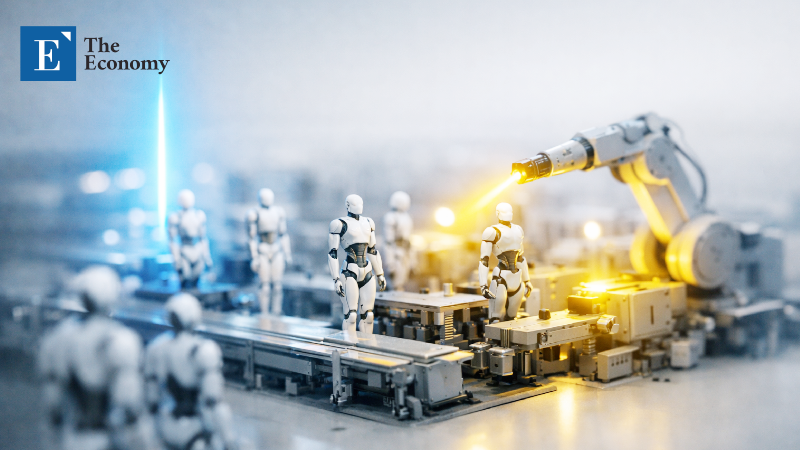
China’s manufacturing ascent, which previously disrupted global markets with low-cost appliances and electric vehicles, is now extending into humanoid robotics. As the era of “physical AI”—the convergence of artificial intelligence and mechanical engineering—gains momentum, China is rapidly transferring its established manufacturing ecosystem and supply chains into the robotics sector, reinforcing its dominance in the industrial robotics market. Nonetheless, a number of challenges remain before robots can expand their capabilities into domains requiring advanced judgment and highly precise operations.
Chinese Robotics Firms Capture Global Market Share
According to market research firm Omdia on the 5th (local time), Chinese companies produced 87% of the roughly 13,000 humanoid robots shipped worldwide last year. AGIBOT shipped 5,100 units to secure the top market share at 39%, followed by Unitree with 4,200 units (32%) and UBTECH with 1,000 units in third place. Leju (500 units) and Fourier (300 units) ranked fourth and sixth globally, respectively. In contrast, shipments from major U.S. firms such as Tesla and Figure AI remained at roughly 150 units each.
China’s overwhelming scale is also evident in total capacity. According to the International Federation of Robotics (IFR) “World Robotics 2025” report, China’s installed base of industrial robots reached 2 million units, accounting for more than half of the global total. Annual installations also hit a record high of 295,000 units. Since 2020, Chinese firms have filed five times more humanoid-related patents than U.S. companies. This expansion of intellectual property (IP) has become a critical driver for accelerating new model launches while reducing manufacturing costs.
The industry’s scale is expanding rapidly as well. According to China’s Ministry of Industry and Information Technology (MIIT), revenue from the robotics sector reached about $33.6 billion in 2024. In the first half of 2025, revenue rose 27.8% from a year earlier, while industrial robot production increased 32% year over year. Analysts note that the pace of revenue growth outstripping installation growth suggests China’s robotics industry is shifting beyond sheer expansion toward higher value-added segments.
Nationwide Policy Support Drives Expansion, Drawing German Interest
China’s robotics industry has struggled to secure advanced semiconductors due to U.S. restrictions, yet it is widely assessed to have already achieved technological autonomy and supply-chain completeness in the hardware domain. Although the localization rate of industrial robots in China has not yet reached the 70% target set under the “Made in China 2025” initiative, core components—including reducers, servo systems, and controllers—have already exceeded a 50% domestic production rate, meeting key milestones. Rather than isolating China, the technological rivalry with the United States has effectively accelerated the country’s push toward technological self-reliance.
Behind China’s rapid expansion lies a national strategy optimized for commercialization. The Chinese government has designated humanoid robotics as a next-generation strategic industry and provided substantial subsidies. China currently hosts about 160 humanoid robot manufacturers, and when including roughly 600 suppliers of core components, the broader robotics ecosystem encompasses nearly 10,000 related companies. Many are startups founded within the past decade, yet they are reportedly already capable of simultaneously producing between 5,000 and 6,000 units at scale.
This production capability stems from China’s formidable supply-chain competitiveness. By clustering component suppliers, software developers, and finished-robot manufacturers around major innovation hubs, China has integrated design, testing, and mass production into a unified pipeline. The model shortens the interval between validation and commercialization, cultivates early demand within the domestic market, and advances localization of components in parallel. A tightly integrated supply chain both accelerates production speed and significantly reduces manufacturing costs.
Large-scale capital inflows have also become a central driver of industry expansion. Investment in China’s robotics sector reached about $4.2 billion last year. The country’s strategy of open-source collaboration and large-scale data accumulation within the robotics ecosystem has further reinforced growth foundations. Through institutions such as the Beijing Academy of Artificial Intelligence (BAAI), one of China’s leading AI research centers, key technological resources are increasingly being opened to broader participation.
China’s rapid rise in robotics has also drawn the attention of Germany, a traditional manufacturing powerhouse. German Chancellor Friedrich Merz visited China last month on his first trip to the country since taking office and held a summit with Chinese President Xi Jinping before touring Unitree alongside an economic delegation. The delegation included around 30 chief executives from major companies such as Volkswagen, BMW, Siemens, Bayer, Adidas, Mercedes-Benz, DHL, and Commerzbank. China’s state-run English-language newspaper Global Times noted that “even three decades ago it would have been difficult to imagine the leader of Germany—a manufacturing powerhouse—closely examining components produced by Chinese firms amid such a tightly packed schedule.”
From Technology Demonstrations to Mass Production
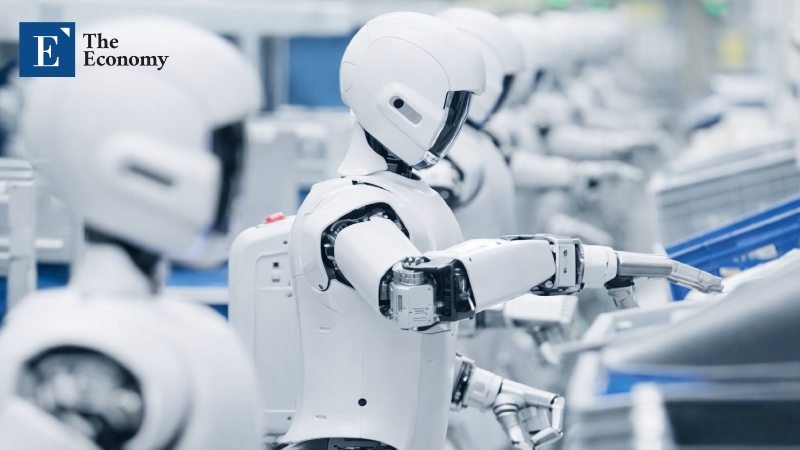
Through its “Humanoid Robot Innovation Development” policy, the Chinese government has set out a blueprint to deploy robots across 1,000 industries and 100 detailed sub-sectors by 2028. For years, Chinese robots were widely perceived as exhibition pieces—dancing or performing martial arts at Lunar New Year galas. The current trend, however, is sharply focused on operational efficiency. Yuli Zhao, chief strategy officer (CSO) of Galbot, said that “customers are now asking whether robots can reliably reduce human workloads in real-world environments,” noting that industry attention has shifted toward practical utility.
Deployment in industrial settings is accelerating as well. AGIBOT and Unitree recently signed a robot supply contract worth $18 million with the Chinese state-owned telecommunications firm China Mobile. AGIBOT has also secured a contract to deploy about 100 robots at the factory of precision parts manufacturer Fulin Precision, marking its entry into the stage of tangible revenue generation. Some leading robotics companies are also preparing to expand into the household market over the longer term. Zhou Bin, co-founder and vice president of Fourier, said, “The ultimate success of the humanoid robotics industry will hinge on its adoption in homes,” adding that “just as households once began purchasing automobiles, a future is approaching where robots become commonplace in both homes and workplaces.”
Despite the striking momentum, significant challenges remain beneath the surface of China’s robotics rise. While China has taken the lead in the “muscles and skeleton” of robots, it still relies heavily on U.S. technology for the “brain”—namely chips and AI operating systems. Most Chinese robotics firms currently use Nvidia’s Orin chip as their core hardware platform. China also trails in the race to secure the vast datasets required to build “world models,” which enable robots to perceive and interpret their surroundings autonomously. Unlike language models, data capturing physical motion is far more difficult to collect. Additional hurdles include enabling precise object manipulation, ensuring error recovery in unstructured environments, and guaranteeing safety in collision or malfunction scenarios. In particular, achieving fully autonomous locomotion and manipulation capabilities based on high-performance drive systems, sensors, and battery integration requires substantial costs, leading many analysts to conclude that it may take more time before humanoid robots achieve economic viability relative to human labor.
Anne-Marie Nicholson is a fearless reporter covering international markets and global economic shifts. With a background in international relations, she provides a nuanced perspective on trade policies, foreign investments, and macroeconomic developments. Quick-witted and always on the move, she delivers hard-hitting stories that connect the dots in an ever-changing global economy.
Similar Post