Israel’s ‘Iron Beam’ Nearing Battlefield Debut, Air Defense Paradigm Faces Drone-Era Upheaval

Authored On
Modified
Signs of real-world deployment of Israel’s ‘Iron Beam’ emerge
“Costly interceptor missiles no longer necessary”—is the era of economic attrition ending?
Drone-centric warfare expected to trigger a tectonic shift in modern combat

Analysis has emerged suggesting that Israel may have deployed its next-generation laser air defense system, the Iron Beam, in actual combat operations. As hostilities intensify across the Middle East, the system—long confined to experimental testing—appears to have entered operational use on the battlefield. Experts warn that widespread adoption of the Iron Beam could trigger a sweeping transformation across the global air defense architecture.
Israel’s Laser Air Defense System
According to academic outlet The Conversation and international media reports on the 5th (local time), footage circulating on social media recently captured rockets launched by Lebanon’s Hezbollah being destroyed mid-air almost instantly, with no visible sign of interceptor missiles being fired. Military analysts say the scene closely resembles the operational characteristics of directed energy weapons (DEW), specifically high-power laser systems. The possibility has therefore been raised that Israel’s Iron Beam system may have been used in combat.
The Iron Beam is a high-energy laser air defense system jointly developed by Israel’s Ministry of Defense and domestic defense contractor Rafael Advanced Defense Systems. Whereas conventional air defense systems launch interceptor missiles that detonate near a target, the Iron Beam fires a concentrated high-power laser that burns through the outer casing of drones, artillery shells, and short-range rockets, destroying them in flight. The system operates using a 100-kilowatt-class solid-state laser mounted on a mobile trailer platform.
The system’s performance stems from breakthroughs that overcome traditional limitations of laser weapons. Iron Beam integrates coherent beam combination (CBC) technology and adaptive optics, enabling it to mitigate obstacles such as dust, humidity, and atmospheric scattering that complicate long-range interception. CBC merges multiple laser beams into a single, more powerful beam, concentrating energy capable of penetrating atmospheric interference. Adaptive optics technology analyzes distortions caused by atmospheric turbulence and refraction hundreds of times per second and corrects them in real time.
Superior Cost Efficiency Compared With Interceptor Missiles
Israel has experimented with the Iron Beam system for several years. The Israeli military previously disclosed that in May of last year it intercepted dozens of Hezbollah drones using low-power laser systems during the autumn of 2024. According to the announcement, four drones launched by Hezbollah were intercepted using a 30-kilowatt reduced-scale version of Iron Beam, followed by the downing of several dozen additional drones.
In December of last year, Israel also officially announced the operational deployment of Iron Beam to counter aerial threats. The country intends to incorporate the system into its existing multi-layer missile defense network—comprising Iron Dome, David’s Sling, and Arrow—in order to enhance overall capability. The plan is designed to counter rocket barrages from Iran-aligned armed groups in the region, including Hamas in Palestine, Hezbollah in Lebanon, and the Houthi rebels in Yemen, as well as coordinated Iranian attacks involving ballistic missiles and drones.
If Israel begins deploying Iron Beam on a large scale, the long-standing dynamic of “economic attrition”—in which interceptor missiles costing tens of thousands of dollars are used to neutralize drones or rockets worth only a few hundred dollars—could rapidly collapse. The Iron Beam offers overwhelming cost efficiency. Israel’s well-known Iron Dome air defense system relies on Tamir interceptor missiles, each of which costs about $50,000 to launch. By contrast, firing the Iron Beam costs only a few dollars per shot. In 2022, then-Prime Minister Naftali Bennett said the cost of firing Iron Beam was roughly $3.50.
Potential Transformation of Drone-Centric Warfare
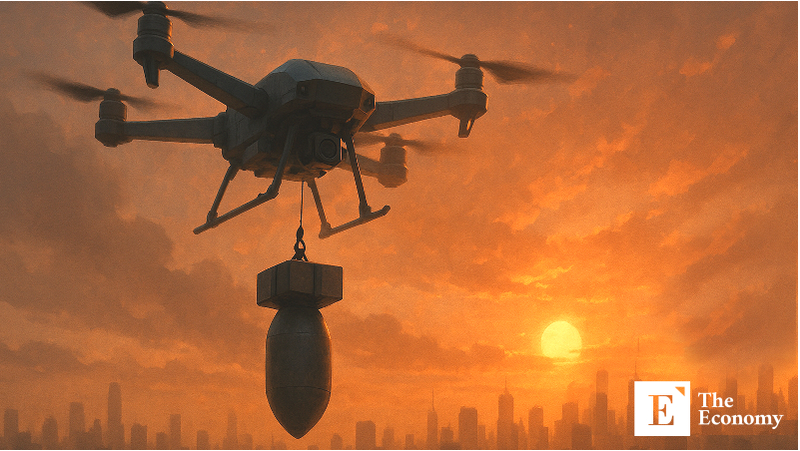
Some analysts believe Iron Beam could reshape not only Israel’s defenses but also the global air defense landscape. The structure of modern battlefields has increasingly shifted away from tanks and fighter jets toward drone-centric operations. Until the Cold War era following the end of World War II in 1945, drones were largely limited to reconnaissance and intelligence-gathering missions. Advances in communications systems and battery performance in the 21st century, however, have enabled drones to carry small weapons such as bombs and strike enemy targets in place of ground forces.
More advanced drones began appearing in conflict zones across the Middle East and Africa during the 2010s and 2020s. At the time, warfare in the Middle East and Afghanistan largely consisted of irregular operations centered on guerrilla activity, terrorism, and covert missions. Combat drones were used to locate and eliminate concealed operatives. Drones were also used in the United States’ assassination of al-Qaeda leader Ayman al-Zawahiri on July 31, 2022. Zawahiri had succeeded Osama bin Laden as the head of al-Qaeda and had previously helped orchestrate the September 11 attacks alongside bin Laden.
Drones have since undergone another stage of evolution through the Russia-Ukraine war, the largest full-scale conflict in Europe in the 21st century. On the Ukrainian battlefield, FPV (first-person-view) drones costing only a few hundred dollars each have effectively functioned as miniature missiles. More recently, Iran has also carried out attacks in the Middle East involving the simultaneous deployment of hundreds of suicide drones. In effect, drones have evolved from simple strike platforms into unmanned aerial bombardment weapons.
The expanding influence of drones on the battlefield is largely driven by their cost efficiency. Small drones can be manufactured or modified at minimal expense yet still deliver meaningful strikes against critical military equipment. Their ability to conduct reconnaissance and attacks simultaneously, combined with remote operation that reduces risks to personnel, has further boosted their utility. Compared with tanks or fighter jets—which require massive acquisition and operational costs—drones represent a low-cost, high-efficiency weapon system.
Similar Post