AI Data Center Water Consumption Set to Surge, Next-Generation Cooling Race Intensifies Amid Widespread Adoption of Liquid Cooling

Aoife Brennan is a contributing writer for The Economy, with a focus on education, youth, and societal change. Based in Limerick, she holds a degree in political communication from Queen’s University Belfast. Aoife’s work draws connections between cultural narratives and public discourse in Europe and Asia.
Authored On
Modified
Escalating Water Demand from AI Data Centers
Liquid Cooling Becomes Mainstream with High-Density Racks
Acceleration of Next-Generation Cooling Technologies Including Immersion Systems
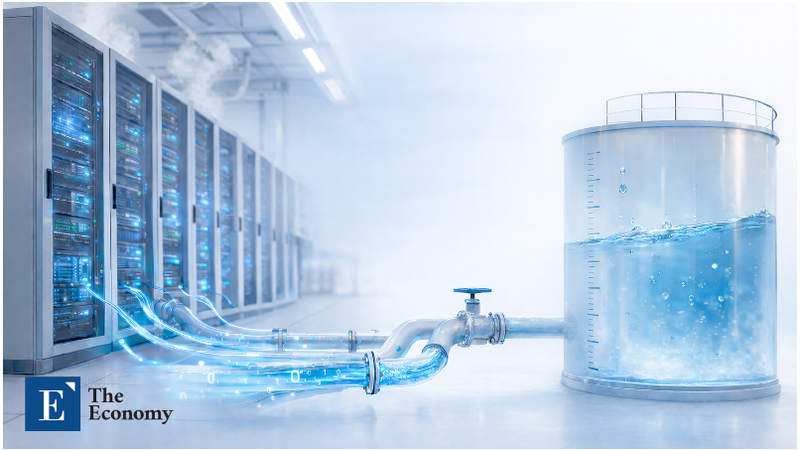
As artificial intelligence (AI) adoption accelerates and the data center market enters a period of rapid expansion, water consumption has emerged as a new industrial risk. The industry’s primary cooling approach is shifting from conventional air-cooling systems to more efficient liquid-cooling technologies, driving a steady increase in water demand. Against this backdrop, industry players are intensifying efforts to advance liquid-cooling systems while developing next-generation cooling solutions.
Massive Water Consumption by AI Data Centers
On March 6, technology publication Gizmodo reported that water scarcity risks are rapidly emerging as a new growth constraint for the AI industry. According to a recent paper published by a research team led by Associate Professor Shaolei Ren of the Department of Electrical and Computer Engineering at the University of California, Riverside, U.S. data centers will require between at least 697 million gallons (about 2.638 billion liters) and up to 1.45 billion gallons (about 5.488 billion liters) of additional daily water supply by 2030 if current water-use efficiency levels remain unchanged. The scale is comparable to the amount of tap water supplied to New York City in a single day.
Expanding public water systems in regions with high concentrations of data centers is projected to require between $10 billion and $58 billion by 2030. Ren noted that these estimates are highly conservative and emphasized that it would be virtually impossible for local communities hosting data centers to bear such costs independently. While some big tech companies are investing hundreds of millions of dollars in infrastructure improvements through partnerships with local communities, analysts say these efforts remain insufficient to close the funding gap.
This substantial water demand originates not only within data centers but also at power generation facilities. According to the report “Water-Power Nexus: How Data Centers Are Reshaping America’s Water Landscape,” released by market research firm Bluefield Research, approximately 72% of water consumption associated with data centers will occur at power plants by 2030. Amber Walsh, research director at Bluefield Research, noted that although data centers directly use water for cooling, the industry’s rapidly rising electricity demand is significantly increasing overall water consumption projections. She emphasized that the primary water risk for the data center industry stems from power generation rather than cooling itself.
Liquid Cooling Drives Expansion in Water Demand
The widespread adoption of liquid-cooling technologies lies at the center of growing water consumption at data centers and power facilities. Until several years ago, air-cooling systems were the industry standard. Air cooling circulates chilled air using mechanical chillers to absorb heat generated by servers and was suitable for low-density racks of around 2.2 kilowatts that dominated data centers until about 2020. However, the emergence of high-density racks in the 30–50 kilowatt range has rapidly increased demand for liquid-cooling systems due to their superior thermal efficiency compared with air cooling.
Liquid cooling removes heat directly using circulating coolant and is broadly categorized into two approaches: in-row cooling and rack-based rear-door cooling. In-row cooling installs cooling units between high-density racks to absorb heat generated by servers directly while circulating chilled water through a coolant distribution unit (CDU). Rear-door cooling attaches heat-exchange units to the rear doors of racks, converting hot exhaust air into cooled air through immediate heat exchange without allowing the hot air to escape into the surrounding environment.
Liquid-cooling systems provide several advantages for data centers. Because they offer higher heat-transfer efficiency than air cooling, they help maintain stable server temperatures, reduce overheating risks, and allow hardware to operate at peak performance. Liquid cooling also consumes less energy than air-cooling systems, lowering electricity expenses and overall operational costs for data centers. In addition, the absence of large air-conditioning units and ducting requirements enables more efficient use of facility space.
Recognizing these benefits, data center operators have increasingly adopted liquid-cooling systems. What was once considered a niche solution is now regarded as a core infrastructure component. The global market for liquid-cooling systems in data centers reached $5.52 billion in 2025 and is projected to grow to $15.75 billion by 2030. If these projections materialize, the sector’s compound annual growth rate will reach 23.31%.

Acceleration in Advanced Cooling Technology Development
Industry participants are also moving beyond basic liquid-cooling adoption toward technological refinement. Lenovo’s Neptune liquid-cooling system, for example, cools the entire system using warm water, enabling hot-water reuse while eliminating the need for fans by removing heat generated by all components, including power supplies. Super Micro Computer’s next-generation direct liquid-cooling solution, DLC-2, also supports high-temperature coolant intake and seals all components within cold plates, allowing lower fan speeds and fewer fans.
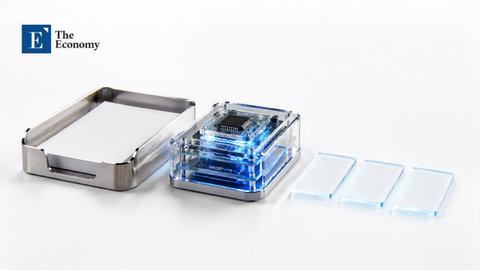
Development of immersion-cooling systems, widely viewed as a next-generation technology, is also gaining momentum. Immersion cooling submerges servers or motherboards in dielectric fluid, a non-conductive cooling oil. When the temperature of the cooling liquid rises, the fluid moves to an external heat exchanger for cooling before returning to the tank. Because heat is removed directly across the entire surface of heat-generating components, the system is widely regarded as offering exceptional cooling efficiency. However, the need for specialized servers raises installation costs, slowing large-scale commercial adoption.
Nevertheless, experimental deployments are expanding across the market. In the United States and Europe, big tech companies including Microsoft and the high-performance computing (HPC) sector are increasingly introducing immersion-cooling technology. Microsoft previously operated “Project Natick,” an experimental underwater data center project near the coast of Scotland that utilized seawater cooling technology. Global cooling solution providers such as Submer and Green Revolution Cooling are also supplying immersion-cooling systems, expanding deployments centered on HPC and AI servers.
In Hainan, China, a project is underway to build an operational subsea data center facility that uses seawater to dissipate server heat. In South Korea, large corporations including Samsung SDS, SK Telecom, and KT Cloud continue pilot operations at dedicated testing centers. Refining and energy companies such as GS Caltex and SK Enmove, along with immersion-cooling technology firm ImmersCool, are actively participating in the development and supply of cooling fluids while exploring ways to expand the market.
Aoife Brennan is a contributing writer for The Economy, with a focus on education, youth, and societal change. Based in Limerick, she holds a degree in political communication from Queen’s University Belfast. Aoife’s work draws connections between cultural narratives and public discourse in Europe and Asia.
- Previous Trump Says “War Will End Soon” vs. Iran Declares “We Decide When It Ends,” U.S.–Iran Conflict Sinks Deeper Into Uncertainty
- Next With the patent expiration of semaglutide in China approaching, an all-out price war is expected to erupt amid intensifying competition for leadership in next-generation obesity treatments
Similar Post