U.S. Pushes ‘Critical Mineral Re-Resource Utilization’ to Break China’s Grip on Rare-Earth Supply Chains, Betting on Recycling Technology

Authored On
Modified
U.S. Accelerates ‘Waste-Based Critical Mineral Recovery Strategy’
Rare earths extracted from discarded computers, smartphones, and batteries
Dual objectives: critical mineral self-sufficiency and environmental protection
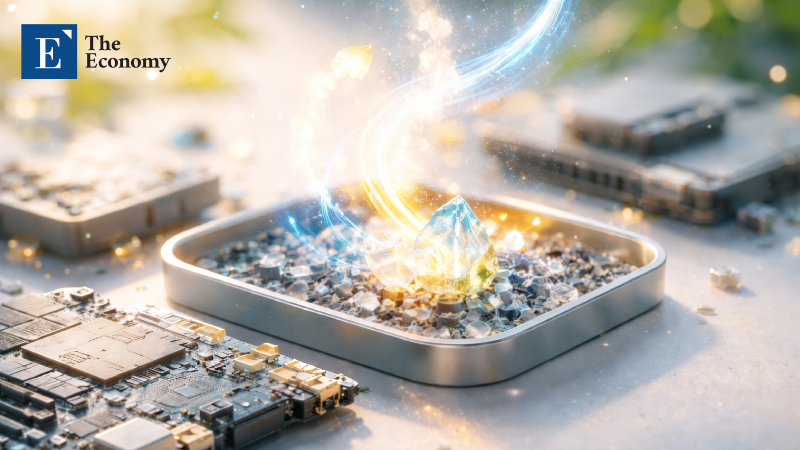
The United States has unveiled a new strategic initiative aimed at loosening China’s grip on global critical mineral supply chains. Moving beyond a traditional reliance on expanded mining development, Washington is pursuing a strategy that combines electronic-waste recycling with ultra-precision refining technologies to strengthen supply-chain competitiveness. Critical mineral re-resource utilization refers to recovering rare earths and other strategic minerals from recyclable resources such as spent batteries, electronic waste, discarded permanent magnets, and used catalysts, and then supplying them again as industrial raw materials. In effect, minerals are extracted from discarded products to create what amounts to a “second mine.” Through this approach, the United States aims to secure both critical mineral self-sufficiency and environmental protection simultaneously.
DOE, Waste Recycling Could Become a Game Changer
According to Hong Kong’s South China Morning Post on March 10 (local time), Audrie Robertson, Assistant Secretary at the U.S. Department of Energy (DOE), stated during a Council on Foreign Relations (CFR) event that new mineral recycling technologies could deliver tangible results within the next year and potentially reshape the trajectory of U.S.–China competition in critical minerals. Robertson explained that building a domestic system to recycle metals and magnets represents the fastest path toward transforming supply chains, highlighting that processing technologies for “black mass,” the residual powder produced from lithium-ion batteries, have advanced rapidly in recent years.
Robertson also praised recent progress made by the United States in critical mineral refining and processing. She noted that American research laboratories are currently working with corporate partners to develop innovative technologies capable of simultaneously processing multiple minerals within a single production line. “This could become a genuine game changer,” she said. Robertson further argued that if electricity and water consumption, as well as processing times that currently take several months, can be drastically reduced, the United States could decisively surpass China, which she said remains reliant on established conventional processes.
Some participants at the event raised concerns that significantly reducing U.S. dependence on Chinese critical minerals would be far from easy. Nathan Ratledge, founder and chief executive officer of U.S.-based mineral separation technology firm Alta Resource Technologies Inc., pointed out that dismantling China’s three-decade strategic dominance within just two years would be extremely difficult. Robertson rejected that assessment, arguing that Chinese companies built around legacy processing methods could lag behind in the pace of innovation. She reiterated that technological advances in the United States could ultimately allow it to overtake China in refining and processing capabilities.
Project Vault to Accelerate Strategic Stockpiling and Urban Mining
The United States continues to face challenges in securing sufficient critical minerals required for industrial production. At the U.S.–China summit held in Busan in November last year, the two countries agreed to a temporary “trade truce,” under which the United States lowered tariffs related to fentanyl issues while China agreed to suspend for one year its export restrictions on key minerals such as gallium, germanium, and antimony. Despite the agreement, the supply environment has shown little improvement.
China currently controls roughly 70% of global mineral production and about 80% of processing capacity, exercising supply control through measures such as limiting quarterly production volumes and delaying export licensing procedures for extended periods. With China’s Ministry of Commerce intensifying scrutiny of end users, companies attempting to secure new mineral procurement channels now face significant obstacles. Supply of small quantities of heavy rare-earth materials such as dysprosium—widely used in electric vehicles and wind turbines—has reportedly slowed to a near halt. Although rare earth deposits exist in the United States, development remains difficult due to environmental concerns during production and the fact that many deposits are located within protected areas.
Against this backdrop, the Trump administration has designated critical mineral security as a national security issue and is promoting policies aimed at building a full-cycle supply chain within the United States, spanning mining development, refining and smelting, and recycling. The government has accelerated supply-chain localization efforts through measures such as equity investments in rare-earth producers, approvals for seabed mineral development, and executive orders designed to boost mineral production. Washington has also pursued bilateral cooperation agreements with countries including Australia, Thailand, and Malaysia, emphasizing expanded bilateral partnerships rather than multilateral frameworks as part of a strategy to gradually reduce reliance on China-centered supply chains.
Early last month, the United States hosted a critical minerals cooperation forum attended by more than 50 countries and unveiled Project Vault, a $12 billion (approximately $13.2 billion) strategic stockpiling initiative for critical minerals. The re-resource utilization strategy referenced by the DOE is also part of this project. Under Washington’s emerging mineral strategy, the government plays an active role in the market by providing funding and supporting private-sector companies.
Earlier this month, the DOE announced a funding call totaling $19.5 million (approximately $21.5 million) through the National Energy Technology Laboratory (NETL) to support technologies for recovering critical minerals and materials. The program targets four technical areas: technologies that simultaneously produce critical minerals and manufacturing precursors from carbon-based unconventional feedstocks such as coal and coal waste; technologies to recover mid- and late-stage rare earth elements from secondary and unconventional resources; technologies to extract lithium and other critical minerals from produced water generated during oil and gas operations; and process technologies that produce rare-earth oxides or salts using recycled materials and unconventional feedstocks. The U.S. government expects these initiatives to secure domestic supply stability for battery materials such as lithium and cobalt—resources with heavy foreign dependence—while also converting waste streams into assets within a circular economy.
Japan Expands Subsidies for Rare-Earth Extraction from Scrap Motors and Electronics
Japan is also accelerating efforts to reduce dependence on China through critical mineral recycling. Beginning in fiscal year 2026, the Japanese government plans to provide subsidies for building rare-earth recycling infrastructure, including transportation, storage, and testing equipment, in order to establish a stable domestic supply system. The Ministry of the Environment will support costs associated with transporting waste materials from across the country to designated processing hubs and will also fund the construction of storage facilities. In addition, the government plans to support pilot projects and equipment procurement aimed at verifying whether rare earths extracted from waste materials can be reused in actual products. For this program, the ministry reportedly allocated $40 million (approximately $44 million) in the national budget proposal for this year.
Japan is placing particular policy emphasis on recovering neodymium from discarded motors. Neodymium, known for its powerful magnetic properties, is an essential material used in a wide range of advanced technologies including electric vehicles (EVs), generators, and smartphones. In the past, many scrap motors in Japan were sold overseas as second-hand goods or melted down simply to recover iron due to cost constraints. The government now plans to recycle these motors as resources to expand domestic rare-earth supply.
Beyond scrap motors, Japan also intends to build a system to recover rare earths from discarded electronic circuit boards. The country already imports waste circuit boards from regions such as Europe for recycling at domestic facilities, and the Ministry of the Environment plans to significantly expand processing volumes. By 2030, Japan aims to increase waste circuit board processing by about 50% compared with 2020 levels, reaching approximately 500,000 tons annually.
Meanwhile, technological competition among individual companies is also intensifying. Glencore, one of the world’s largest commodity traders, sources roughly 15% of the feedstock for its Quebec smelter in Canada from recycled materials recovered from electronic waste. Metals extracted through the process—including copper, gold, silver, and platinum—are then supplied back to manufacturers. Germany’s Wieland and Aurubis are also participating in efforts to strengthen supply-chain independence by constructing copper and alloy recycling plants in the United States with investments ranging from $100 million to $800 million (approximately $110 million to $880 million). Startups across the United States, Canada, and Germany are likewise accelerating development of technologies that recover rare metals from data-center hard drives, electric vehicle motors, and MRI equipment. Canadian firm Cyclic Materials has developed a process to recover rare earths from electric vehicle motors and wind turbines and has committed $20 million (approximately $22 million) to build a factory in Arizona.
Similar Post