The Next Battleground in Solar Power: Perovskite Tandem Cells, as China’s Maxwell Bets $506 Million

Authored On
Modified
Accelerating high-efficiency solar cell production capacity
Expanding from ground power to space energy supply
Japan nears commercialization; China accelerates entry

China’s advanced equipment manufacturer Maxwell has begun constructing a large-scale solar cell equipment factory, signaling that competition around next-generation “perovskite”-based tandem solar cells is spreading across the broader industry. Analysts say China—already dominant in manufacturing capacity in the conventional silicon solar market—is accelerating the creation of a full technology ecosystem by expanding investment into equipment and materials. As solar demand begins extending beyond terrestrial power generation into the emerging space-power market, technological competition among China, South Korea, and Japan around next-generation solar cells has entered a new phase.
Overcoming the Limits of Silicon Solar Cells
According to a March 10 report by Nikkei Asia, Maxwell Technologies, an advanced precision equipment manufacturer headquartered in Suzhou, China, recently announced plans to invest $506 million to build a dedicated manufacturing equipment facility for perovskite solar cells. The project centers on establishing mass-production facilities for “tandem cells,” which stack perovskite layers on top of conventional silicon to maximize power generation efficiency. To support the project, Maxwell has secured land-use rights for a 90,000-square-meter state-owned site near its headquarters.
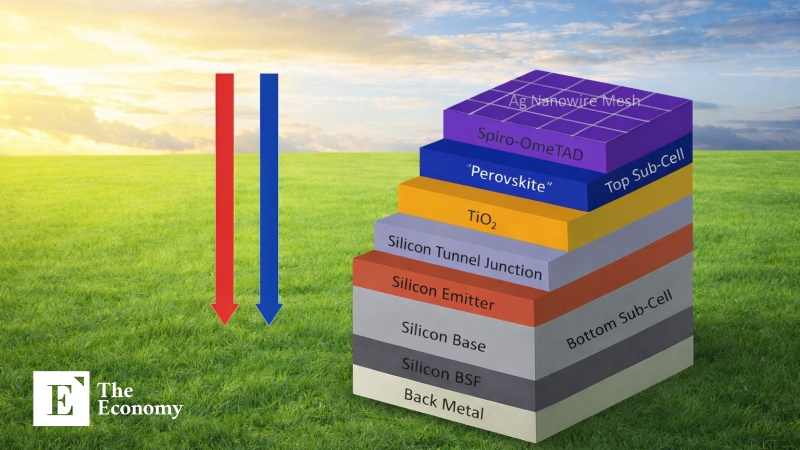
Industry observers interpret the move as a signal that China is shifting away from pure low-cost competition toward technological upgrading. Tandem cells incorporating perovskite are widely viewed as a next-generation technology capable of surpassing the efficiency limits of traditional single-junction silicon solar cells. Conventional silicon cells typically face a theoretical efficiency ceiling of about 29%. In contrast, a tandem structure that stacks two solar cells designed to absorb different wavelengths of light can raise power conversion efficiency to roughly 35%. On the strength of this technological potential, industry insiders often describe tandem cells as a “game changer” capable of reshaping the solar power industry.
On the ground, competition around next-generation solar technology is advancing rapidly through efficiency records. A perovskite-based tandem cell developed by China’s LONGi has achieved efficiencies of 34.9% at the cell level and 30.1% at the module level. At the module level, this corresponds to roughly a 20% improvement in power generation performance compared with conventional single-junction silicon solar cells. Among South Korean companies, Hanwha Qcells developed an M10-format tandem cell that achieved 28.6% efficiency and received international certification from Germany’s Fraunhofer Institute for Solar Energy Systems. Hanwha Qcells has positioned itself at the forefront of the technological race by achieving these results with a large-area format suitable for commercial modules.
Against this backdrop, Maxwell’s investment is interpreted as a strategic move to participate fully in the emerging supply-chain competition for next-generation solar cells. China is already rapidly building an industrial base capable of mass production of perovskite technology. Startup UtmoLight launched a mass-production line in Wuxi with annual capacity of 1 gigawatt in February 2024, and in June of the same year GCL Perovskite began operating another 1-gigawatt facility. Maxwell’s strategy is to solidify China’s supply-chain influence in the next-generation solar industry by supplying critical equipment to this expanding network of production lines.
From Efficiency Competition to Expansion of Applications
The market itself is also expanding rapidly, broadening the demand base for next-generation solar technologies. In a recently published industry report, market research firm Growth Research concluded that “the solar industry is evolving beyond simple ground-based power generation facilities into a form of ‘space power infrastructure.’” As global plans for space-based data centers begin to gain traction, demand is rising for space energy technologies capable of generating their own electricity. In this context, ultra-lightweight perovskite solar cells have emerged as a leading candidate.
In the space business, launch costs rise in proportion to payload weight, making the weight of power systems a central determinant of economic viability. Conventional silicon solar panels typically deliver power output of about 0.5 to 2 watts per gram. In contrast, film-based perovskite solar cells are projected to achieve outputs of approximately 23 to 30 watts per gram. This implies that the weight of power systems required to produce the same amount of electricity could be reduced to roughly one-tenth to one-fifteenth that of silicon-based solar systems—an advantage that could simultaneously lower both launch and operational costs.
Another advantage is the high flexibility inherent in film-type structures. During launch, panels can be rolled or folded to minimize volume, then deployed across large surface areas once the spacecraft reaches its target orbit. Observers also note that some technical weaknesses traditionally associated with perovskite cells may be partially mitigated in space environments. On Earth, moisture and oxygen have been major factors reducing durability, but such degradation drivers are largely absent in outer space.
Solar panels must pass the international IEC 61215 certification standard before entering the commercial market. As major companies have recently begun passing this test with perovskite-silicon tandem cell structures, prospects for commercial deployment have improved. Corporate investment is becoming increasingly concrete as a result. Hanwha Qcells is investing more than $690 million to convert existing silicon production lines into tandem-cell manufacturing lines, targeting mass production by 2027. UK-based Oxford PV has also established a commercial tandem-module production line and has begun supplying the European premium residential market since early this year.
Production Expansion vs. Raw-Material Supply Chains
In the past, solar cells were a strategic field in which South Korean companies concentrated efforts to secure technological leadership. Given the country’s limited land area, technologies capable of generating more electricity from the same footprint were directly linked to industrial competitiveness. Recently, however, the competitive landscape has shifted as Chinese companies accelerate both research and production investment in next-generation solar technologies. This shift is evident in tandem cell efficiency records certified by the U.S. National Renewable Energy Laboratory. China’s LONGi Green Energy has set the highest recorded efficiency at 34.85%, while JinkoSolar reported 34.76%. Tongwei Solar and Trina Solar followed with efficiencies of 31.4% and 31.1%, respectively.
Chinese companies are not stopping at research achievements and are also accelerating expansion of production facilities. GCL completed a 1-gigawatt tandem cell production facility in June last year, while earlier in February UtmoLight also announced plans to build gigawatt-scale production capacity. On a smaller scale, Wonder Solar and Microquanta have each established production lines with capacity of 100 megawatts. As efficiency records at the research stage and real-world production capacity expand simultaneously, the influence of Chinese companies in the next-generation solar market is rising rapidly.
Japan has pursued leadership in the next-generation solar supply chain through a different strategy. Japan’s Ministry of Economy, Trade and Industry has proposed introducing 20 gigawatts of perovskite solar cells by 2040 while simultaneously building supply chains for key raw materials such as iodine and specialized films. At the industrial level, Nippon Shokubai has secured mass-production technology for formamidinium iodide (FAI), a core material used in large-scale perovskite solar cells, and has successfully produced prototype batches. The company extracts iodine and natural gas from Japan’s largest water-soluble natural gas field and produces both hydroiodic acid and formamidine—key inputs for FAI—positioning itself to establish a global supply system based on this integrated production capability.
Similar Post