Trump Urges Five Nations, Including South Korea, to Dispatch Warships to Hormuz, Seeking to Deter Iranian Provocations Through ‘Multinational Joint Response’

Authored On
Modified
Five countries specifically cited, envisioning joint operations with U.S. forces
“Countries affected by Iran’s blockade of the Strait of Hormuz”
Iran: “Do not escalate the conflict; we have no intention of negotiating with the U.S.” vows prolonged war
President Donald Trump, who has consistently emphasized expanding the security burden of allies, has begun drawing allies directly into the war with Iran. He is pressuring four allied nations, including South Korea, as well as China, to dispatch warships to safeguard the Strait of Hormuz. This marks the first time during the war with Iran that President Trump has requested a third country—other than Israel—to join military operations, suggesting an intention to elevate the issue of the Strait of Hormuz blockade from a unilateral U.S. response to a multinational joint response.
Calls for Deployment by South Korea, China, Japan, the U.K., and France, Posting Twice on Social Media in One Day
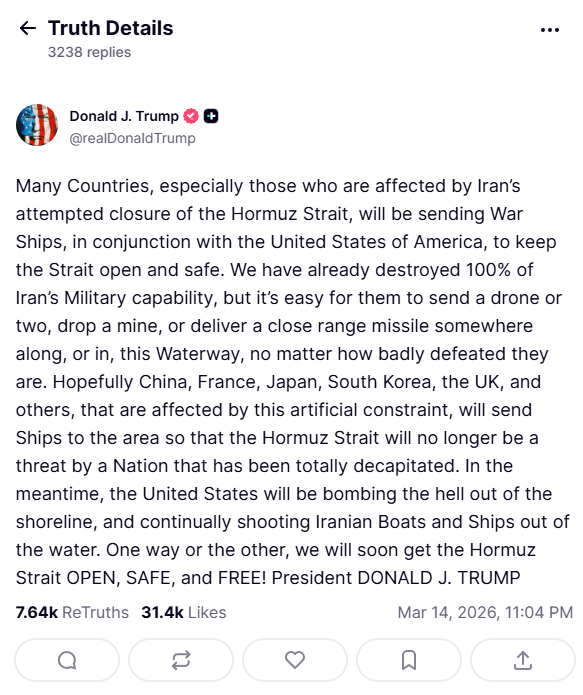
On the morning of the 14th (local time), President Trump stated via the social media platform Truth Social, “Many countries, particularly those affected by Iran’s attempt to blockade the Strait of Hormuz, will be sending War Ships with the United States to keep the Strait open and safe.” He added, “We have already destroyed 100% of Iran’s military capabilities,” but wrote that “even if they have suffered a major defeat, it is still easy for them to send one or two drones somewhere in this waterway, drop mines, or fire short-range missiles.”
President Trump stressed, “I hope that many countries affected by this artificial restriction—China, France, Japan, South Korea, the United Kingdom, and others—will send ships to the region so that a completely neutralized nation can no longer threaten the Strait of Hormuz.” Of the five countries mentioned by President Trump, four—excluding China—are U.S. allies. He added, “Meanwhile, the United States will continue to heavily bomb Iran’s coastline and sink boats and ships out of the water,” saying, “One way or another, we will soon make the Strait of Hormuz free, safe, and open.”
Later that afternoon, President Trump posted a second message, arguing that “countries around the world that receive oil through the Strait of Hormuz should manage that passage, and the United States will help them a great deal,” adding that “this should have been a collective effort from the beginning, and now it will be.” He continued, “The United States will coordinate with relevant countries to ensure everything proceeds swiftly and smoothly,” claiming that “this will unite the world in harmony, security, and everlasting peace.”
The United States is currently escalating its offensive by striking a large number of military facilities on Iran’s key oil export hub, Kharg Island, as leverage to force the reopening of the Strait of Hormuz. Kharg Island is Iran’s largest oil terminal and a critical strategic site for the Iranian economy, handling 90% of the country’s oil exports, and is often referred to as a “treasure island.” The coral island, roughly seven times the size of Yeouido (23㎢ in area), lies 25–43 kilometers off Iran’s northern coast in the Persian Gulf. Oil produced in Ahvaz, Marun, and Gachsaran is transported via subsea pipelines to the island, where it is stored in large-scale storage facilities before being loaded onto tankers. Iran also operates an oil terminal in Jask, located outside the Strait of Hormuz, but its processing capacity is only one million barrels per day—about half that of Kharg Island.
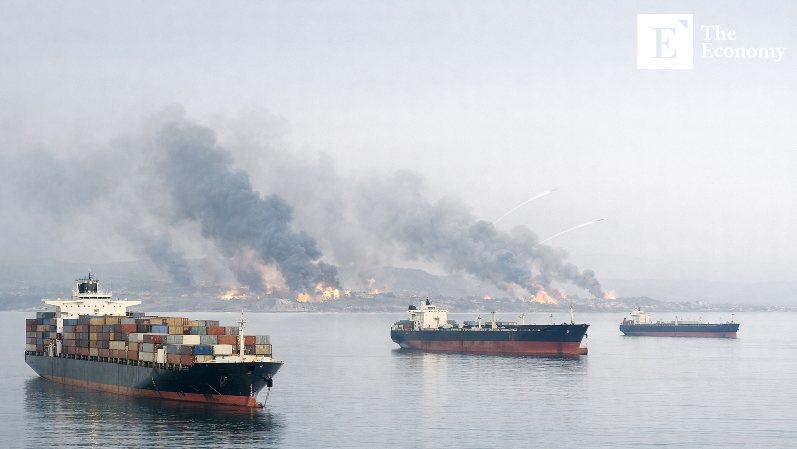
Petrochemical Industry in Crisis Amid Hormuz Blockade
This marks the first time President Trump has explicitly requested a third country—other than Israel, which is jointly conducting the war against Iran—to participate in military operations against Iran. Although President Trump began his statement with the somewhat definitive phrase “will be sending,” he added the qualifier “Hopefully” when mentioning the five countries affected by the artificial restriction (the blockade of the Strait of Hormuz)—China, France, Japan, South Korea, and the United Kingdom. In other words, it is currently interpreted as a request for warship deployment. As major “stakeholders” experiencing disruptions in crude oil supply due to Iran’s blockade of the Strait of Hormuz, they are effectively being asked to join U.S. military operations.
In fact, South Korea’s domestic petrochemical industry relies heavily on the Middle East for naphtha procurement. According to import-export statistics from the Korea International Trade Association, more than 75% of South Korea’s naphtha imports come from the Middle East, and 53.8% of those imports originate from countries whose shipments must pass through the Strait of Hormuz. By country, the largest share comes from the United Arab Emirates (23.5%), followed by Qatar (12.6%), Kuwait (12.6%), Iraq (4.3%), Bahrain (2.7%), and Saudi Arabia (1.9%). Naphtha, often referred to as the “rice of industry,” is a key feedstock used in producing fundamental petrochemical materials such as plastics, synthetic fibers, and rubber.
Industry observers warn that if the blockade of the Strait of Hormuz is not lifted before April, some factories may even be forced to suspend operations. An official at a petrochemical company said, “Companies typically maintain about one month’s worth of naphtha reserves, but since the war has already lasted more than two weeks, the remaining stock is likely only enough for one to two weeks at most,” adding, “Even if additional crude oil reserves are refined to secure naphtha, it will not be easy to endure for an extended period.” Another industry official also noted, “Even if the blockade is lifted, it will take time to place orders for raw materials and transport them by sea, so there will be a considerable lag before supply normalizes,” predicting that “production disruptions will be difficult to avoid.”
For the petrochemical industry, which has been undergoing government-led restructuring since last year, the capacity to respond is already limited. With mergers among companies and reductions in naphtha cracking facilities (NCC) underway, overall production capacity has already declined. If supplies of basic chemical products such as ethylene are disrupted, the shock could spread across the broader manufacturing sector that uses plastics and rubber. The crisis is expanding beyond South Korea to the broader Asian petrochemical industry. Indonesia’s largest petrochemical company, Chandra Asri, and the Singapore Petrochemical Corporation have already declared Force Majeure.
South Korea, China, and Japan ‘Cautious’ Over Hormuz Warship Request, U.K. and France ‘More Proactive’
However, the United States’ request to dispatch warships effectively calls on countries to join a war that could escalate into a full-scale conflict, requiring extreme caution. The South Korean government stated that it will closely monitor President Trump’s remarks on social media and continue communicating closely with the United States while carefully reviewing the situation before making a decision. The presidential office said on the 15th, “While closely monitoring developments in the Middle East and the movements of related countries, we are comprehensively considering and exploring various measures to protect our citizens and ensure the safety of energy shipping routes.” The response is interpreted as expressing initial sympathy with the broader goal of normalizing logistics through the Strait of Hormuz, while maintaining a cautious stance by noting that further communication with the United States is necessary regarding specific matters.
Japan also signaled a cautious stance. Takayuki Kobayashi, policy chief of the ruling Liberal Democratic Party, said during a political debate program on NHK on the 15th, “At this stage, the government does not believe the situation qualifies as a ‘survival-threatening situation’ or a ‘significant impact situation’—conditions required to invoke the right of collective self-defense,” adding that “under the current legal framework, dispatching Self-Defense Force vessels to the Middle East would face an extremely high threshold.”
China avoided giving a direct answer while calling for a ceasefire. A spokesperson for the Chinese Embassy in the United States said in an interview with CNN on the 15th, “All relevant parties have the responsibility to ensure stable and smooth energy supplies,” adding, “China, as a genuine friend and strategic cooperation partner of Middle Eastern countries, will play a constructive role in strengthening communication among the parties, easing tensions, and restoring peace.”
China avoided a direct response while urging a ceasefire. A spokesperson for the Chinese Embassy in the United States said in a CNN interview, “All parties have the responsibility to ensure stable and smooth energy supplies,” adding that “China, as a true friend and strategic partner of Middle Eastern countries, will play a constructive role in strengthening communication among the parties, easing tensions, and restoring peace.”
While South Korea, China, and Japan emphasized caution, the United Kingdom and France appeared more proactive. U.K. Energy Security Secretary Ed Miliband said on the 15th during an appearance on the BBC that “safe passage through the Strait of Hormuz is important,” adding that “there are various ways we can contribute, including mine-detection drones.” He added, “The best and most certain way to reopen the strait is to end the war.” A spokesperson for the U.K. Ministry of Defence also said, “We are currently discussing various options with allies and partners to ensure the safety of shipping in the region.” France is also reportedly exploring the formation of a coalition force to secure the safety of the Strait of Hormuz once the security situation stabilizes.
Iran, meanwhile, warned against expanding the conflict in response to the United States’ move to mobilize allies. Iranian Foreign Minister Abbas Araghchi warned during a phone call with French Foreign Minister Jean-Noël Barrot on the 15th that other countries should “refrain from any actions that could escalate the conflict and expand its scope.” Araghchi also reaffirmed Iran’s readiness for a prolonged war in an interview with CBS the same day, stating that there was no reason to negotiate with the United States. “We have never requested a ceasefire, nor have we even requested negotiations,” he said, expressing Iran’s determination to fight to the end against the United States and Israel. He continued, “No matter how long it takes, we are prepared to defend ourselves. We will continue to defend ourselves until President Trump realizes that this is an ‘illegal war that cannot be won,’” reiterating his willingness to endure a prolonged conflict.
Similar Post