“Department Stores Alone Reap the Rewards of the High Jewelry Boom” As K-Shaped Polarization Reshapes Consumer Spending, Strategic Focus Shifts Toward the Affluent
Oliver Griffin is a policy and tech reporter at The Economy, focusing on the intersection of artificial intelligence, government regulation, and macroeconomic strategy. Based in Dublin, Oliver has reported extensively on European Union policy shifts and their ripple effects across global markets. Prior to joining The Economy, he covered technology policy for an international think tank, producing research cited by major institutions, including the OECD and IMF. Oliver studied political economy at Trinity College Dublin and later completed a master’s in data journalism at Columbia University. His reporting blends field interviews with rigorous statistical analysis, offering readers a nuanced understanding of how policy decisions shape industries and everyday lives. Beyond his newsroom work, Oliver contributes op-eds on ethics in AI and has been a guest commentator on BBC World and CNBC Europe.
Authored On
Modified
High jewelry posts robust growth despite the downturn
A means of wealth transfer beyond the tax net
Seen as an investment asset due to scarcity
Despite geopolitical risks emanating from the Middle East and mounting inflation concerns, major department stores continue to post clear growth, sustaining the recovery trend in offline consumption. At some department stores, sales of high-end jewelry have more than doubled, reinforcing the view that consumption is increasingly extending beyond spending into investment. As K-shaped consumption becomes entrenched, the masstige market aimed at the middle class is contracting, while the market landscape is being recast around ultra-high-net-worth clients.
March Department Store High Jewelry Sales Up 60%
According to the retail industry on April 13, the country’s three major department store operators—Lotte, Shinsegae and Hyundai—each posted double-digit sales growth during their spring sale period, which began on March 27. Lotte Department Store’s overall sales rose 28% year on year during the first weekend of the promotion period, from March 27 to 29. Overseas watches and jewelry in particular surged 55%, leading the broader performance gain, while the sports and fashion categories also recorded growth rates of around 30% each.
Shinsegae Department Store posted the highest growth among the three over the same period, with sales rising 33.6% from a year earlier. Luxury jewelry sales soared 100.7%, while luxury watches climbed 57.8%. Outdoor apparel and women’s and men’s fashion also rose evenly by 10% to 30%, supporting the broader expansion in consumption. Hyundai Department Store likewise posted a 24.8% increase in sales over the same period. Its watches and jewelry segment rose 56%, while sports and fashion categories also posted gains of around 30%, lending further support to the broader recovery in consumer demand.
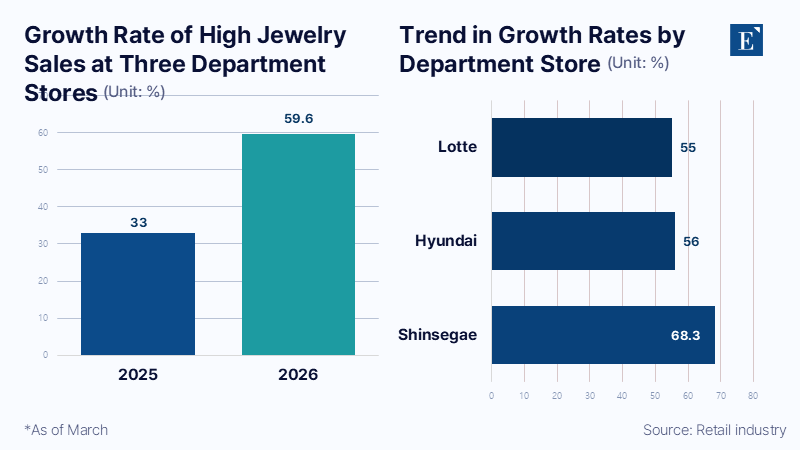
The most striking feature of the latest sales increase was the concentration in high jewelry. The three major department stores—Lotte, Shinsegae and Hyundai—posted an average 59.8% increase in high jewelry sales in March from a year earlier. Shinsegae Department Store recorded growth of 68.3%, followed by Hyundai Department Store at 56% and Lotte Department Store at 55%. Given that the average year-on-year sales growth rate for the high jewelry category at the three department stores stood at 33% for all of 2025, the March increase this year stands out markedly.
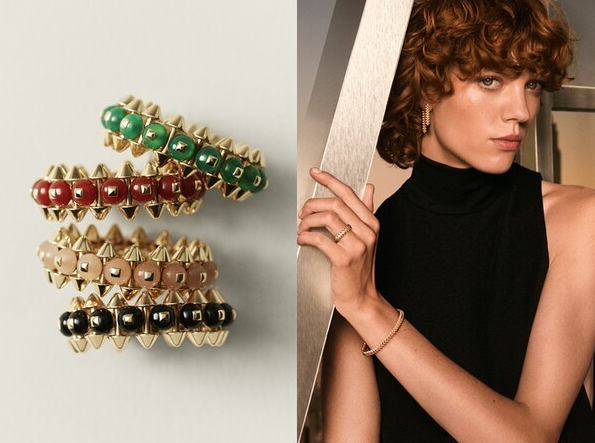
The high jewelry brands that posted particularly strong sales growth across all three department stores were Van Cleef & Arpels, known for its Alhambra series; Cartier, often called the “jeweler of kings”; and Bulgari, known for its vivid color palette. Graff, dubbed the “king of diamonds,” and Boucheron, currently popular for wedding bands, also helped drive sales growth. Prices for precious jewelry at high jewelry brands vary widely, ranging from about $2,000 to hundreds of thousands of dollars. Entry-level jewelry pieces are generally priced at around $2,000 to $4,700, while higher-end items typically range from tens of thousands of dollars to hundreds of thousands. In many cases, even a single necklace requires a payment of roughly $67,000.
Investment Demand, Joined by Chinese Shoppers
Within the retail industry, one factor cited behind the increase in high jewelry sales is the liquidation of homes by owners of multiple properties. The view is that as proceeds from home sales are held on standby rather than being immediately redeployed into property or equities, part of that capital is flowing into high jewelry. A luxury goods industry official said, “The number of transactions involving jewelry priced above $33,500 rose sharply compared with March of last year,” adding, “This suggests that part of lump-sum cash holdings has flowed into jewelry purchases containing gold and rare gemstones.”
Another reason demand has concentrated in high jewelry is scarcity. High jewelry is widely regarded as an art form that combines rare high-value gemstones with exceptional craftsmanship. Because it conveys social status, purchases are made for both investment and collection purposes, and depending on the item, value either holds over time or appreciates. In Cartier’s case, the brand had typically raised prices once or twice a year, but lifted them more than three times last year and implemented another increase this January. Ahead of the Jan. 27 price hike, long queues formed outside major stores. The popular Damour model is said to remain unavailable for the time being despite the sharp price increase, as inventory has been depleted.
This is also why high jewelry is described as “real estate small enough to fit on a fingernail.” A retail industry official said, “High-income consumers have begun to view jewelry not simply as a luxury good, but as an asset worth investing in,” adding, “They see it as a vehicle capable of preserving asset value effectively in an inflationary era.” Another official said, “Consumption also appears to reflect the fact that it can serve as a means of inheritance and gifting beyond the reach of taxation.”
The recovery in spending by Chinese tourists also supported the improvement in performance. According to research and investment information platform Epic AI, Chinese tourists with a strong propensity to consume luxury goods have recently been pouring in on the back of restrictions on travel to Japan and won weakness. Before those restrictions, younger Chinese consumers interested in K-culture mainly spent at Olive Young, Daiso and Musinsa, but since then, Chinese tourists who had previously traveled to Japan for luxury shopping have begun flowing into Korea, significantly lifting department store sales, according to the analysis.
In fact, Lotte Department Store said foreign customer sales across all stores doubled in the first quarter from a year earlier. At its Myeong-dong flagship store in Seoul, a representative tourist shopping district, foreign customer sales grew 130%. Shinsegae Department Store also posted a 65% increase in overall sales at its Myeong-dong flagship store from a year earlier. Foreign customer sales in particular surged 220%, underpinning performance. By category, luxury goods rose 120% and high jewelry increased 56%, highlighting especially strong demand for high-priced items. Hyundai Department Store likewise posted nearly a twofold increase in foreign customer sales last month from a year earlier, with strong growth in luxury goods at 30% and high jewelry at 55%.
As K-Shaped Consumption Entrenches, Department Stores Turn to High-End Brands for a Breakthrough
Consumer polarization, however, is becoming more pronounced. While high-priced luxury goods and jewelry continue to post strong growth, lower- and mid-priced product segments are showing relatively weak momentum. Department stores, which have long struggled with sluggish performance, are increasingly concentrating on high-end brands in response to this K-shaped consumption pattern.
Lotte Department Store recently collaborated with Van Cleef & Arpels to stage an experiential pop-up titled “Spring Is Blooming” at the lawn plaza of Lotte World Tower in Jamsil, Seoul. The event was arranged in the form of installation art across an outdoor space measuring 1,190 square meters, or about 360 pyeong, and was open to all visitors without advance reservations. The exhibition featured an illustrated garden created by French artist Charlotte Gastaut. Gardens and installation works rendered in pastel tones filled the space, while participatory programs such as flower crown making and garden decorating were also presented. Hyundai Department Store is also set to open a Bulgari pop-up store this month on the first floor of its Trade Center branch in Seoul, where it will unveil new products from the brand’s flagship Serpenti line.
The department store industry is also accelerating efforts to strengthen its competitiveness in luxury brands. Lotte Department Store opened a Tiffany & Co. flagship store at its Incheon branch last month, and this month added a Boucheron boutique at the same branch, expanding its high-end jewelry lineup. Shinsegae Department Store enhanced its luxury jewelry competitiveness by opening a Cartier boutique at its main branch in December last year and a Bulgari store at its Gwangju branch during the same period. Hyundai Department Store also expanded its luxury portfolio by introducing Van Cleef & Arpels at The Hyundai Seoul in July last year and opening a Chaumet store at its Pangyo branch in December of the same year.
Experts expect the high jewelry boom to continue for the time being. According to market research firm Industry Research, the global high jewelry market is projected to grow from $180.8 billion this year at a compound annual rate of 7.8%, reaching $355.6 billion by 2035. That outlook stems from the fact that roughly 60% of high jewelry buyers are ultra-high-net-worth individuals, whose purchasing power is rising amid an intensifying concentration of wealth. Worldwide, the number of individuals with more than $1 million in investable assets has surpassed 22 million, with Asia in particular posting a steep increase.
Oliver Griffin is a policy and tech reporter at The Economy, focusing on the intersection of artificial intelligence, government regulation, and macroeconomic strategy. Based in Dublin, Oliver has reported extensively on European Union policy shifts and their ripple effects across global markets. Prior to joining The Economy, he covered technology policy for an international think tank, producing research cited by major institutions, including the OECD and IMF. Oliver studied political economy at Trinity College Dublin and later completed a master’s in data journalism at Columbia University. His reporting blends field interviews with rigorous statistical analysis, offering readers a nuanced understanding of how policy decisions shape industries and everyday lives. Beyond his newsroom work, Oliver contributes op-eds on ethics in AI and has been a guest commentator on BBC World and CNBC Europe.
Similar Post