[U.S.–Iran War] “Strike or Compromise” — Iran with Nothing to Lose vs. the U.S. with No Means of Response

Authored On
Modified
Ceasefire Extended Until Conclusion, Maritime Blockade on Iran Maintained
Iran: “A Stalling Tactic; The Initiative Is Ours”
Immediate Catastrophe Averted, but Breakthrough Remains Uncertain
U.S. President Donald Trump has decided to extend the ceasefire with Iran ahead of its expiration in order to continue negotiations toward ending the war. The move is widely interpreted as a calculation that the risks of carrying out the previously threatened سلسلة of strikes on Iran’s critical infrastructure would be too great. However, with Iran consistently rejecting negotiations while defining the U.S. maritime blockade as an “act of war,” the two sides remain locked in a stalemate. Tehran’s posture is being read as a symbolic signal that the negotiating initiative has shifted in its favor.
Trump “Iran Deeply Fractured, Ceasefire Extended Until Unified Proposal Emerges”
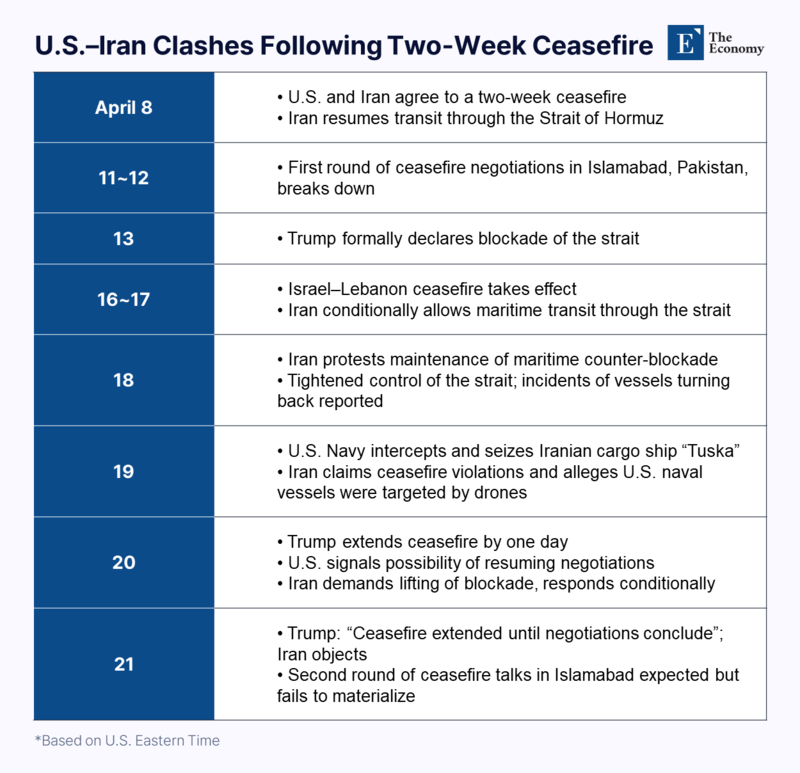
According to an April 21 (local time) report by the Associated Press, President Trump stated on his social media platform Truth Social that “the Iranian government is, as expected, seriously fractured,” adding that he had received requests from Pakistan’s Chief of Army Staff Asim Munir and Prime Minister Shehbaz Sharif to halt attacks until Iran’s leadership and negotiating team present a unified proposal. In response, Trump said he had instructed the U.S. military to suspend offensive operations while maintaining the maritime blockade and overall readiness posture. “We will extend the ceasefire until their proposal is submitted and discussions are concluded one way or another,” he emphasized.
Trump’s ceasefire declaration came one day before the expiration of the “two-week ceasefire.” While the ceasefire had initially been understood to last until the 21st, Trump had clarified the previous day that it would extend until the evening of the 22nd Eastern Time. Although he had repeatedly threatened to resume attacks if Iran failed to reach an agreement and expressed reluctance to extend the ceasefire, he ultimately opted for an extension as the deadline approached. In effect, he moved quickly to prolong even a deadline he had arbitrarily set himself.
While Trump had previously exerted strong pressure on Iran by warning of sequential strikes on key infrastructure if no agreement was reached, he is believed to have been reluctant to follow through. With domestic support for a war with Iran remaining significantly low and pressure from rising oil prices mounting, the administration appears increasingly in need of a swift exit strategy. There is a possibility that Trump judged resuming attacks could lead to a protracted conflict, inflicting greater political damage ahead of the November midterm elections. Publicly, however, he sought to justify the extension by citing Pakistan’s mediation request and internal divisions within Iran. Some analysts suggest that by extending the ceasefire “until Iran presents a unified proposal and discussions conclude in some form,” Trump has effectively declared an open-ended ceasefire with no fixed deadline—interpreted as a willingness to maintain it until negotiations yield some form of outcome.
Iran “We Do Not Recognize the Extension,” Signals Non-Participation in Second Round of Talks
Although the extension is expected to prolong negotiations for the time being, uncertainty remains over whether Iran can produce a unified negotiating position or accept U.S. demands. Core issues such as Iran’s nuclear program and the Strait of Hormuz remain unresolved, and ongoing tensions—including U.S. counter-blockade measures in the strait—make an optimistic outlook unlikely.
Moreover, Iran has escalated its criticism, downplaying Trump’s extension decision. Iranian state television reported immediately after the announcement that Tehran would not recognize the U.S. extension and would act in accordance with its national interests. Given its strong opposition to the maritime blockade, Iran has maintained that it cannot accept a unilateral ceasefire while the blockade remains in place, even as it withheld confirmation of participation in a second round of talks until the last moment. Tasnim News Agency, a semi-official outlet affiliated with the Islamic Revolutionary Guard Corps (IRGC), stated, “Iran never requested an extension,” adding that “Trump could employ every means to deceive Iran, and Iranian authorities do not take such possibilities lightly.” This frames the extension as a U.S. tactic of deception.
The Iranian government has also questioned the intent behind the extension, warning that continued maritime blockade could provoke a military response. Foreign Minister Abbas Araghchi wrote on social media that “blockading Iran’s ports constitutes an act of war and therefore violates the ceasefire agreement.” Hardline rhetoric has also intensified within Iran’s political sphere. Mehdi Mohammadi, an adviser to Parliament Speaker Mohammad Bagher Ghalibaf and a member of the negotiating team, wrote on social media that “the losing side cannot dictate terms,” asserting that “maintaining the maritime blockade is no different from bombardment and requires a military response.” He further claimed that “Trump’s extension is clearly a tactic to buy time for a surprise attack” and declared that “the time has come for Iran to seize the initiative.”
In addition, Iran has formally announced through Pakistan that it will not attend the second round of talks scheduled for April 23 in Islamabad, signaling its determination to defend national interests by refusing to appear at the negotiating table. Tehran has placed responsibility for its absence on Washington. In a phone call with Pakistani Foreign Minister Ishaq Dar, Araghchi stated that “provocative actions by the United States, continued violations of the ceasefire, and contradictory positions toward Iran are obstructing the diplomatic process.” Speaker Ghalibaf also posted on X that “Trump is turning the negotiating table into a ‘table of surrender’ while imposing blockades and violating the ceasefire,” adding, “we will not accept negotiations conducted under the shadow of threats.” Iran has made clear that it considers the U.S. maritime blockade, the seizure of Iranian cargo vessels, and Israeli attacks on Lebanon as violations of the ceasefire, and that it will not return to talks unless such coercive measures are reversed.
Iran Holds the Initiative, Raising Prospects of a Protracted Conflict
With Iran effectively holding the negotiating initiative, experts point to Trump’s credibility gap as a key factor in the shift. His characteristic mix of threats and self-congratulatory rhetoric—often delivered in contradictory fashion—has, analysts say, pushed Iran further away from the negotiating table. On April 21 alone, Trump warned of imminent bombing, only to follow two sentences later by stating that Iran would attend talks the next day. He also oscillated between praising Iran as a “great country” and condemning it as “bloodthirsty,” employing starkly contradictory language. Iran’s diplomatic mission in Ghana mocked the behavior, stating that “within the past 24 hours, the U.S. president has thanked Iran, threatened it, criticized China, praised it, declared success of the blockade, and promised a deal,” likening Trump to “a kind of one-person WhatsApp group.”
Separate from Trump, instability within Iran’s internal power structure is also complicating negotiations. Tehran’s external messaging has recently appeared increasingly disjointed, reflecting factional divisions between hardliners and proponents of negotiation. For instance, after Araghchi announced a limited reopening of the Strait of Hormuz in consideration of the Lebanon ceasefire, the IRGC immediately opposed the move, insisting on maintaining the blockade, prompting the Foreign Ministry to hastily clarify its position. This episode underscores that real decision-making authority in Iran lies not with political officials but with the Revolutionary Guard.
Divisions within Iran’s leadership are deepening. Following the death of Supreme Leader Ayatollah Ali Khamenei, the prolonged seclusion of his successor Mojtaba has reportedly eroded cohesion at the top. Hardliners have denounced Speaker Ghalibaf, who led negotiations, as a “traitor,” with some reports even mentioning the possibility of a coup. Even if Iran’s delegation returns to the negotiating table, analysts warn that without resolving these internal “two voices,” a final agreement will remain difficult.
Among foreign policy and security experts, there is a growing assessment that a diplomatic resolution between the two countries has become even more remote. While military confrontation has been temporarily deferred, key sources of conflict—such as the continued U.S. maritime blockade—remain intact, making a breakthrough unlikely. Karim Sadjadpour, a senior fellow at the Carnegie Endowment for International Peace, noted that “trust between the United States and Iran has always been very low, but now it has completely disappeared,” adding that “Iran believes the United States could attack at any time, including during negotiations, as it has done twice before under Trump, while the White House will never believe that Iran has abandoned its nuclear ambitions even if it agrees to a compromise.”
The prospect of a prolonged conflict is also gaining traction. The core issues in negotiations can be broadly divided into three: Iran seeks sanctions relief, control over the Strait of Hormuz, and recognition of its nuclear program, while the United States demands a halt to nuclear development and the abandonment of uranium enrichment. In particular, Iran views control of the strait and its oil transport capacity as strategic assets and is unlikely to concede them easily. Some foreign media outlets have suggested that Iran is preparing for a long-term standoff rather than a swift resolution, pursuing a strategy of leveraging potential shocks to the global economy to extract U.S. concessions under the belief that it can “endure sufficiently” despite sanctions and military pressure.
The United States, too, has begun preparing for a prolonged confrontation. On April 20, President Trump issued five presidential memoranda under the Defense Production Act (DPA), originally enacted during the Korean War, targeting domestic oil production and refining, coal supply chains, and power grid infrastructure. The move is seen as an effort to mitigate the high energy costs faced by Americans as the conflict with Iran drags on. Trump is also reportedly considering increasing the production of military supplies under the DPA, suggesting an acknowledgment that negotiations toward ending the war may not proceed smoothly. Foreign media likewise expect that even if a second round of ceasefire negotiations materializes, it is likely to face prolonged difficulties.
- Previous “Japan Pushes Beyond the Limits of Land-Based Data Centers” With Land Prices Soaring and Grid Capacity Running Short, Expansion Shifts to Maritime and Rail-Based Sites
- Next “Is Pandemic Season 2 Looming?” Nations Move to Control Daily Life Amid Oil Shock, Shifting to Remote Work, Four-Day Weeks, and Public Transport
Similar Post