“Japan Pushes Beyond the Limits of Land-Based Data Centers” With Land Prices Soaring and Grid Capacity Running Short, Expansion Shifts to Maritime and Rail-Based Sites

Siobhán Delaney is a Dublin-based writer for The Economy, focusing on culture, education, and international affairs. With a background in media and communication from University College Dublin, she contributes to cross-regional coverage and translation-based commentary. Her work emphasizes clarity and balance, especially in contexts shaped by cultural difference and policy translation.
Authored On
Modified
Urban Data Center Infrastructure Bottlenecks
Rise of Maritime- and Rail-Based Alternative Siting Strategies
Strategic Pivot Driven by Surging Construction Costs and Escalating Land Prices
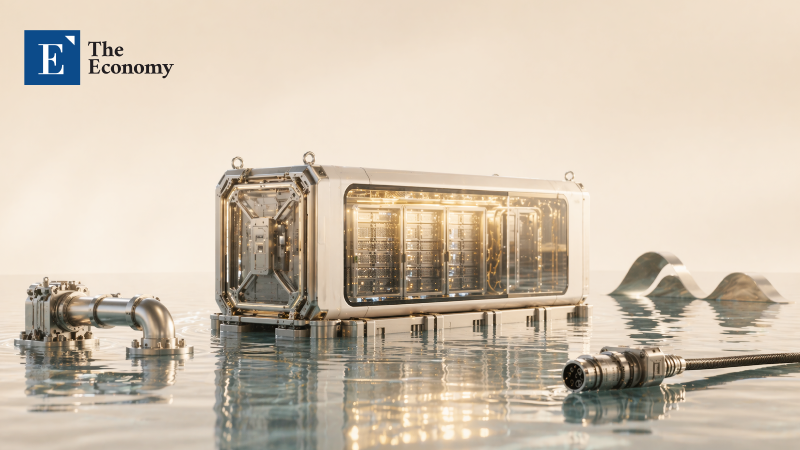
Japan has begun pursuing a data center deployment strategy that extends even to secondhand vessels and the spaces beneath elevated railway structures. The shift reflects the increasingly visible limitations of the conventional siting model, as securing plots near urban centers and connecting to the power grid have simultaneously become acute bottlenecks. With demand surging amid the spread of generative AI, a land-centric infrastructure framework has become increasingly unable to absorb mounting cost pressures and supply constraints, prompting a full-fledged move to disperse cooling, power, and siting challenges into non-terrestrial domains.
Hitachi, MOL to Launch Data Center Built From Retrofitted Secondhand Vessel in 2027
According to French tech media outlet Journal du Geek on April 21 local time, Japanese technology company Hitachi and shipping group Mitsui O.S.K. Lines (MOL) are moving ahead with the construction of a floating data center to overcome the limitations of land-based infrastructure. The two companies have entered the technology verification stage, with commercialization targeted for 2027. They recently signed a memorandum of understanding related to the initiative.
At the core of the project is the plan to convert a secondhand vessel into a data center. A key advantage lies in the use of seawater directly as coolant, which improves energy efficiency and enables infrastructure deployment within a far shorter timeframe than a conventional land-based data center. Of particular note is the prospect of building a data center of roughly 50,000 square meters based on a car carrier, a scale that could deliver processing capacity comparable to that of a large onshore data center in Japan. Freed from the geographic constraints of land, the model also offers far greater flexibility in site selection.
The project is a highly calibrated combination of each company’s strengths. The division of roles is clear. MOL will oversee vessel conversion, maritime operations, and consultations with port authorities, covering the marine logistics component in full, while Hitachi will take charge of data center design, IT infrastructure buildout, and overall operations. In particular, Hitachi plans to draw on its prior experience operating land-based data centers to define the network and security architecture and lead efforts to secure prospective customers. MOL, which had been advancing the development of a floating data center platform with renewable energy company Kinetics since July last year, has now given that vision far more concrete form through its partnership with Hitachi.
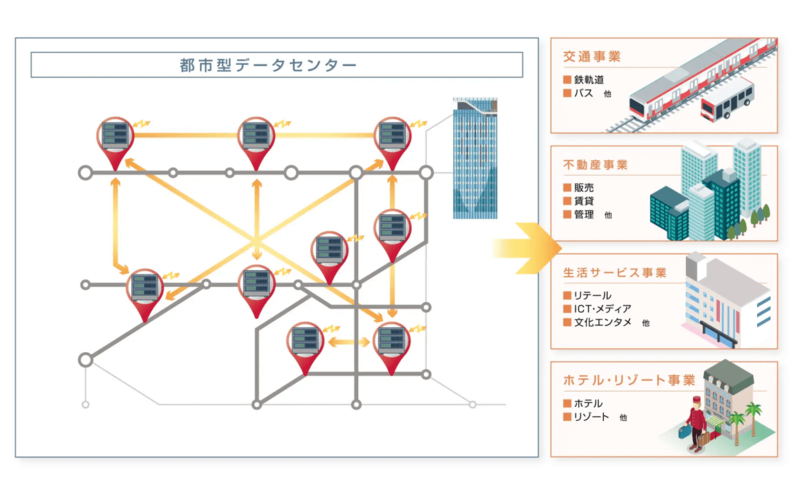
Data Center Installation Beneath Tokyo Railway Tracks
In Japan, plans are also advancing to install modular data centers in unused spaces beneath elevated railway tracks, alongside floating data centers. Last month, a consortium of four Tokyu Group affiliates announced plans to begin installing a modular data center beneath an elevated section of Tokyo’s Oimachi Line from June. The test is intended to determine whether compact server infrastructure can operate stably in spaces beneath elevated railway structures, taking into account a range of environmental variables, including vibration and temperature fluctuations. The central issue is whether operational stability can be maintained under conditions where strong vibration and noise generated by passing trains coincide with external environmental changes.
Participants in the project include Tokyu Corporation, Tokyu Railways, Its Communications, and Tokyu Construction. Tokyu Construction is developing the modular unit itself, Tokyu Railways is providing the site beneath the elevated track, and Its Communications plans to provide fiber-optic connectivity using optical cables already installed along the railway corridor. The main verification items include soundproofing, thermal insulation, vibration suppression, and cooling efficiency, while the facility to be deployed is a compact modular data center integrating servers, cooling equipment, and power systems. Because it can be installed without constructing a separate large-scale building, the model is regarded as particularly well suited to space-constrained urban environments.
One of the key advantages on which the consortium is placing strong expectations is the high-capacity optical fiber network that Its Communications has already built along the Tokyu rail lines. Rather than laying new fiber-optic cables to connect the facility, the plan is to install the infrastructure beneath the tracks and link it directly to the existing backbone network. The consortium is also reviewing a longer-term plan to build data centers across the entire Tokyu rail network, including Shibuya, as part of a broader digital infrastructure strategy.
Existing Land-Centric Model Exposes Its Limits
Behind Japan’s turn toward maritime and rail infrastructure lies the severe infrastructure strain gripping the Tokyo data center market. As AI services spread rapidly, large-scale data center construction is accelerating across Japan. In January, KDDI, one of Japan’s major telecommunications companies, began operating its latest data center on the site of a Sharp factory in Sakai, Osaka Prefecture, while SoftBank is building a 150-megawatt facility in Sakai with completion targeted within the year.
Local governments in Toyama and Kagoshima prefectures are also reviewing plans with regional companies to build ultra-large data centers in the 350- to 400-megawatt class. According to Yomiuri, 132 data centers are currently in operation, and at least 18 more are scheduled to be built this year. Large-scale data centers in Japan had traditionally remained in the several-dozen-megawatt range, but the trend is now shifting toward facilities in the hundreds of megawatts. Japan’s Ministry of Internal Affairs and Communications projects that the domestic AI-related market will reach about $26.4 billion by 2029, roughly triple last year’s level, based on a recent exchange rate of about ¥159.26 to the dollar.
Yet the pace of infrastructure development remains frustratingly slow. In a recent interview, Yasuo Suzuki, vice president of NTT Global Data Centers, said that waiting times for grid connections in central Tokyo can stretch from five to 10 years. On top of that, the processes of site selection, permitting, and civil engineering construction also take years. Construction costs, meanwhile, have surged to virtually unmanageable levels. According to a report by British construction consultancy Turner & Townsend, Tokyo ranked as the world’s most expensive data center construction market for the second consecutive year. General construction costs rose 38% between 2020 and 2025, while land-based data center construction costs jumped 2.5-fold over the same period. Pressure from land prices is also intensifying. According to Mordor Intelligence, land prices in Tokyo rose by about 69% last year.
Siobhán Delaney is a Dublin-based writer for The Economy, focusing on culture, education, and international affairs. With a background in media and communication from University College Dublin, she contributes to cross-regional coverage and translation-based commentary. Her work emphasizes clarity and balance, especially in contexts shaped by cultural difference and policy translation.
Similar Post