“Japan and EU Build Subsea Cable Alliance to Counter ‘China-Russia Communications Network Sabotage,’ Also Cooperate on New Arctic Sea Route”

Siobhán Delaney is a Dublin-based writer for The Economy, focusing on culture, education, and international affairs. With a background in media and communication from University College Dublin, she contributes to cross-regional coverage and translation-based commentary. Her work emphasizes clarity and balance, especially in contexts shaped by cultural difference and policy translation.
Authored On
Modified
Deepening instability in global communications infrastructure
Japan and EU accelerate security cooperation and joint response framework
Arctic bypass route also pursued to secure strategic autonomy
As geopolitical risks threatening the stability of global communications networks and maritime logistics intensify, Japan and the European Union (EU) have moved to strengthen security cooperation across the board. The two sides are jointly building early detection and recovery systems to protect subsea cables, a core infrastructure asset, while also accelerating efforts to secure strategic autonomy by developing Arctic routes that bypass existing major sea lanes. The move is seen as a strategic measure to protect economic security from maritime blockades or sabotage by specific countries and to maximize the flexibility of global supply chains.
Agreement on Research for Early Detection of Damaged Cables
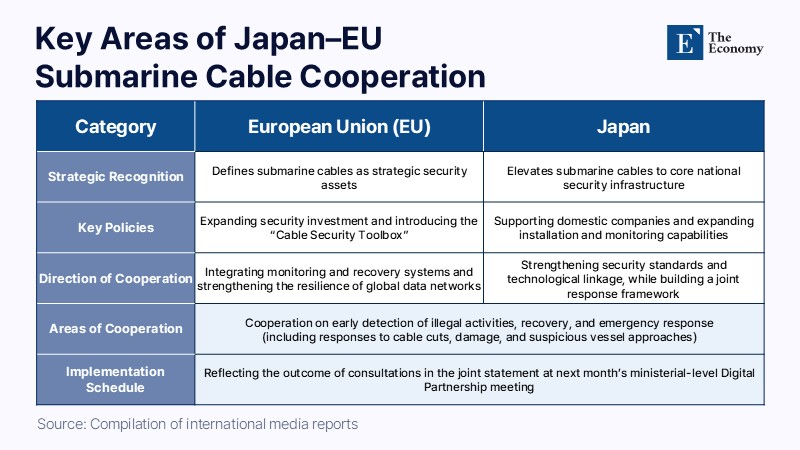
According to the Nihon Keizai Shimbun on the 27th, the EU and the Japanese government have agreed to strengthen cooperation on the installation and maintenance of subsea cables. The two governments plan to reflect the outcome of their discussions in a joint statement at next month’s ministerial meeting on their digital partnership, and will cooperate on early detection and repair of illegal acts and emergency response, with cable cuts or damage and the approach of suspicious vessels in mind. Around 500 subsea cables have been installed worldwide, mainly across the Pacific and Atlantic, with a total length of 1.5 million km. As core infrastructure responsible for 99% of international communications, cooperation between the two sides is expected to improve communications speed between Japan and Europe by about 30% if realized.
The EU is defining subsea cables as strategic security assets and raising its level of response. The European Commission is shifting its policy focus toward simultaneously strengthening the resilience and control of global data networks through cooperation with Japan, while integrating monitoring and recovery systems through expanded security investment and the introduction of a “Cable Security Toolbox.” Japan is also elevating subsea cables to the status of core national security infrastructure and reorganizing its response framework. The Japanese government is supporting domestic companies while expanding installation and monitoring capabilities, moving to secure independent operational capacity, and is in the midst of building a joint response system by strengthening security standards and technological connectivity through cooperation with the EU.
Both Japan and Europe have strengths in the subsea cable sector. France’s Alcatel Submarine Networks, the largest company in the field, holds a 40% share of the global market, while Japan’s NEC holds a 20% share. In addition to these two companies, telecom operators that own, install and maintain subsea cables are also expected to participate in the cooperation framework. Demand for subsea cables has been rising recently due to growing demand for video and artificial intelligence (AI) services. Japan serves as a hub connecting North America and Asia, with many cables passing through Japanese waters.
Frequent Damage from Russian and Chinese Attacks
Behind the two sides’ cooperation lies concern over cuts to global subsea cables. Since Russia’s invasion of Ukraine began in February 2022, damage to subsea cables in the Baltic Sea has occurred frequently. Located in Northern Europe, the Baltic Sea is an active commercial shipping route connected to nine countries, including Russia. Damaging subsea communications cables to affect the communications networks of hostile countries is one method of sabotage. It involves a ship lowering its anchor to the seabed and dragging it along, severing cables. Because 99% of global financial flows pass through subsea cables, physical attacks undermine the stability of the financial system. If an oil shipping route is blocked, an alternative route can be sought, but when subsea cables are damaged, there are few viable alternatives.
EU countries have not named a specific country, but they suspect Russia may be behind the incidents. Western countries have long argued that Russia has used “hybrid” tactics, including hacking and infrastructure arson, to obstruct Western support for Ukraine. In fact, in 2023, Dutch authorities detected a Russian spy ship in the North Sea surveying subsea cables and gas pipelines while preparing for sabotage.
Subsea cables have also been severed by Chinese vessels in waters near Taiwan, close to Japan. In November 2024, a Chinese bulk carrier cut two data cables in Taiwanese waters, and early last year another Chinese-owned vessel damaged a Pacific cable while crossing waters off Taiwan’s northern coast. Western countries and Taiwan have raised suspicions that such situations may amount to China’s “gray-zone tactics” — military actions designed to achieve security objectives through low-intensity provocations that do not escalate into direct armed conflict or war — citing the detection of Chinese cargo vessel activity in areas where subsea cables were severed. In recent years, China has intensified gray-zone operations around Taiwan that consistently threaten sovereignty and security, though below the level of full-scale war.
Iran, which is at war with the United States, is also raising the level of threat by bringing out the card of cutting subsea cables. Tasnim News Agency, an Iranian semi-official media outlet linked to Iran’s Islamic Revolutionary Guard Corps (IRGC), warned in an article on the 22nd local time titled “The Strait of Hormuz, the Key Artery of Internet Cables for Persian Gulf Coastal States” that “if, for any reason — natural disaster, a ship dropping anchor, maritime accident, or intentional act — several major cables in the strait are severed at the same time, a ‘digital catastrophe’ will occur,” adding that “the internet would suffer severe disruption or widespread outages, and daily economic losses would reach hundreds of millions to billions of dollars.” This is read as a warning that the Iranian military could cut cables as well as impose a logistics blockade in response to the U.S. reverse blockade of the Strait of Hormuz. At least seven subsea communications cables linking coastal states pass through the Strait of Hormuz, including major subsea cables spanning Asia, the Middle East and Europe such as FALCON, AAE-1, TGN-Gulf and SEA-ME-WE, meaning Japan and Europe are also not free from the risk.

Japan and Europe Seek New Routes in the Arctic Sea
Cooperation between Japan and Europe does not stop at subsea cables. The two sides are also accelerating the construction of a new route connecting Japan and Europe via North America through the Arctic Sea. The Arctic route is a sea route that links the Asian continent and Europe through the Arctic Ocean, and there are two routes. One is the Northwest Passage, which runs from Asia (the Pacific) westward to Europe via the north of the North American continent, and the other is the Northeast Passage, which runs from Asia eastward to the Bering Strait via the north of the Eurasian continent, mainly Siberia. The Northwest Passage was first navigated in 1906 by Norwegian explorer Roald Amundsen, and the Northeast Passage in 1920.
Russia has long sought to develop the Arctic, including the Arctic route. Russian President Vladimir Putin said in 2011 that “the Arctic is the shortest route connecting Europe and Asia-Pacific, the world’s largest markets,” arguing that the Arctic route offers an excellent opportunity to optimize costs. Russia is opening regular routes at least twice a year between St. Petersburg and ports in the Far East to increase navigation and freight transport along the Arctic route. This also includes dredging work to allow vessels to move in and out smoothly. Russia is also accelerating development of Chukotka, the “land of natural resources.” Russia aims to turn the region into a maritime trade gateway for the Arctic route.
China, which does not directly possess territory there, has also been accelerating Arctic route development since announcing its “Polar Silk Road” project in 2018. The Polar Silk Road is a national vision to build a maritime logistics route connecting China and Europe by utilizing the Arctic route, thereby extending China’s Belt and Road Initiative — its land and maritime Silk Road — to the Arctic. Of course, the Arctic route still carries risks that make it difficult to replace existing China-Europe transport routes in the short term. The Arctic route remains highly unpredictable due to fluctuations in sea ice and sudden changes in weather, making punctuality difficult to guarantee. Even so, the Arctic route is regarded as a viable alternative that can replace or supplement existing transport routes.
If Japan and the EU secure a new route through this cooperation, they will be able to exchange logistics without passing through traditional maritime transport routes, sharply reducing shipping time and maximizing cost savings. This will serve as a core driver for securing flexibility in global supply chains while diversifying routes for energy and raw material procurement, thereby strengthening their ability to respond to sudden disruptions in specific regions. The route also carries strategic significance from a geopolitical perspective. If the new route operates stably, Japan will be able to reduce its dependence on existing maritime routes that pass through the South China Sea and the Taiwan Strait. Experts say this would be a factor that could substantially mitigate the level of direct impact on Japan even if military tensions between China and Taiwan escalate or lead to an actual conflict.
Siobhán Delaney is a Dublin-based writer for The Economy, focusing on culture, education, and international affairs. With a background in media and communication from University College Dublin, she contributes to cross-regional coverage and translation-based commentary. Her work emphasizes clarity and balance, especially in contexts shaped by cultural difference and policy translation.
Similar Post
















