Even the Middle East—A Key Buffer Amid China’s Slowdown—Takes a Hit, Dealing a Blow to the Global Luxury Industry

Matthew Reuter is a senior economic correspondent at The Economy, where he covers global financial markets, emerging technologies, and cross-border trade dynamics. With over a decade of experience reporting from major financial hubs—including London, New York, and Hong Kong—Matthew has developed a reputation for breaking complex economic stories into sharp, accessible narratives. Before joining The Economy, he worked at a leading European financial daily, where his investigative reporting on post-crisis banking reforms earned him recognition from the European Press Association. A graduate of the London School of Economics, Matthew holds dual degrees in economics and international relations. He is particularly interested in how data science and AI are reshaping market analysis and policymaking, often blending quantitative insights into his articles. Outside journalism, Matthew frequently moderates panels at global finance summits and guest lectures on financial journalism at top universities.
Authored On
Modified
LVMH’s First-Quarter Revenue Stagnates
Middle East Conflict Shaves 1 Percentage Point Off Growth
Kering, Hermès Also See Middle East Sales Decline
Meanwhile, “Ultra-Wealthy Consumption” Remains Intact
Global luxury companies have recently reported disappointing results. Following a slowdown in the Chinese market, the Middle East—previously identified as a new growth engine—has become entangled in geopolitical conflict, turning concerns over deteriorating industry performance into reality. Nevertheless, even amid extreme market uncertainty, demand for ultra-high-end luxury goods remains resilient, further accentuating polarization within the sector.
Europe’s Big Three Luxury Houses Post Across-the-Board First-Quarter Declines
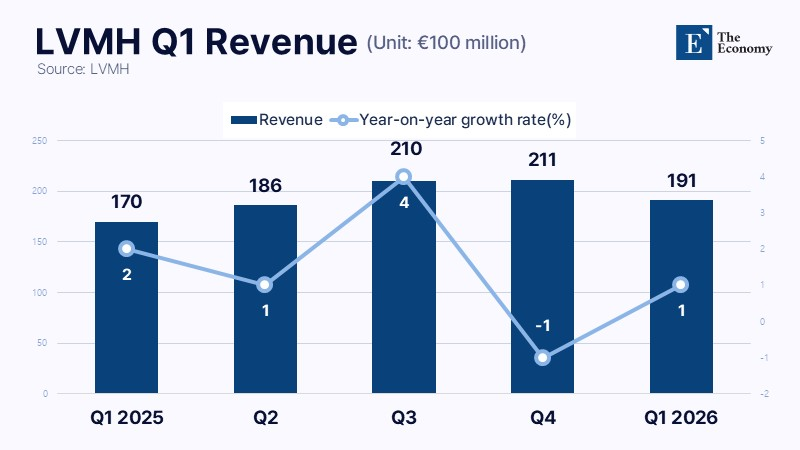
According to the Financial Times (FT) on the 26th (local time), LVMH, the world’s largest luxury conglomerate with brands including Louis Vuitton, Dior, Celine, and Tiffany, posted first-quarter revenue of $20.6 billion on a like-for-like basis, excluding scope changes and currency effects. This represents a mere 1% increase year-on-year, effectively signaling stagnation. The company noted that while there were no changes in consolidation scope, currency fluctuations reduced revenue by approximately 7%.
By region, the U.S. market remained relatively resilient, while Europe and Japan saw domestic demand partially offset declines in tourist spending. Asia excluding China continued to demonstrate robust growth, extending the recovery trend observed since the second half of last year. South Korea played a key role as a stabilizing force in the region. Louis Vuitton Korea recorded revenue of $1.34 billion last year, up 6.1% year-on-year, while operating profit surged 35.1% to $380 million.
However, the Middle East began to feel the direct impact of conflict in March. LVMH stated that conditions in the region reduced overall first-quarter revenue growth by approximately 1 percentage point. Its core fashion and leather goods division also underperformed, with revenue declining 2% year-on-year to $9.99 billion, largely reflecting the effects of the Middle East conflict. This marked the seventh consecutive quarterly decline for the segment.
Other luxury players are facing similar challenges. Hermès International reported on the 15th that its first-quarter revenue, excluding currency effects, rose 5.6% year-on-year to $4.4 billion, but this fell well short of market expectations of 7.1% growth. Notably, Middle East revenue declined by around 6%. Kering Group, which owns Gucci and Saint Laurent, posted first-quarter revenue of $3.86 billion, down 8% year-on-year. Its Middle East sales grew during the first two months of the year but plunged 11% in March.
Middle East Market Disruption and Waning Chinese Demand Undermine the Foundation of Growth
The luxury sector had endured several years of stagnation due to weakening Chinese consumption, only beginning to show signs of recovery in the third quarter of last year. However, the outbreak of war involving Iran on February 28 halted this rebound. While the Middle East accounts for only about 5% of the global luxury market, it has been one of the fastest-growing regions due to affluent local consumers and tourist spending. Eric du Halgouët, Chief Financial Officer of Hermès, stated, “Sales at luxury shopping malls in Gulf regions, including Dubai, dropped by as much as 40% in March,” adding that stores in Italy, Switzerland, and the UK were also affected by the decline in Middle Eastern shoppers.
According to the UK-based fashion outlet Business of Fashion, global luxury brands have been shutting down Middle Eastern stores amid military tensions involving Iran, the United States, and Israel. Kering has temporarily closed all its stores in key Middle Eastern markets, including the United Arab Emirates, Kuwait, Bahrain, and Qatar. It has also imposed a complete ban on employee travel to the region. Chalhoub Group, the largest luxury distributor in the Middle East, has shut all its stores in Bahrain. The company operates regional outlets for brands such as Louis Vuitton, Dior, Fendi, Celine, Givenchy, and Christian Louboutin. While stores in the UAE, Saudi Arabia, and Jordan remain open, employees are allowed to decide whether to report to work, effectively suspending normal operations.
In addition to geopolitical risks, declining Chinese demand is further weighing on the industry. Chinese consumers, who once accounted for 30% of global luxury spending, are no longer opening their wallets as before, making it increasingly difficult for the sector to achieve the double-digit growth rates of the past. Experts attribute this contraction to the interplay of macroeconomic factors. The “excess savings” accumulated during the COVID-19 pandemic and the subsequent wave of “revenge spending” have now been largely exhausted. According to Bain & Company, China’s share of global luxury consumption has fallen to around 22%, down from a pandemic peak of approximately 33%.
Moreover, the prolonged high-interest-rate environment is exerting downward pressure on asset prices, giving rise to the so-called “reverse wealth effect.” Typically, when the value of assets such as real estate and equities declines, consumers become psychologically constrained and reduce spending. This behavioral shift is particularly pronounced in markets like luxury goods, where consumption is closely tied to signaling wealth. Compounding these factors is the cultural shift known as “guochao”—a growing preference for domestic brands driven by national pride—which is further dampening demand for foreign luxury goods.
High-End Brands Remain Resilient, Deepening Polarization in the Luxury Market
Against this backdrop, concerns are mounting that a prolonged Iran conflict could inflict even greater damage on industry performance. Bernard Arnault, Chairman of LVMH, warned at the company’s annual general meeting on the 23rd, “The world is currently facing a highly serious crisis in the Middle East,” adding that “this situation could escalate into a global catastrophe with profoundly negative economic consequences.” Although a ceasefire between the United States and Iran is currently holding, the timeline for a definitive end to the conflict remains uncertain.
Consequently, growth forecasts for the luxury market—once expected to rebound this year—are being revised downward. HSBC recently lowered its projection for the sector’s revenue growth by 1.1 percentage points to 5.9%, citing weak demand in Europe and the Middle East as key factors. The Financial Times noted that “the Middle East conflict, which risks dampening global consumer spending, is delaying the long-anticipated recovery in luxury goods demand following several challenging years.”
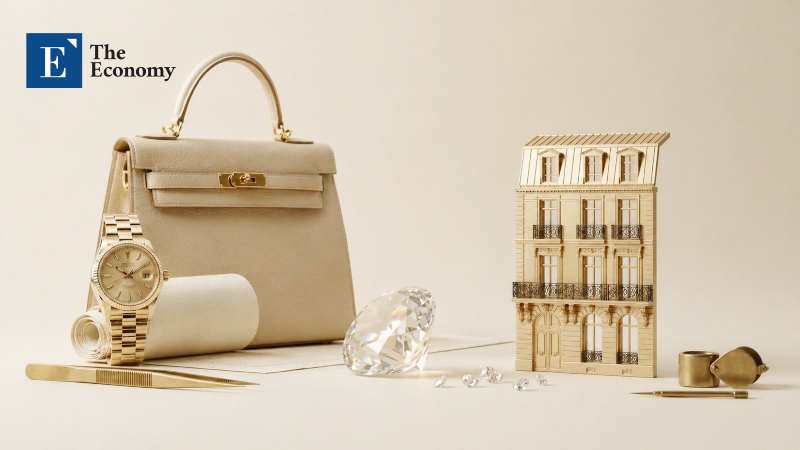
Nonetheless, even in this environment, demand is increasingly concentrating on select high-asset-value brands. As fears of war intensify, wealthy consumers tend to favor “safe-haven luxury goods” that preserve value, rather than trend-sensitive fashion items. Representative examples include Hermès Birkin and Kelly bags, as well as ultra-high-end watches such as Patek Philippe and diamond-centric high jewelry. Notably, Hermès has experienced relatively smaller declines in its share price compared to other brands, reflecting strong investor confidence in its pricing power and resilience during economic downturns or periods of conflict. In contrast, mid-tier luxury brands continue to face stagnating or declining performance.
Matthew Reuter is a senior economic correspondent at The Economy, where he covers global financial markets, emerging technologies, and cross-border trade dynamics. With over a decade of experience reporting from major financial hubs—including London, New York, and Hong Kong—Matthew has developed a reputation for breaking complex economic stories into sharp, accessible narratives. Before joining The Economy, he worked at a leading European financial daily, where his investigative reporting on post-crisis banking reforms earned him recognition from the European Press Association. A graduate of the London School of Economics, Matthew holds dual degrees in economics and international relations. He is particularly interested in how data science and AI are reshaping market analysis and policymaking, often blending quantitative insights into his articles. Outside journalism, Matthew frequently moderates panels at global finance summits and guest lectures on financial journalism at top universities.
Similar Post