“Defense Big Three Reduced to Subcontractors” — Silicon Valley Upends the Defense Landscape in the AI-Era Arms Race

Anne-Marie Nicholson is a fearless reporter covering international markets and global economic shifts. With a background in international relations, she provides a nuanced perspective on trade policies, foreign investments, and macroeconomic developments. Quick-witted and always on the move, she delivers hard-hitting stories that connect the dots in an ever-changing global economy.
Authored On
Modified
The Advent of a “Cheap and Fast” AI War Era
SpaceX and Anduril Expand Their Presence in Defense
U.S. Defense Procurement Reshaped as the Traditional Big Three Lose Grip
A wave of change is sweeping through the U.S. military and defense industry. Having recognized the limits of relying on high-cost weapons against artificial intelligence (AI)-powered unmanned systems, the U.S. government is deepening its dependence on technology companies. The shift symbolically shows that the dominance of the traditional “defense Big Three” is weakening, while the center of gravity in the defense industry is moving toward Silicon Valley.
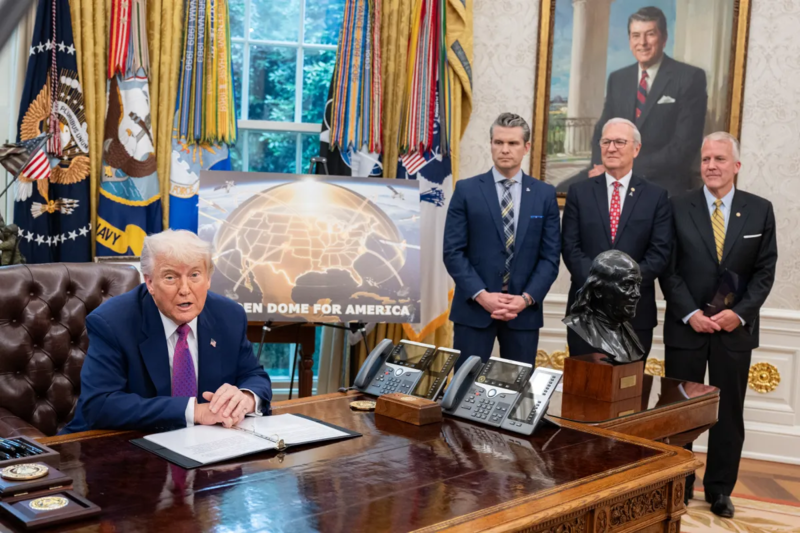
SpaceX and Anduril Selected to Develop Golden Dome’s Core Interceptors, Beating Defense Heavyweights
According to Fortune on the 26th/local time, the U.S. Space Force recently selected 12 major companies, including SpaceX and Anduril, to develop prototypes for space-based interceptor missiles and signed contracts worth a combined $3.2 billion. The contracts were awarded through an expedited procedure known as Other Transactional Authority (OTA). The system is designed to bypass ordinary procurement bureaucracy and broaden competition.
Under the contracts, SpaceX will lead construction of the interceptor satellite constellation, the hardware core of Golden Dome, and design the foundation of the physical defense network. SpaceX will develop a next-generation platform capable of tracking and striking hypersonic missiles from low Earth orbit, using its unrivaled reusable launch-vehicle technology to deploy persistent space-based surveillance and immediate interception assets. Unlike conventional high-cost, low-efficiency satellites, SpaceX is focusing on maximizing interception success rates by securing uninterrupted monitoring and a resilient defense posture through a large-scale low Earth orbit satellite network.
Anduril is expected to serve as Golden Dome’s brain by building an intelligent command-and-control system that processes vast volumes of space and ground data in real time. In particular, it will integrate sensor data collected across theaters through AI autonomous software, predict missile trajectories, and implement an open network architecture that calculates optimal interception points in real time. Anduril’s technology is expected to function as a “multi-domain bridge” that connects fragmented military networks, becoming a core engine for neutralizing enemy missile threats through mechanical and intelligent decision-making even in complex battlefield conditions.
Golden Dome is a system designed to defend the U.S. homeland and broader U.S. territory from a wide range of threats, including ballistic missiles, hypersonic missiles, and cruise missiles. While existing systems have primarily targeted North Korean long-range missiles, Golden Dome is aimed at a far broader threat set, including long-range ballistic missiles, hypersonic missiles, and next-generation drones from strategic competitors such as China and Russia. Although inspired by Israel’s Iron Dome, its operating environment and technical difficulty are entirely different. Iron Dome is a relatively simple system that intercepts short- and medium-range rockets flying within the atmosphere from Hamas, Iran, and others, whereas Golden Dome must intercept nuclear-armed long-range ballistic missiles traveling at far higher speeds outside the atmosphere at high altitude. The area to be defended is also vastly different: Israel covers only about 22,072 square kilometers, roughly the size of the U.S. state of New Jersey at about 22,591 square kilometers, while U.S. territory is 450 times larger than Israel. Technical difficulty and development and deployment costs are therefore bound to surge.

Traditional Defense Playbook Under Strain
The contract reflects the U.S. Space Force’s strong determination to move away from the rigid legacy defense procurement system and create an agile defense ecosystem capable of responding to ultra-fast missile threats. The core of the Golden Dome project is command-and-control software. It collects data from radars and sensors scattered across the U.S. military, detects threats, and controls interceptor missiles. Gen. Michael Guetlein of the Space Force, who oversees the project, recently said at a conference that “this software connects different military services,” stressing that command-and-control capability will be Golden Dome’s “secret sauce.”
The project structure is even more notable. Traditional defense powerhouses such as Lockheed Martin, Northrop Grumman, and RTX, formerly Raytheon, are participating virtually as subcontractors helping develop the software operating system rather than leading the program. This illustrates an unusual reversal in which technology companies rise to the top of the defense ecosystem as the center of weapons systems shifts from hardware to software.
Signs of the shift emerged earlier this year. In January, U.S. Defense Secretary Pete Hegseth unveiled a new AI strategy at SpaceX’s Texas facility, saying the Pentagon would “accelerate at Elon Musk speed.” Last month, Palantir’s AI command-and-control system Maven was adopted as an official program, and the U.S. Army signed a 10-year contract with Anduril worth up to $20 billion. The traditional defense Big Three, of course, still retain overwhelming strength. Their combined revenue is eight times that of Silicon Valley’s three emerging defense players, and the F-35 stealth fighter program led by Lockheed Martin alone is worth more than $2 trillion.
Yet capital-market sentiment has clearly shifted. The combined valuation of Silicon Valley’s three companies has already exceeded that of the defense Big Three by more than threefold. SpaceX is preparing what could be the largest initial public offering in history, while Anduril, still lossmaking on revenue of $2 billion, is reportedly raising funds at a valuation of $60 billion. In tandem with the U.S. government’s policy pivot, venture capital is also flowing into second-tier startups such as maritime drone maker Saronic and Shield AI, which develops autonomous fighter-pilot AI. President Trump’s plan to increase the defense budget by more than 40% from current levels to $1.5 trillion is also reinforcing this mood. The proposed increase includes investment in drones, counter-drone systems, and AI.
The AI Commander Rewriting the Equation of War
Behind this reversal lies a radical transformation in modern warfare. Past wars were defined by clashes between heavy tanks and fighter jets; today’s wars are defined by swarms of micro-drones and AI-powered precision strikes. Modern wars unfolding in Ukraine and Iran have exposed the limits of strategies centered on expensive precision weapons, elevating cheap, mass-producible AI-based unmanned systems as the new protagonists of the battlefield.
The common factor in the Venezuela decapitation operation and the assassination of Iran’s supreme leader earlier this year was AI. In both operations, Anthropic’s AI model Claude was used through systems operated by AI defense company Palantir. Claude was reportedly deployed to process vast volumes of intelligence data, analyze satellite imagery, and track the movement patterns of enemy command leadership. In effect, AI assumed the role of a command-and-control room directing battlefield conditions.
AI was originally developed under the stated aim of noncommercial use and the advancement of human civilization. This was why major technology companies such as Google and Microsoft (MS) had been reluctant to cooperate with the U.S. military. In 2018, Google withdrew from Maven, the Pentagon’s AI target-identification project, after collective backlash from employees. Thousands of workers insisted that AI must never be used to create “Google Earth for War.”
The situation changed with the emergence of a developer group known as technocrats. They expressed strong dissatisfaction that Silicon Valley companies, executives, and developers were unwilling to work for the nation. Palantir was the standard-bearer of this camp. Alex Karp, the chief executive officer who continues to lead the company, has long argued that AI technology should be actively used to defend Western democracy. This view was treated as heretical in early Silicon Valley, but Palantir never stopped working with the U.S. military, and cooperation accelerated in the 2020s as more Silicon Valley developers began to share Palantir’s worldview.
The U.S. government, having recognized AI’s potential, also began moving quickly. In 2024, the U.S. military deployed Claude, through its partnership with Palantir, on classified U.S. military networks, and the Pentagon signed a $200 million contract with Anthropic in July last year. Claude is now broadly deployed across nuclear-related national laboratories, intelligence analysis, and Defense Department operations, and is integrated into Palantir’s Maven Smart System as a core engine supplying real-time targeting information.
Experts expect AI’s battlefield influence to expand further. The paradigm of modern warfare itself is shifting from manned aircraft and tanks toward drones, missiles, and unmanned systems. Iran, hit by U.S. airstrikes, is a representative example. After Supreme Leader Ayatollah Ali Khamenei was killed, Iran focused attacks on U.S. military bases and energy facilities in the Middle East using Shahed-136 suicide drones and ballistic missiles instead of traditional ground warfare. The strategy was to exhaust the defender’s costly interception assets by deploying relatively cheap drones in large numbers.
The United States and Gulf countries suffered significant economic losses in a short period as they responded by launching large numbers of Patriot (PAC-3) interceptor missiles. Although the interception success rate exceeds 90%, using missiles that cost $4 million each against drones priced at about $20,000 inevitably imposes a heavy burden. This marks a clear departure from the past, when thousands of intelligence assets, fighter jets, and ground forces had to be mobilized to attack a specific target. An era has arrived in which unmanned missiles and drones fly in to assassinate a national leader once AI collecting data simply designates coordinates. AI’s ability to analyze thousands of satellite images and massive volumes of signals intelligence in an instant and calculate the optimal strike window is already seen as having surpassed human limits.
Anne-Marie Nicholson is a fearless reporter covering international markets and global economic shifts. With a background in international relations, she provides a nuanced perspective on trade policies, foreign investments, and macroeconomic developments. Quick-witted and always on the move, she delivers hard-hitting stories that connect the dots in an ever-changing global economy.
Similar Post