“Beyond EVs Into Physical AI”: Xpeng’s Strategic Pivot Reshapes China’s EV Competition

Authored On
Modified
“Outperform Tesla”: China’s Xpeng Moves to Advance Autonomous Driving
Accelerating Push Into Humanoids, Taking Tesla Head-On
China’s EV Industry Turns From Bleeding Price Wars to Qualitative Growth
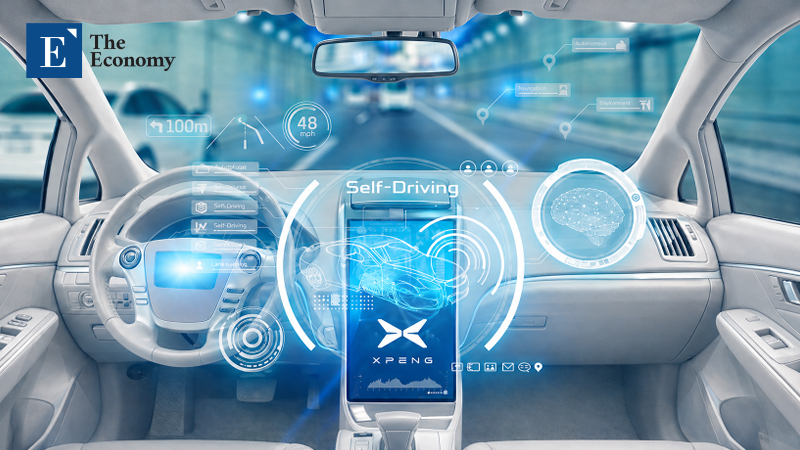
Chinese EV startup Xpeng has thrown down the gauntlet to Tesla. By aggressively deploying its proprietary artificial intelligence chips and models, the company has begun a full-scale expansion into physical AI businesses including autonomous driving and humanoids. Market observers say Xpeng’s moves vividly reflect the current state of China’s EV market, which is starting to move past low-price competition and focus on qualitative growth.
Xpeng’s Confidence in Autonomous Driving
According to a South China Morning Post report on April 26, Xpeng co-founder and chief executive He Xiaopeng said at a media briefing for Auto China 2026 in Beijing on April 25, “We have set a goal of fully surpassing Tesla’s FSD in the Chinese market by August.” He added that while a direct comparison remains difficult because the full version of Tesla’s FSD system has yet to receive approval for use in China, Xpeng’s vision-language-action system has already outperformed the U.S. company in certain complex driving scenarios.
He had also expressed confidence in autonomous driving technology during an on-site media interview related to China’s Two Sessions last month. At the time, he said, “The combination of large language models and our proprietary computing infrastructure has sharply increased research and development efficiency,” adding that “development tasks that previously took one year have recently been completed in just four weeks.” Based on these technological advances, he predicted that Level 4 autonomous driving would be commercialized within one to three years, and that the era of Level 5 fully autonomous driving, requiring no driver intervention, would arrive within five years.
Xpeng is reportedly accelerating data accumulation by significantly expanding beta testing of its second-generation VLA system among general users. VLA 2.0 has learned from roughly 100 million extreme-driving scenario datasets and is said to adopt a “vision-only” approach that precisely recognizes and judges complex urban environments using only cameras, without expensive lidar sensors. This is similar to Tesla Vision, Tesla’s technology that removes radar and relies solely on camera-based computer vision. In effect, Xpeng has chosen a direct confrontation with Tesla, which it has long treated as its core benchmark.
A Direct Contest With Optimus, Led by Iron
The rivalry between Xpeng and Tesla is also emerging in the humanoid sector. Xpeng is currently pushing to commercialize its next-generation humanoid robot Iron. First unveiled at the company’s AI Day event in Guangzhou last November, Iron is characterized by the direct extension of AI technologies accumulated during autonomous vehicle development. It adds whole-body control and manipulation functions to existing perception and decision-making structures and AI chip architecture. This helps lower development costs in terms of chips, software and data utilization. Iron’s body has around 82 degrees of freedom, while each hand is equipped with an elaborate 22-degree-of-freedom joint structure. It also incorporates a humanoid spine, bionic muscle structure and flexible skin to produce natural movement.
Xpeng has positioned Iron’s initial use case in the enterprise market. The company plans to gradually expand its applications around industrial sites, including factory inspections and work assistance. Iron has been deployed on production lines for Xpeng’s EV models such as the P7+ and G6, where it performs real-world tasks including assembly and inspection, and its applicability is also being tested at manufacturing sites operated by Chinese steelmaker Baosteel. Xpeng plans to establish a large-scale production system for Iron this year and begin full-scale mass production at the end of the year. In February, it also announced that it had broken ground on a 110,000-square-meter dedicated humanoid mass-production base in Guangzhou’s Tianhe District.
Market analysts say Iron could become a leading rival to Optimus. Optimus is Tesla’s bipedal intelligent humanoid robot. Tesla has been collecting data and training Optimus at its Fremont factory in California and plans to begin initial production this year, increasing deployment at its own factories. Mass production is scheduled to begin in 2027. The timing of sales to general consumers has not yet been determined, and early commercialization, as with Iron, is expected to proceed in industrial settings such as factory work.
China’s EVs Move Beyond the Era of Bleeding Competition
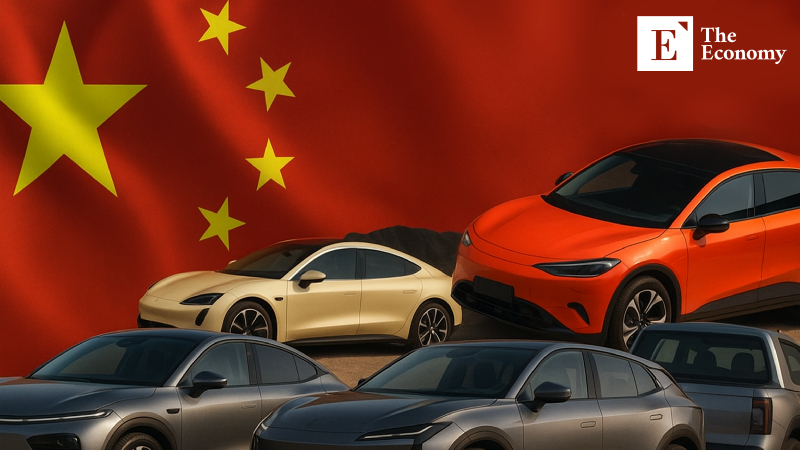
Xpeng’s recent moves are seen as a case study in the changing growth strategy of China’s EV industry. Until just a few years ago, Chinese EV makers had staked their survival on cutthroat low-price competition. According to the China Passenger Car Association, more than 40 brands and over 200 models cut prices in 2023 alone, with some models lowering prices by as much as 20% to 30%. This eroded the profitability of local automakers. CPCA data show that China’s auto industry revenue fell 0.9% year on year in January and February this year, while net profit shrank 30%. The average profit margin stood at 2.9%, only half the manufacturing industry average of 5.8%.
The local market, however, is gradually entering a transition phase. More companies are moving beyond mass production of low-cost vehicles and focusing on qualitative growth. The technologies unveiled by Chinese automakers at Auto China 2026 clearly illustrate this trend. Geely Auto, the largest brand under Geely Automobile Group, unveiled the world’s first architecture dedicated to new-energy off-road vehicles and the Galaxy Light second-generation concept car, while jointly introducing China’s first robotaxi-dedicated prototype, the EVA Cab, with Afari Technology and CaoCao Mobility. After broadly applying AI technology across all aspects of vehicles through its “full-domain AI” system last year, the company is accelerating efforts to build an open AI ecosystem.
Zeekr unveiled three premium vehicles, including the new 009, 9X and 8X. The company said the 8X comes standard with a 900V high-voltage system and that the electric drive motor delivers a peak instantaneous output of 1,030kW, or 1,400 horsepower. It accelerates to 100km/h in just 2.96 seconds. Elsewhere, China’s largest EV maker BYD displayed vehicles in an unusual booth set below minus 30 degrees Celsius to demonstrate high-speed charging capability even in extreme cold, while China’s largest battery maker CATL also showcased an experiential booth emphasizing the charging performance of sodium-ion batteries in ultra-low-temperature environments.
Xpeng is also actively joining this shift. The company recently changed its name from Xpeng Motors to Xpeng Group, formalizing its transition from a simple automaker into a physical AI technology company. According to Chinese economic media outlet Yicai, He said in a recent media interview that “making cheap, low-margin cars is meaningless,” adding that the company would not enter the market for vehicles priced below $14,700. In fact, the six new vehicles Xpeng unveiled this month focus on enhancing AI performance rather than cutting prices. Their prices range from about $17,600 to $22,300.
Similar Post