Rheinmetall, Core Pillar of Germany’s Rearmament, Takes Hard Line with “$13 Billion Increase” for F126 Program: “Full-Scale Push to Monetize Its Dominant Position”

Siobhán Delaney is a Dublin-based writer for The Economy, focusing on culture, education, and international affairs. With a background in media and communication from University College Dublin, she contributes to cross-regional coverage and translation-based commentary. Her work emphasizes clarity and balance, especially in contexts shaped by cultural difference and policy translation.
Authored On
Modified
Pressure for F126 Renegotiation Amid Fears of a Capability Gap
Maritime Supremacy Ambitions Through Serial Acquisitions of Strategic European Shipyards
Rheinmetall’s Expanding Clout Across Germany’s Security Policy
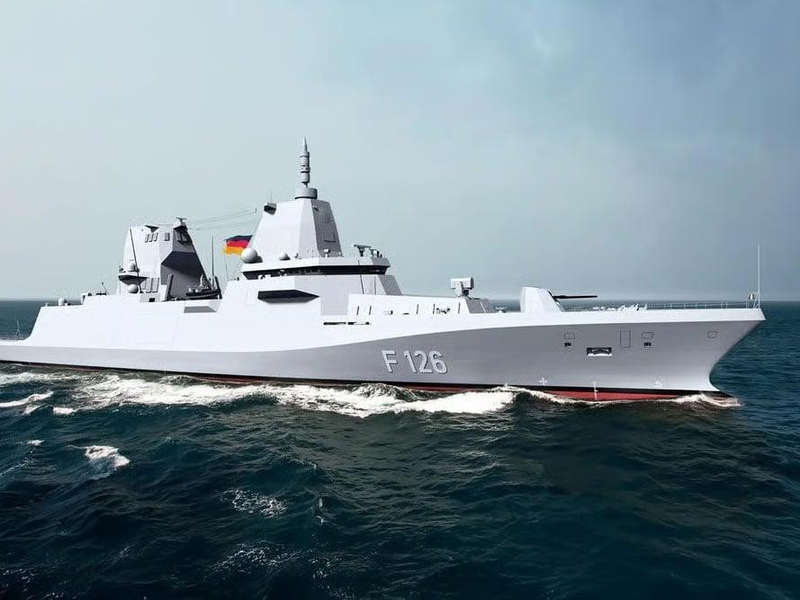
Rheinmetall, often described as the pride of Germany’s defense industry, has taken a hard line with the German government by demanding a vast cost increase for the country’s next-generation naval frigate program. As Germany’s dependence on defense contractors deepens amid Europe’s rearmament drive, Rheinmetall’s bargaining power is also swelling rapidly. With Berlin facing limited alternatives, expectations are growing that the government will ultimately accept some level of cost increase.
Demand for $13 Billion Increase as Condition for Taking Over F126
According to the Financial Times and Reuters on the 7th, local time, Rheinmetall has reportedly demanded an additional $13 billion from the German government as a condition for taking over the troubled F126 frigate construction program. The amount requested by Rheinmetall represents purely additional funding beyond the already approved budget. If the proposal is accepted, the total cost of building six vessels would rise far beyond the original plan to about $15.1 billion. That would mark an unprecedented single-vessel construction outlay in German naval history.
This demand follows six months of due diligence conducted after Rheinmetall acquired the naval shipbuilding division NVL from the Lürssen Group last year. The F126 program is Germany’s next-generation multipurpose stealth frigate project, aimed at replacing the existing F123 Brandenburg-class vessels and securing anti-submarine warfare, air-defense and blue-water operational capabilities at the same time. In 2020, the German government selected a consortium led by Dutch shipbuilder Damen as preferred bidder, with TKMS, ESG and others participating in the project.
However, after the program began, delays in integrated combat systems and software development started to destabilize the entire schedule. The German Navy’s requirements continued to expand, while a decentralized production structure involving multiple countries and companies sharply increased project complexity. Within Germany’s Defense Ministry and procurement agency BAAINBw, distrust toward incumbent contractor Damen has accumulated to a considerable degree, and Rheinmetall has emerged as the realistic alternative. Rheinmetall is making clear that it intends to secure tangible gains in exchange for stepping in as rescuer.
Aggressive Absorption of European Shipyards and a Maritime Defense Empire Ambition
After pushing earlier this year to expand its stake in German shipbuilder NVL and reorganize its naval business, Rheinmetall has actively reviewed the possibility of taking full control of the F126 program. Analysts say the move reflects a strategic intent to integrate its weapons systems, electronic warfare systems and ammunition supply chain, thereby extending its influence across German naval platform programs.
That intention is also evident in Rheinmetall’s recent moves. After acquiring NVL last year and incorporating the division’s results into its consolidated financial statements in March this year, Rheinmetall also entered the race to acquire German Naval Yards Kiel (GNYK), a military shipyard in Kiel. GNYK is a strategic shipyard with experience building German Navy vessels and support ships. Rheinmetall submitted a nonbinding acquisition offer for GNYK earlier this month and is expected to begin due diligence soon.
Rheinmetall has not stopped there. On the 6th, it also began work to acquire Romania’s largest shipbuilder, Mangalia Shipyard. The proposed deal is understood to involve the Romanian government contributing land and key assets in kind, while Rheinmetall and MSC jointly assume management control and investment operations. Mangalia Shipyard is one of Romania’s largest shipbuilding facilities on the Black Sea coast. Established in 1976, it was later operated with the participation of Korea’s Daewoo Shipbuilding & Marine Engineering, now Hanwha Ocean, before Damen acquired a stake and took over operations. But years of deteriorating management conditions and weak orders eventually pushed the shipyard into bankruptcy proceedings this year. Concerned about the impact of the shipyard’s collapse on the regional economy and defense industrial base, the Romanian government moved to attract a strategic investor, with Rheinmetall emerging as a leading candidate.
Rheinmetall’s plan extends beyond shipyard acquisitions. The company has recently been expanding rapidly from its traditional tank-and-artillery-shell-centered business structure into naval, drone, space and missile sectors. Its entry into the European naval platform market has accelerated in particular since the acquisition of NVL this year. The push to secure Mangalia Shipyard is being interpreted as part of the same strategic trajectory. Rheinmetall is understood to be considering the facility as a base for both Romania’s naval modernization program and a logistics production hub for NATO’s eastern flank.

The Rheinmetall Empire and Its Exclusive Position
Behind Rheinmetall’s aggressive expansion lies the German government’s strategic dependence. According to Bloomberg, Rheinmetall Chief Executive Armin Papperger has maintained close ties with Germany’s political establishment and is believed to be capturing a substantial share of the defense budget. A significant portion of Germany’s $108 billion special defense fund is being channeled into Rheinmetall’s ammunition production expansion, next-generation armored vehicle development and naval shipbuilding takeover plans. By 2029, annual defense spending is expected to reach roughly $162 billion, and analysts widely believe many new programs will ultimately feed into Rheinmetall’s production network.
The German government’s stated reason for relying on Rheinmetall is speed. Within a bureaucratic defense procurement system, Rheinmetall’s ability to deliver immediate mass production makes it one of Berlin’s most attractive options. Rheinmetall is indeed expanding production facilities aggressively with German government backing. It recently converted two automotive plants in Germany into defense production sites, a development seen as evidence that the direction of German industrial policy itself is changing. Germany’s manufacturing strategy, once centered on electric vehicles, machinery and chemicals, is shifting toward defense amid the Russian threat and an expanding military posture.
Rheinmetall has already become a core supplier in the Bundeswehr’s artillery shell supply chain. Since Russia’s attack on Ukraine in 2022, the company has expanded shell production more than tenfold, and Papperger recently said publicly that some production increases were carried out preemptively based on trust with the German government, even without written contracts. Rheinmetall is also simultaneously expanding across the Leopard main battle tank production network, 155mm shell production, air-defense systems, drones, military trucks, missiles and naval shipbuilding, while recently moving into satellite communications and broadening its footprint into space and communications.
Germany’s dependence is also clearly visible in the naval sector. The German government is reported to have encouraged Rheinmetall to take over the F126 frigate program led by Damen. This also reflects defense protectionism aimed at safeguarding domestic technological capability and creating jobs. Under these conditions, experts say it will be difficult for the German government to simply ignore Rheinmetall’s demand for a cost increase. The most striking element among Rheinmetall’s proposed conditions for taking over the F126 frigate program is an “inflation clause.” In effect, this would require the government to bear all future risks stemming from raw material price fluctuations.
The problem is that schedule delays are also widening sharply. The German government originally planned to deploy the first ship in 2028. Under current internal reviews, however, delivery of the first vessel could slip to at least 2031 or 2032. Concerns over a capability gap are therefore growing within the German Navy. With the existing F123 vessels aging rapidly, a prolonged drift in the F126 program could create real operational gaps in the North Sea, Baltic Sea and North Atlantic. One military security expert said, “If Rheinmetall’s demand for a cost increase is not accepted, the burden of a naval capability gap and further project delays will fall squarely on the German government, making it highly likely that Berlin will ultimately accept a certain level of conditions.”
Siobhán Delaney is a Dublin-based writer for The Economy, focusing on culture, education, and international affairs. With a background in media and communication from University College Dublin, she contributes to cross-regional coverage and translation-based commentary. Her work emphasizes clarity and balance, especially in contexts shaped by cultural difference and policy translation.
Similar Post