“Safety Voids Exposed by the Race for Speed” — China Halts Autonomous Driving Licenses After Robotaxi Failures, Putting AI Credibility on Trial

Authored On
Modified
China Suspends New Autonomous Vehicle Permits Following Robotaxi Service Breakdown
China’s Rapidly Expanding Autonomous Driving Sector Prioritized Competition Over Safety Validation
Concerns Mount Beyond the Robotaxi Industry to China’s Broader AI Capabilities
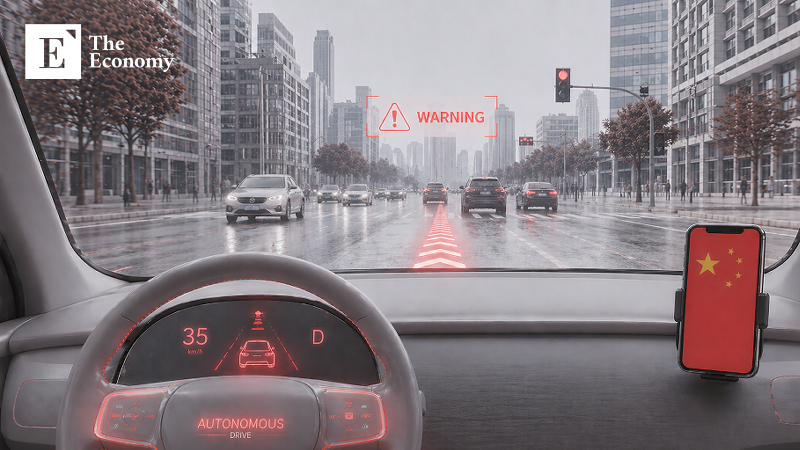
The Chinese government has abruptly suspended the issuance of new operating permits for autonomous vehicles. The move follows a major service disruption involving Baidu’s robotaxi fleet earlier this month, an incident that sent shockwaves through what had become an overheated autonomous driving market. As structural vulnerabilities left unresolved during China’s breakneck autonomous driving expansion begin surfacing in earnest, concerns are growing that the disruption could hinder not only Chinese robotaxi operators expanding overseas, but also the broader trajectory of China’s artificial intelligence (AI) industry.
Baidu Robotaxis Halted Across Major Roads
Bloomberg reported on the 29th, citing sources familiar with the matter, that Chinese authorities have suspended approvals for new autonomous vehicle operating permits. Government agencies including the Ministry of Industry and Information Technology (MIIT) reportedly convened meetings earlier this month with officials from cities operating robotaxi and autonomous driving pilot programs, instructing local governments to conduct comprehensive internal inspections and strengthen safety oversight. The measures will restrict autonomous driving companies from deploying additional robotaxis, launching new pilot programs, and expanding into new cities. It remains unclear how long the suspension will remain in effect.
The crackdown follows a large-scale disruption involving Baidu’s robotaxi service Apollo Go in Wuhan earlier this month. On the 1st, Wuhan police stated in an official notice that they had received multiple reports of Baidu robotaxis suddenly stopping in the middle of roads due to system malfunctions. Some vehicles reportedly came to a halt on highways and major arterial roads, disrupting traffic flow and triggering rear-end collisions.
More than 1,000 fully driverless Apollo Go robotaxis are currently operating in Wuhan, with at least 100 vehicles believed to have been affected by the incident. Videos circulating on Chinese social media platforms showed numerous robotaxis immobilized on public roads, obstructing surrounding traffic. Although the vehicles were equipped with manual door-release functions, passengers reportedly struggled to exit due to severe congestion during rush hour. Some riders remained trapped inside the vehicles for nearly two hours. No fatalities or serious injuries were reported.
China’s Fragile Autonomous Driving Expansion
Industry observers argue that the incident reflects the unsustainable pace at which China’s autonomous driving sector has expanded. Excessive competition across the industry created an environment where rapid deployment and marketing impact were prioritized over rigorous safety verification. Chinese automakers aggressively rushed incomplete technologies into the market, frequently promoting advanced driver assistance systems (ADAS) as near-autonomous driving solutions in an escalating race for market dominance. As a result, consumers increasingly overestimated the capabilities of the technology without fully understanding its limitations.
The rapid spread of autonomous driving technologies also outpaced the development of an adequate regulatory framework, exposing major policy gaps. In practice, commercialization advanced before Chinese regulators established clear governing standards. For years after the emergence of autonomous driving technologies, China maintained comparatively looser regulations than many other countries, to the extent that “public beta testing” involving ordinary consumers was effectively tolerated. Borrowed from the smartphone industry, the public beta model allowed automakers to distribute unfinished features to thousands of users in order to collect operational data.
China only recently began constructing a comprehensive regulatory framework. In April of last year, the MIIT summoned roughly 60 major automakers and unveiled a new regulatory direction. Authorities introduced strict marketing restrictions, including bans on expressions such as “autonomous driving” and “smart driving,” while ordering manufacturers to clearly specify technology levels based on Society of Automotive Engineers (SAE) classifications. At the same time, regulators prohibited public beta testing involving ordinary consumers and mandated that over-the-air (OTA) software updates could only be deployed after prior verification and government approval.

Will China’s Global AI Position Be Shaken?
Industry insiders believe the Apollo Go disruption could expose the vulnerabilities of China’s autonomous driving technologies to global scrutiny. Analysts warn that countries where Chinese robotaxi operators have already launched services could experience significant fallout. Dubai in the United Arab Emirates (UAE) stands out as a key example. Chinese autonomous driving firm WeRide formally launched driverless robotaxi services in Dubai’s Jumeirah and Umm Suqeim districts late last month through partnerships with Uber and Grab. In February, the company also pledged alongside Uber to deploy more than 1,200 robotaxis across Abu Dhabi in the UAE and Riyadh in Saudi Arabia.
WeRide recently launched a new autonomous public transportation service in Singapore’s Punggol district in partnership with Grab, Southeast Asia’s largest mobility platform. The service operates along fixed routes connecting residential areas with transportation hubs and public facilities, though it currently includes onboard safety operators rather than fully driverless operation. The approach reflects Singapore’s regulatory framework and the structural characteristics of its public transportation system. WeRide currently offers the service free of charge but plans to transition to a paid model in the future. The growing skepticism surrounding Chinese autonomous driving technology following the Apollo Go incident could emerge as a severe obstacle to WeRide’s broader international expansion ambitions.
Some analysts argue the crisis could deepen fundamental doubts surrounding China’s AI capabilities beyond autonomous driving itself. Autonomous driving represents one of the most sophisticated AI applications, relying on sensors such as cameras and lidar to perceive surrounding environments while AI systems identify and predict objects before determining driving paths and vehicle controls including acceleration, braking, and steering. Should such concerns intensify, the growth trajectory of Chinese AI models — whose global usage has been rising rapidly — could also face significant headwinds. According to AI model marketplace OpenRouter, Chinese AI models surpassed the combined token usage of U.S. models for the first time in February.
Similar Post