“Countdown to a Bilateral Military Alliance” India and Russia Open Military Bases to Each Other, Building an ‘Energy-Security Complex’ to Contain China’s Expansion

Authored On
Modified
Military base-sharing framework established by the two countries
Relationship bound by energy and arms supply chains
Expansion of strategic coordination to check China’s rise
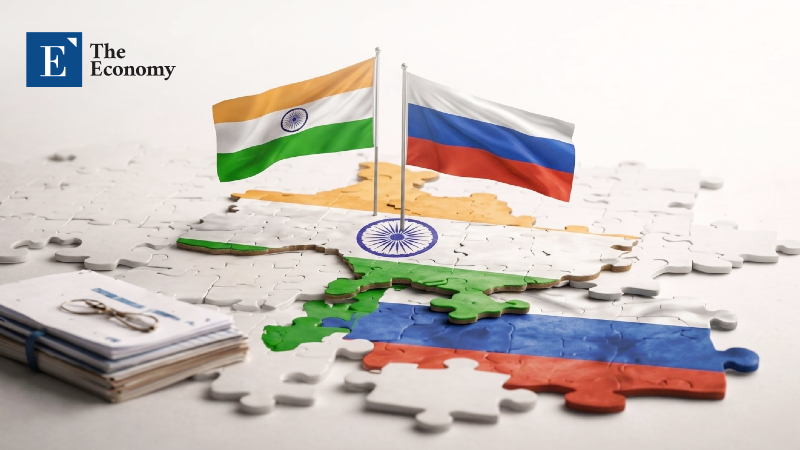
India and Russia, which have maintained a traditionally friendly relationship, have established a framework allowing each side to deploy troops, warships and military aircraft on the other’s territory. The arrangement amounts, in effect, to a near-alliance military cooperation system, bringing renewed attention to the military partnership structure the two countries have sustained since the Soviet era amid the war in Ukraine and the intensifying U.S.-China rivalry. In particular, the agreement is being interpreted as a move by both countries to use each other as strategic leverage and raise the level of deterrence against China, as Beijing accelerates its entry into the Indian Ocean and expands its maritime influence.
Mutual Stationing of Up to 3,000 Troops and Five Warships
According to the bilateral agreement published in Russia’s official gazette on the 5th local time, Russia and India will be allowed to station up to five warships, 10 military aircraft and 3,000 troops in each other’s territory. The agreement also includes broad logistics-support provisions covering refueling and repairs for warships and military aircraft in the partner country, as well as cross-training related to humanitarian assistance and disaster relief.
The agreement is designed to simplify procedures for each country’s military to deploy forces on the other’s territory. Details of the Reciprocal Exchange of Logistics Agreement, or RELOS, which the two sides signed last year and which took effect in January this year with a five-year extension clause, were disclosed on Russia’s official legal information portal. India also signed a logistics-support agreement, LEMOA, with the United States in 2016, but unlike RELOS, that pact does not contain provisions allowing the deployment of troops and other assets in the partner country.
According to Russia’s state-run TASS news agency, RELOS regulates not only the deployment of military personnel and equipment but also logistics. TASS reported that “the established procedure will be used for joint exercises, response to natural and man-made disasters, and other agreed cases.” It added that “the document simplifies mutual use of the two countries’ airspace and port calls by Russian and Indian warships.”
In practice, Russia has secured a foothold under the agreement to strengthen the operational sustainability of its activities toward the Indian Ocean. India, for its part, will gain access to ports stretching from Vladivostok in Russia’s Far East to the Arctic port city of Murmansk in the northwest. This new route through the Arctic Ocean will sharply shorten transport distances compared with the existing Suez Canal route and is expected to serve as a key driver fundamentally reshaping India’s energy security landscape. It is also regarded as an important safeguard against disruptions in global supply chains.
The details of the agreement were disclosed as Russia seeks to increase oil and gas exports to India. India relies heavily on imported petroleum products to meet domestic demand. India and Russia maintain a strategic partnership: Russia has long supplied weapons to India, while India has purchased substantial volumes of crude oil from Russia since the outbreak of the Ukraine war in February 2022. As a result, India has faced opposition from U.S. President Donald Trump and European leaders, as its imports of Russian crude effectively help finance Russian President Vladimir Putin’s war in Ukraine. Even so, Russia is set to dramatically improve its access to the Indian Ocean through the implementation of the agreement.
Traditional Russia-India Friendship and a Recalibration Toward Greater Autonomy
The core of the agreement lies in the ability of each country’s military to use the other’s military facilities as if they were its own bases. For Russia in particular, formally securing access to the Indian Ocean can be assessed as the culmination of its long-sought eastward policy dating back to the Cold War. Although the agreement is framed on the surface as a mechanism for logistics supply and repairs, in substance it could create a powerful counterweight to the Western-led maritime order by enabling Russian fleets and troops to maintain a standing presence at key points in the Indian Ocean.
The foundation of bilateral ties rests on a long-standing security cooperation structure that has continued since the Soviet era. During the Cold War, as the United States moved closer to the Pakistan-China axis, the Soviet Union cultivated India as its core strategic partner in South Asia. During the 1971 Indo-Pakistani War, Moscow backed India through diplomatic support at the United Nations Security Council and even naval deployments. Since then, India’s armed forces have reorganized core capabilities, including fighter jets, submarines and air-defense networks, around Soviet and Russian weapons systems, with much of their maintenance, repair and parts supply chains still closely linked to Russia.
After the war in Ukraine, energy interests became intertwined with the relationship, further tightening bilateral cooperation. As Western sanctions narrowed export routes for Russian crude, India aggressively purchased large volumes of discounted oil, emerging as a key consumer market for Russia. This allowed India to reduce its energy cost burden, while Russia secured a stable export channel capable of circumventing Western sanctions. At the same time, India is recalibrating its foreign policy toward greater strategic autonomy among the United States, China and Russia. It is maintaining security cooperation with Washington to deter China while simultaneously pursuing military and energy cooperation with Moscow, accelerating efforts to secure its own strategic space.
Strategic Symbiosis to Contain China
The growing closeness between Russia and India is widely analyzed as reflecting their shared intent to avoid subordination to either pole in an international order being reorganized around the United States and China. India belongs to the U.S.-led Quad, the four-nation anti-China framework, but has not taken an especially active posture. The Carnegie Moscow Center interpreted the rapprochement by noting that “Russia, China’s friend, is in geopolitical confrontation with the United States over Ukraine, while India, a U.S. friend, is in geopolitical confrontation with China over the Kashmir border dispute,” adding that “Russia and India’s approach may be a strategy to use each other as strategic leverage against enemies and friends alike.”
India is, in effect, seeking to check China through Russia while extracting practical gains in its relationship with the United States. India continues to face border tensions with China and maintains a firm stance against the expansion of Chinese naval power in the competition for supremacy in the Indian Ocean. As Russia strengthens military cooperation with India, the strategic tension between China and India is also being reshaped in more complex ways. In addition, Russia’s international isolation after the Ukraine war has increased China’s importance to Moscow, a development that is unwelcome for India, which maintains close economic and diplomatic ties with Russia.
Against this backdrop, the United States is seeking to bring India in as a central pillar of its China-containment strategy, while Russia is also calculating that India can help ease its deepening dependence on China. India, in turn, appears to be leveraging the interests of both sides simultaneously to expand its strategic room for maneuver. The prevailing analysis is that such multilayered interests underpin India’s ability to preserve an independent course even as the international order is reorganized into bloc-based confrontation.
For India, moreover, Russia is both a supplier of inexpensive energy resources and the only country capable of acting as a mediator in a potential conflict with China. In particular, the two countries’ decision to share military bases constitutes a substantive response capable of neutralizing China’s “string of pearls” strategy, its effort to secure maritime routes across the Indian Ocean. With Russian military power projected into the Indian Ocean, a natural deterrent against China’s maritime expansion has been established. This creates a multilayered dynamic in which India, Russia and China may appear to form a common front against the United States, while internally they continue to check one another. India is already using this delicate tension to maximize its national interests by securing advanced military technology transfers from Russia and development rights to resources in the Russian Far East. In this sense, India’s military closeness with Russia represents a balancing diplomacy that uses Russia as leverage to prevent China’s unilateral dominance.
Similar Post