The Price of Rare Earth Security

Working across research, policy, and data-driven analysis, the Editorial Board ensures that published pieces reflect a consistent institutional perspective grounded in quantitative reasoning and long-term structural assessment.
Authored On
Modified
Rare earth security should not become costly self-sufficiency
Japan’s deep-sea push shows the price of replacing China
The smarter path is allied supply, processing, recycling and stockpiles
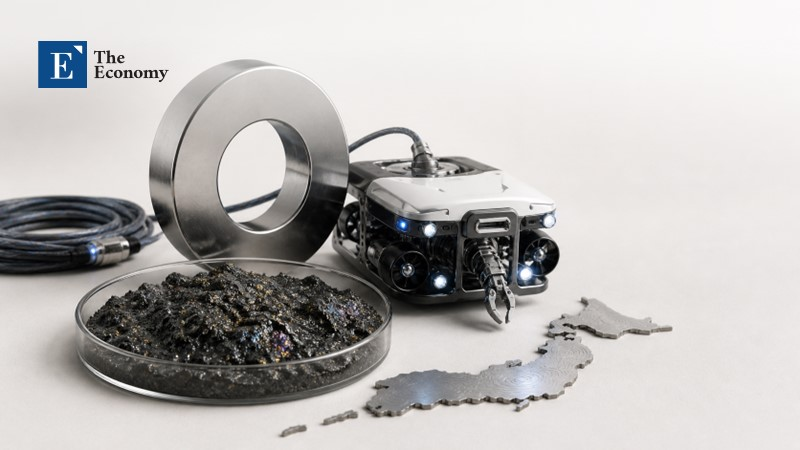
The danger of rare earth security is illustrated by just one number: 94%. Last year, 94% of all sintered permanent magnets in the world-the incredibly small, but immensely important components of electric cars, drones, wind turbines, factory robots, missiles and a host of high-end electronics-came from China. This is not just a mining advantage: it's an entire industrial system that integrates raw material, separation processes, smelting and refining, alloys, human expertise, cheap economies of scale, patient state support and customers ready to accept large quantities. Japan’s scheme to raise rare earth-bearing mud from a staggering depth of 6,000 meters below the Pacific Ocean is, of course, technically brilliant. But it also encapsulates the dilemma facing Japan, as well as the United States, Europe and Australia. Where an antagonist owns the entire supply chain, the automatic reaction is to replicate it; the correct response is to question which components must be replicated, which can be shared and which are not economically rebuildable just for the sake of pride and functioning capability.
Self-sufficiency does not necessarily mean rare earth security
The debate on rare earth security is often framed as a choice between dependence and self-sufficiency. While that may seem true in simplistic terms, complete independence might also be undesirable because it makes every mineral deposit subject to a national referendum of state power. The deep-sea project off the coast of Minamitorishima represents this challenge in a perfect, if slightly absurd, way: It may eventually be possible for Japan to raise mud containing large quantities of rare earths from the seafloor at great depths, putting Tokyo in a strong position when prices escalate and supply becomes restricted. The key question is not whether mud can be raised from that depth, but whether it can be raised, transported, separated, smelted, refined and transformed into components with reasonable industrial cost and scalability.
The difference in outlook is important since rare-earth security does not mean anything as sensational as a mantra: it’s about the balance sheet of a nation. A government can allocate millions of dollars to build and mine a domestic mine, but remain exposed if there are no separation plants, no metal producers, no magnet factories and no customers willing to buy the output. The difficulty is not in the hole of the earth, but in the middle, where rare earths mixed together are separated, then into oxides and then into metals, alloys and magnets-the area where China possesses overwhelming leverage. Restricting imports by commanding domestic extraction might offer political comfort, but an informed policy requires assessing where additional investment mitigates the most significant risk, which could involve everything from stockpiling and recycling to joint processing, magnet manufacturing, substituting materials, defining purchasing regulations and mining at home.
There is no clear consensus on the central issue among Japanese authorities yet. Raising test-material samples from the deep sea may be possible, but it does not confirm the future of the whole commercial extraction and processing project; it will have to demonstrate its entire production chain, transporting the mud, separating it into oxides and then refining the compounds into usable materials, at a manageable cost. Therefore, "rare earth security" has limits. State financing for resource security can be justified where the markets are otherwise static. But the project must be evaluated with regard to a financial ceiling, a time limit and a definite end point, lest it devolve into an open check with a tacit understanding among all involved that the mineral's strategic importance justifies any expense, making the venture one of industrial theater instead of sound policy.
The 1940s warning: resource panic can beat economic logic
The comparison with the 1940s is not about warfare in the Pacific, but the tendency of resource panic to corrupt logical assessment. Japanese leaders in the 1940s were seeking not merely strategic minerals, but were operating in the belief that a modern economy required unfettered access to oil, rubber, metals and sea lanes; the growing lack of these components made acquiring them a national imperative, far more about strategic ideology than rational economics and resulted in policy choices that readily accepted enormous risks because Japan perceived a choice between acquisition and industrial suffocation. Today, a similar lesson remains relevant; although the impacts are different from a cutoff of oil and rubber, it is essential to recognize that overemphasis on resource security can lead to reckless decisions.
While the global supply of rare earth does not pose the same acute danger as oil, it is a less extensive product whose required production processes are beyond what is currently possible anywhere other than China. A delay of a few days for a shipment of rare earth would certainly not bring the global economy to a standstill. However, some magnets utilize mineral input that will be incorporated into sectors like defense, cars, digitization, data centers, robotics and semiconductors that are strategically important. This means that internal policy politics may trump tonnage data; although the quantities required for magnets are small, a key component can easily warrant substantial markups. Japan could not turn resource access in Southeast Asia into lasting security without widening the war.
The prestige-driven approach starts with a flawed premise: “We must own our own mine.” It assumes that possessing a resource, rather than its management and accessibility within a complex system, is the true mark of power. Many wartime substitute efforts followed this pattern; despite the benefits of polymers, state reserves and scavenging from battlefields, none can replace a fully integrated system. Though Japan gained access to oil and rubber by penetrating Southeast Asia, the sheer scale of shipping operations turned the issue into an obstacle and increased the risk of war. The real lesson then is not that resource ownership is bad, but that duress and hysterical responses force policymakers into paying any price for a false sense of security. Exclusive focus on resource acquisition at any cost, despite the availability of alternate approaches, simply presents an alternative guise of the same trap.
How the Chinese model is unaffordable to copy
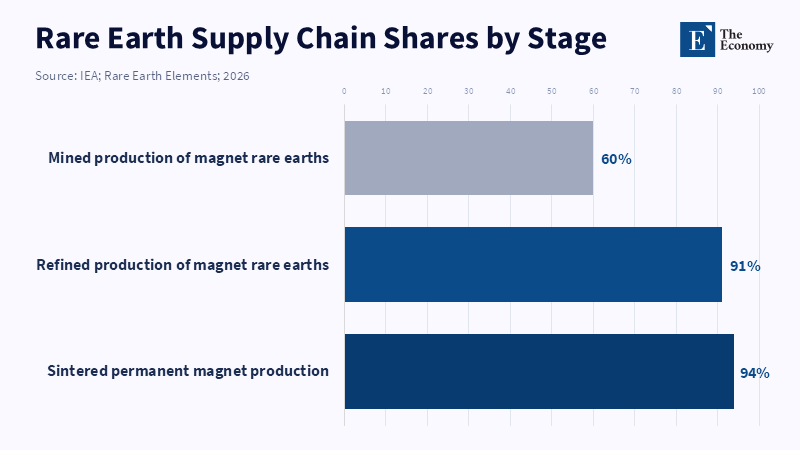
China's near monopoly in rare earths is not due to geology alone. They achieved it through decades of system aptitude, low-cost scale, tolerance of externalities, export discipline and superb end-market proximity. A new report from the IEA says that China is likely to produce around 60% of the world's primary magnet raw material and some 91% of all refined output in 2024; it also took just under 94% of all sintered magnet production. Even if raw material is mined in Australia, there are unlikely to be mines capable of turning it into a magnet without the entire processing track that goes with China's dominance. If that track stays in China, the mine will hardly address the problem of dominance.
Ultimately, the notion of deep-sea mining makes sense. It will only face engineering difficulties that are of a slightly higher order; shorter operating windows and the burden to be lifted from great depths will not tolerate minimalist chemistry that fails to meet industrial grade. It must compete with land-based supply and the Chinese price curve if it aims to profit and insurance should be its aim if it does not need to turn excess costs into profit: its success would not require this cost to be recovered. This must, however, be revealed upfront so that a solution is not transformed into yet another endless bailout to polluters and financiers. Now it is the state's rhetoric that portrays an unrealistic picture of end-to-end costs of production for metals or materials, while the real policy must contain domestic assurance, allied sharing, security of processing, reliable inventory stock, recycling, substitution and the use of medium to long-term contracts.
This must also be how other allies cooperate instead of making expensive copies of the silliest projects with nations that the former collaborates with for unrelated reasons; this sharing out is not charity, it is division of labor.
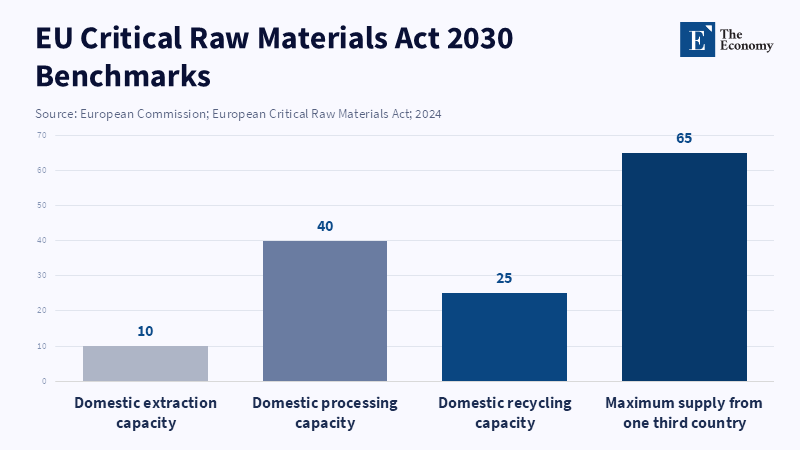
Australia possesses tremendous mineral resources. Japan's expertise in metallurgy brings high precision metallurgical processing, large inventories and magnets; America uses weaponized purchasing power to stabilize large domestic demand markets. Europe has a huge demand and competent engineering experience to combine with new resource discoveries within existing high resource deposits and allied nations such as Vietnam and Malaysia can establish their own capacity, given stable and patient investment arrangements. Australia can bypass the end-to-end logistical and commercial network that others are obliged to build and at a fraction of the cost to them. They must not, therefore, be forced to ruin themselves building unserviceable gargantuan projects and there is no need for each nation concerned about cost to be diminutive in scope, because China’s internal economic benefit from division of labor outweighs the benefit of self-reliance.
In defense, opponents may suggest that these efforts are so preliminary that the rivalry will force all nations to undertake the entire development on their own, just to show what is possible and that this will simply give way to shopping basket politics. This can be said of the approach described above, but they miss the fact that the Chinese experience already demonstrated the leverage in the entire supply chain and not at one point; security requires not just a defended mine, but a sustainable after-market capacity; resilience requires not only a processing plant but also its users and a reserve stock is only effective with the promise of continued refillment. The optimum policy for rare earth resource management, therefore, must include, as a minimum essential, a component of domestic security and guarantee of supply and allied redundancy in processing and a trusted customer base backed up by security of inventory, recycling options, substitution and medium to long-term contracts to manage the market demand. Some cost will, of course, have to be incurred for security, but not every penny in the name of national pride or false power.
The number, 94%, might panic government officials into political oversimplification, but it should drive others to do the arithmetic. China has turned supply-chain depth into strategic leverage, and Western governments must respond with discipline rather than panic. The Western powers must, however, respond with greater discipline. Japan has, by design, retreated to an insurance strategy and does not need to view every segment of the supply chain as being equal from an economic perspective. Crucially, it must not reinforce the notion with which policy makers seek to remedy every failing by digging another hole. Actually, cutting off supply triggered war in the 1940s, but the shame of it was avoided once more and it was a political taboo again. What we see now are the real challenges to modern states: the construction of security, not a shortage of critical resources through their candidates’ approach: low-cost domestic production, allied sharing, secure processing, reliable inventories, demand substitution, recycling and medium to long-term commercial contracts to secure market use and ensure against true supply shocks.
The views expressed in this article are those of the author(s) and do not necessarily reflect the official position of The Economy or its affiliates.
References
Barnhart, M.A. (1987) Japan Prepares for Total War: The Search for Economic Security, 1919–1941. Ithaca: Cornell University Press.
Bond, B. (2012) British and Japanese Military Leadership in the Far Eastern War, 1941–45. London: Routledge.
Cordier, D.J. (2025) ‘Rare Earths’, in Mineral Commodity Summaries 2025. Reston: U.S. Geological Survey.
Drea, E.J. (2003) In the Service of the Emperor: Essays on the Imperial Japanese Army. Lincoln: University of Nebraska Press.
European Parliament and Council of the European Union (2024) ‘Regulation (EU) 2024/1252 establishing a framework for ensuring a secure and sustainable supply of critical raw materials’, Official Journal of the European Union.
Higgs, R. (2006) ‘How U.S. Economic Warfare Provoked Japan’s Attack on Pearl Harbor’, The Freeman, 56(May), pp. 36–37.
International Energy Agency (2025) Global Critical Minerals Outlook 2025. Paris: International Energy Agency.
International Energy Agency (2026) Rare Earth Elements: Pathways to Secure and Diversified Supply Chains. Paris: International Energy Agency.
Katoch, H.S. (2016) The Battlefields of Imphal: The Second World War and North East India. London: Routledge.
kieslowskifan (2017) ‘During WW2, Japan had decisively conquered the resource-rich Southeast Asia…’, r/AskHistorians, Reddit, 18 March.
Nakano, J. (2026) ‘Japan’s Deep-Sea Quest for Mineral Supply Security’, East Asia Forum, 5 May.
Obayashi, Y. (2025) ‘Japan to Begin Test Mining Rare-Earth Mud from Seabed in Early 2026’, Reuters, 4 July.
Obayashi, Y. (2026) ‘Japan Retrieves Rare Earth Mud from Deep Seabed in Test Mission’, Reuters, 2 February.
Quora contributor (n.d.) ‘How Did Japan Get Oil During World War II When America Embargoed Them? What Happened to All That Oil After the War Ended?’, Quora.
Record, J. (2009) Japan’s Decision for War in 1941: Some Enduring Lessons. Carlisle, PA: Strategic Studies Institute, U.S. Army War College.
Yamaguchi, M. (2026) ‘Japan Retrieves Rare Earth-Rich Mud from Seabed to Lower Reliance on China’, Associated Press, 2 February.
Working across research, policy, and data-driven analysis, the Editorial Board ensures that published pieces reflect a consistent institutional perspective grounded in quantitative reasoning and long-term structural assessment.